From 211% a Year to 1.7% a Month: How Milei Rebuilt Argentina’s Economy — and What Comes Next
Key takeaway
In December 2023 Argentine prices rose 25.5% in a single month. In August 2026 they rose 1.7%. Two consecutive years of fiscal surplus, three rating upgrades between May and July, record oil output and a trade surplus five times larger than a year earlier took country risk from roughly 1,900 basis points to about 400 at its July low. The bond market has paid for most of that rebuild. Argentine growth — wages, consumption, earnings — has not been repriced yet, and that is the half still available.
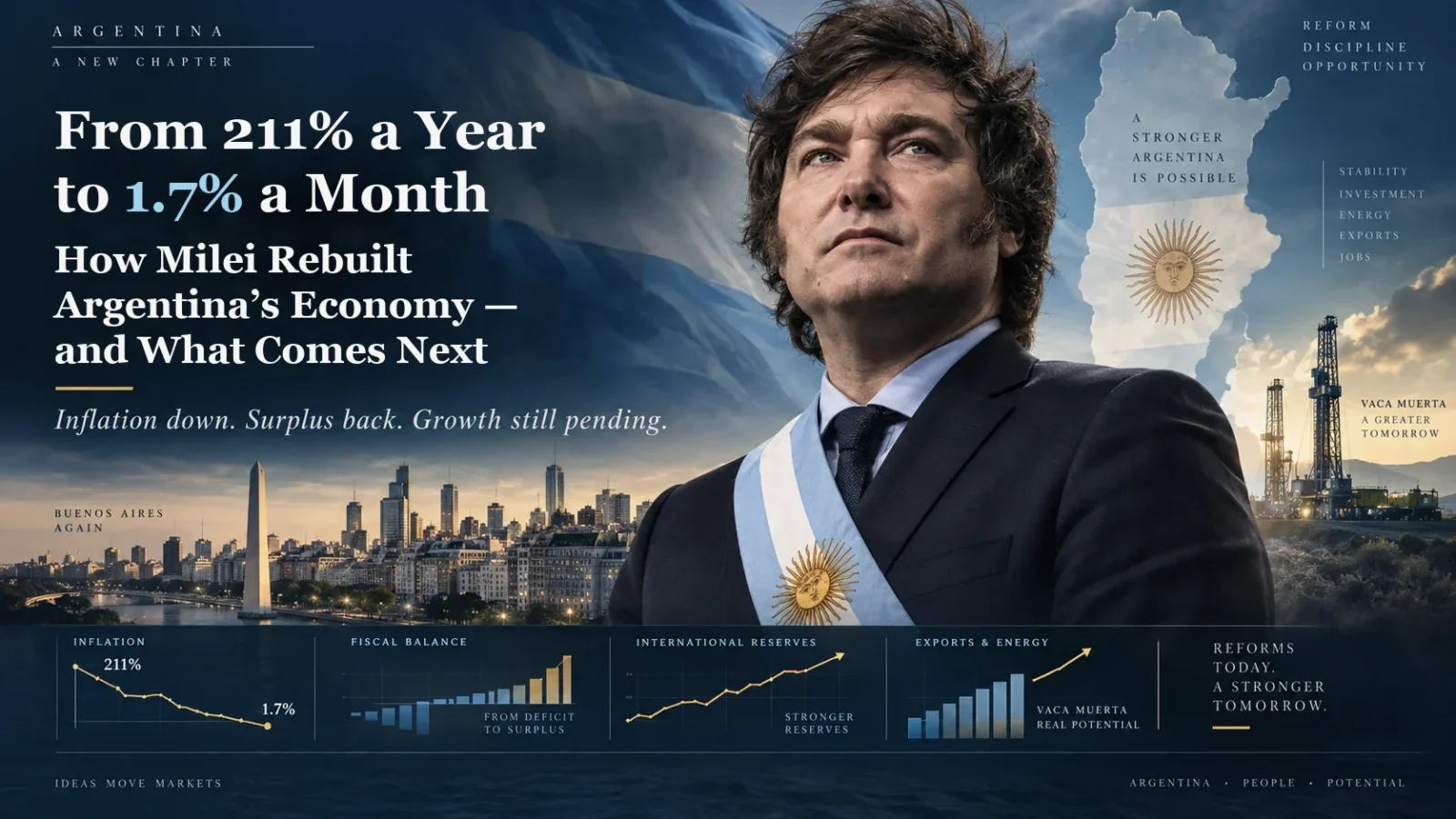
In December 2023, prices in Argentina rose 25.5% in a single month — the fastest monthly reading in three decades. In August 2026 they rose 1.7%. Along the way the budget moved into surplus for two consecutive years for the first time since 2008, all three major rating agencies upgraded the country between May and July 2026, and the trade surplus of the first half of 2026 came in at more than five times that of a year earlier. Country risk — the premium investors demand to lend to Argentina rather than to Washington — fell from roughly 1,900 basis points to about 400 at its July low. A September sell-off has since pushed it back above 550, still some 1,300 points below where it started.
That is the rebuild, and the bond market has already paid for it. The more useful question for an investor in September 2026 is what happens to the half that has not been paid for yet. Stabilisation under Javier Milei repriced Argentine credit in under three years; it has not yet repriced Argentine growth, because real wages, consumption and corporate earnings move on a much longer lag than a spread does. This article covers both: what was actually rebuilt, with the numbers, and what has to happen for the second leg to arrive.
The number that moved
Country risk — the EMBI+ spread J.P. Morgan calculates over comparable US Treasuries — is the cleanest single measure of what markets think of a government’s ability to pay. It is not a sentiment survey. It is the extra yield real money demands to lend to Argentina rather than to Washington.
| December 2023 | September 2026 | |
|---|---|---|
| Country risk (EMBI+) | ~1,900 bps | ~400 bps (July low); above 550 (24 Sept) |
| Annual inflation | 211.4% (2023) | 33.5% (August, year on year) |
| Fiscal balance | Primary deficit | Second consecutive year of surplus |
| Central bank reserves | Negative on a net basis | US$50.5bn gross (11 Sept) |
| Trade balance | Deficit (drought year) | US$13.9bn surplus in H1 2026 |
| Credit ratings | Deep distress across all three agencies | Three upgrades between May and July 2026 |
A compression of roughly 1,500 basis points is not a rounding error or a sentiment swing. It is the market sharply cutting the probability it assigns to a near-term default. In July 2026 the spread came within a few points of 400, its lowest in eight years, before widening again: to the mid-480s by mid-September and above 550 on 24 September, its highest since the spring. Analysts cited a US 10-year yield at 5%, central-bank dollar purchases that slowed to about US$13 million a day in September, and a 2027 election the market no longer treats as settled. For most of the last decade, Argentine bonds traded on recovery value: what you would get after a restructuring. They now trade on yield.
The fiscal anchor did the work
Everything downstream of that number rests on one policy choice made in the first weeks and never abandoned: the budget balance was treated as non-negotiable, and every other variable was allowed to adjust around it.
The numbers are specific. Argentina closed 2025 with a primary surplus of 1.4% of GDP and, after interest payments, a financial surplus of 0.2% — the second consecutive year in the black, and the first time since 2008 that Argentina has posted two consecutive years of cash-basis financial surplus. Primary spending in 2025 was, on the Treasury’s own accounting, 27% lower in real terms than in 2023. The 2026 budget targets a 1.2% primary surplus and 0.3% financial surplus.
Why that matters more than it sounds: Argentina’s defaults have never been caused by a lack of resources. They have been caused by financing a permanent deficit with money printing until the currency broke, then with debt until the debt broke. Removing the deficit removes a central mechanism behind that cycle. That is the entire basis of the repricing, and it is why the spread reacts more to a monthly fiscal print than to any speech.
The second, less visible leg is deregulation. The Ministry of Deregulation and State Transformation says it has modified or eliminated more than 17,000 articles of regulation since 2023 — price controls, import licensing, rental law, transport and professional licensing rules, capital market restrictions. Individually these are small. Cumulatively they change the cost of operating a business in ways that show up in investment decisions years later, not in this quarter’s GDP print.
Inflation: from 211% a year to 1.7% a month
This is the achievement most visible to an ordinary Argentine, and also the one where the honest story has two halves.
| Period | Inflation |
|---|---|
| 2023 (full year) | 211.4% — highest since 1990 |
| December 2023 (single month) | 25.5% |
| 2024 (full year) | 117.8% |
| 2025 (full year) | 31.5% — lowest in eight years |
| August 2026 (month) | 1.7% — lowest in 14 months |
| January–August 2026 | 21.3% accumulated |
Going from a monthly rate above 25% to a monthly rate below 2% in under three years is, by any historical standard, a successful stabilisation. Argentina has attempted this repeatedly since the 1970s and has almost always ended with a currency crisis. It has not this time.
The unfinished part: disinflation has stalled near 30%. August’s year-on-year figure was 33.5%, higher than the 31.5% with which 2025 closed. The 21.3% accumulated over January–August annualises to about 33%, which means 2026 is not currently on track to improve on 2025 — though the central bank’s survey of forecasters still puts the end-2026 figure near 30%, since the remaining months of 2025 were themselves fast. The fall from three digits to two was the easy part — it came from closing the deficit and ending monetary financing. Getting from 30% to single digits requires something harder: an exchange rate regime the market believes in without a band, and indexation habits that take years to break.
The dollar constraint that has eased
For fifty years, every Argentine expansion died the same death: growth pulled in imports, dollars ran out, the peso collapsed, inflation returned. That constraint — la restricción externa — is the one that has eased most, and for structural rather than political reasons.
- Trade surplus: US$13.9bn in the first half of 2026, more than five times the US$2.8bn of the same period in 2025. Exports rose 24.4% to US$49.5bn; imports fell 3.9%.
- External accounts: the central bank’s foreign-exchange current account — the dollars actually passing through the exchange market, which is not the same measure as INDEC’s balance of payments — ran a US$3.5bn surplus between January and July 2026, against a US$1.8bn deficit a year earlier. On the balance-of-payments definition the deficit also narrowed sharply, to US$1.65bn in Q1 2026 from US$5.16bn a year earlier.
- Reserves: US$50.5bn gross as of 11 September, with the central bank having bought a net US$14.2bn during 2026 and hitting its IMF accumulation target roughly half a year early.
- Energy: a US$6.9bn energy trade surplus in the first seven months of 2026, with fuel and energy exports above US$9.1bn, up roughly 50% year on year and driven overwhelmingly by Vaca Muerta. Oil output hit a record 916,200 barrels per day in July 2026, up 17.2% on the year — of which Vaca Muerta alone produced 643,100, more than seven of every ten barrels.
The detail that captures the shift: in the first half of 2026, crude oil was Argentina’s single largest export product at US$4.7bn, ahead of maize (US$4.17bn) and soybean meal (US$4.16bn). A country whose dollar supply depended on one weather-exposed harvest in one three-month window now has a second engine that produces every month and is still ramping. That is a change in the shape of the risk, not just its level.
The rating agencies read it the same way. Fitch upgraded in May 2026, S&P in June, Moody’s in July to B3 with a positive outlook — three upgrades in under three months, and the first time in a decade that all three major agencies rate Argentina above the deeply distressed tier. It is worth being precise about the destination: B−/B3 is still firmly speculative grade. What changed is the direction and the speed of travel, not the category.
The political unlock
None of the above survives without the votes to defend it, which is what the October 2025 midterms settled. La Libertad Avanza won nationally with 39% against 29.4% for the Peronist Fuerza Patria, taking its own bench from roughly 43 deputies to 97 and its senators from 7 to 21. That converted a government that survived by veto into one that can legislate with provincial governors and the PRO.
The first use of it was the labour reform, given final approval on 27 February 2026 — the first structural change to Argentine labour law in decades. Its core is decentralisation: company-level agreements take precedence over sector-wide collective bargaining, and expired agreements no longer roll over indefinitely by default, with the parties called back to the table, subject to exceptions. Tax reform is queued behind it, and pension reform behind that, in a deliberate sequence: the government’s position is that each needs the previous one bedded in before it becomes viable.
What the market has bought — and what it hasn’t
Here is where the single-trade framing breaks down. Sort the evidence by asset and the picture stops being uniform.
| Status | What it says | |
|---|---|---|
| Sovereign credit | Spread from ~1,900 to ~400 at the July low, back above 550 in late September; three upgrades | Default risk has been repriced. Largely paid for. |
| Equities | The Global X MSCI Argentina ETF returned about 30% on a trailing 12-month total-return basis to 11 September 2026, but trades roughly 8% below its 52-week high | Investors bought the stabilisation, then stopped. Earnings growth is the missing input. |
| GDP | +5.8% year on year in Q1 2025, +2.3% in Q1 2026; two consecutive monthly contractions around May | The rebound from the 2024 floor is over. Trend growth is the open question. |
| Consumption | SME retail sales fell for eleven consecutive months into 2026 | Domestic demand has not participated in the recovery. |
| Poverty | 41.7% inherited in H2 2023, peaked at 52.9% in H1 2024, down to 28.2% by H2 2025, back up to 32.3% in H1 2026 (INDEC, provisional) | A steep cost up front, then the largest single gain of the programme. |
Poverty deserves the full sequence, because it is the number most often quoted wrongly in both directions. The official rate was 41.7% in the second half of 2023 — the level the government inherited. It then jumped to 52.9% in the first half of 2024. That spike was the price of the initial correction: a devaluation, the removal of price controls and the unwinding of energy and transport subsidies all reached household budgets at once, months before disinflation did. From that peak it fell for three consecutive semesters — 38.1%, then 31.6%, then 28.2% in the second half of 2025. That is roughly 8.5 million people across the 31 urban areas INDEC surveys, about 13.5 million extrapolated nationally, and 13.5 percentage points below the level inherited two years earlier.
Then it turned. INDEC’s reading for the first half of 2026, published on 24 September, put poverty at 32.3% of people and 24.4% of households — up 4.1 points in a single semester, and above the 31.6% a Universidad Torcuato Di Tella projection had anticipated. Indigence rose to 7.5%, and poverty among children aged 0 to 14 to 44.5%. The mechanism is in the same report: the basic basket that defines the poverty line rose 19.6% over the semester, while average income per adult equivalent rose 11.3%. Prices of essentials outran incomes again, which is exactly what the wage bridge in the next section has to fix. The level is still 20.6 points below the 2024 peak and 9.4 points below what the government inherited, but it is the first increase since that peak, and it lands on the one number the programme has not yet delivered to the people who paid for it up front.
This is the gap. Credit investors were paid by the fiscal surplus itself — a government that runs a surplus is a far better credit than one that does not, well before growth arrives. Equity investors and workers need something the surplus does not automatically deliver: real income growth. A currency held inside a band that now adjusts with lagged inflation keeps imports cheap and inflation anchored, but it also keeps domestic producers competing against cheaper foreign goods with a weak credit market and lagging wages. Stabilisation and expansion are not the same policy, and Argentina has completed the first without yet starting the second.
The 2027 wall
Everything ahead converges on a single year, and the convergence is not coincidental.
The maturities. Press estimates put 2027 principal at roughly US$23bn, or about US$32bn including interest; the IMF’s own repayment schedule accounts for something close to US$8bn of that. The country has not issued debt in international markets since 2018, and at current spreads it could plausibly place ten-year paper at 8.5–9% in dollars, against the double digits it faced until recently. Note the disagreement here, because it matters: the Economy Ministry’s position, stated in mid-2026, is that the 2026–2027 financing programme is already closed and does not depend on a return to international markets, while the IMF programme’s projections assume Argentina does return to voluntary markets and refinances part of the wall. Market access is therefore not the difference between paying and defaulting — it is the difference between refinancing cheaply and running reserves down to pay.
The election. Argentina votes for president in October 2027. Milei has said he will seek re-election. Moody’s flagged the election explicitly when it upgraded. The arithmetic is demanding: the government must meet roughly US$30bn of obligations in the same year it faces the voters, and the variable that decides the vote — real incomes — is the one the programme has been slowest to deliver.
The reserve question underneath both. Gross reserves above US$50bn look solid; the net figure, once swaps and liabilities are stripped out, is a long-running dispute among Argentine economists and is materially lower. The US$20bn exchange-stabilisation agreement signed with the US Treasury in October 2025 was drawn on during the fourth quarter of that year and settled in December 2025, which the central bank announced on 9 January 2026. Argentina used the line and gave the money back inside a quarter — which is the detail worth keeping. A backstop is not a balance sheet.
What would have to be true from here
If you strip the politics out, the bull case for Argentina from today’s prices — as opposed to from December 2023’s prices, which is a case that has already been made and paid — requires four things, roughly in order:
- The fiscal surplus survives an election year. Every previous Argentine stabilisation died at exactly this point. A surplus maintained through October 2027 would be the first real evidence that the anchor is institutional rather than personal.
- Market re-entry happens before the maturities, not during. A successful international placement in 2026 or early 2027 converts the wall from a solvency event into a refinancing exercise.
- Real wages turn. This is the bridge between the credit story and the equity story. Without it, consumption stays flat, domestic earnings stay flat, poverty — which rose again in the first half of 2026 — does not resume its fall, and the political base for the programme erodes precisely when it is tested.
- Disinflation resumes below 30%. Stalling near 30% is a stable outcome for bondholders and a corrosive one for households, because it keeps indexation alive and keeps the exchange rate regime under permanent scrutiny.
The bear case does not require a collapse. It only requires the current state to persist: solvency maintained, growth absent, incomes flat into an election. That is enough to make 2027 a genuine binary rather than a continuation.
The practical consequence
The practical consequence is that “investing in Argentina” is not one decision. Sovereign dollar bonds now price a country expected to pay, with most of the compression already realised — a carry-and-convergence position whose remaining upside is the distance back to the July low and whose main risk is political rather than economic, as the late-September widening showed. Argentine equities price a recovery that has not arrived in the real economy; they are a bet on growth and multiple expansion, not on solvency, and they have been flat-to-lower since January while the credit story kept improving. A single-country emerging markets exposure of this kind is a concentrated position with a known catalyst date attached, which is a sizing question before it is a view question — see position sizing and the risk of ruin for the arithmetic of how large a binary-outcome holding can responsibly be.
The wider point is about sequence. Solvency comes first because it can be decided: a government stops spending money it does not have, and the bond market reprices within months. Growth comes second because it cannot be decided — it arrives when investment made under the new rules starts producing, which takes years, not quarters. Argentina has finished the part that is fast and visible. The part that is slow is also the part still available to be priced.
Frequently asked questions
Has Milei’s programme worked?
On its own stated terms, largely yes: inflation fell from 211% in 2023 to 31.5% in 2025, the budget has been in surplus for two consecutive years for the first time since 2008, country risk fell from about 1,900 basis points to about 400 at its July low (it has since widened back above 550), reserves exceed US$50bn, and all three rating agencies upgraded Argentina in 2026. On growth and living standards the record is mixed — poverty first rose from the 41.7% it inherited to 52.9% during the initial shock, then fell for three straight semesters to 28.2% before rising back to 32.3% in the first half of 2026; consumption has been contracting; and GDP growth decelerated sharply into 2026.
Why is inflation still above 30% if the fiscal deficit is gone?
Closing the deficit ends the printing of money to finance it, which is what takes an economy out of triple digits. Getting from 30% to single digits depends on different mechanisms: inflation expectations, widespread indexation of contracts and wages, and an exchange rate regime credible enough that firms stop pre-emptively raising prices. Argentina is at the point where the easy source of disinflation is exhausted.
What is Vaca Muerta and why does it matter for the currency?
It is a shale formation in Neuquén that now produces about 70% of Argentina’s oil and drove a US$6.9bn energy surplus in the first seven months of 2026. It matters because Argentina’s recurring crises came from running out of dollars. A monthly, non-agricultural, growing source of export earnings changes the structure of that constraint rather than just its level.
What happens in 2027?
Two things at once. On press estimates Argentina faces roughly US$32bn in debt service including interest, about US$8bn of it to the IMF, and it holds a presidential election in October. The Economy Ministry says the financing programme for 2026–2027 is already closed; the IMF’s projections assume a return to international debt markets, closed to Argentina since 2018, to refinance part of it. Either way the political question is the same: the programme has to still look successful to voters, which depends on real incomes recovering.
Are Argentine assets still cheap?
That depends entirely on which asset. Sovereign bonds have already made most of their move: a spread in the 400–580 range seen between July and late September is not distressed pricing, so what remains is yield plus a limited further compression. Equities are a different question, because they have not fully participated this year: the country ETF trades below its 52-week high despite a strong trailing twelve-month return. The credit has repriced; the growth has not.
What is the single biggest risk?
Political continuity meeting the 2027 maturity wall in the same twelve months. The economic programme has demonstrated it can produce solvency. It has not yet demonstrated it can produce rising real incomes, and that is the variable that decides elections.
Related reading
- Why bond yields rise when central banks cut rates — what a spread actually measures and why the long end has its own mind.
- Why savings lose value — the mechanics Argentines have lived through at 200% a year.
- Position sizing and the risk of ruin — how to size a position with a known binary catalyst.
- Elections and markets — what political outcomes actually change in a portfolio, and what they don’t.
- Crisis-proof investments — which exposures behave differently when a single-country bet goes wrong.
- How to manage risk in your investments — the framework that comes before any country view.
This article is general information, not personalised investment advice. It does not take into account the financial situation, objectives or risk tolerance of any individual reader, and the same text is distributed to all readers. Figures are a snapshot as of mid-September 2026, with country risk and poverty updated to 24 September, and come from INDEC (prices, trade, poverty via the EPH household survey), the BCRA, the Argentine Treasury, the IMF, J.P. Morgan’s EMBI+ and the rating agencies; market levels change continuously and poverty figures include INDEC’s first-half 2026 reading, published on 24 September 2026 (provisional). Single-country emerging market exposure carries currency, political and liquidity risks that broad indices do not. Capital is at risk and past performance does not indicate future results.