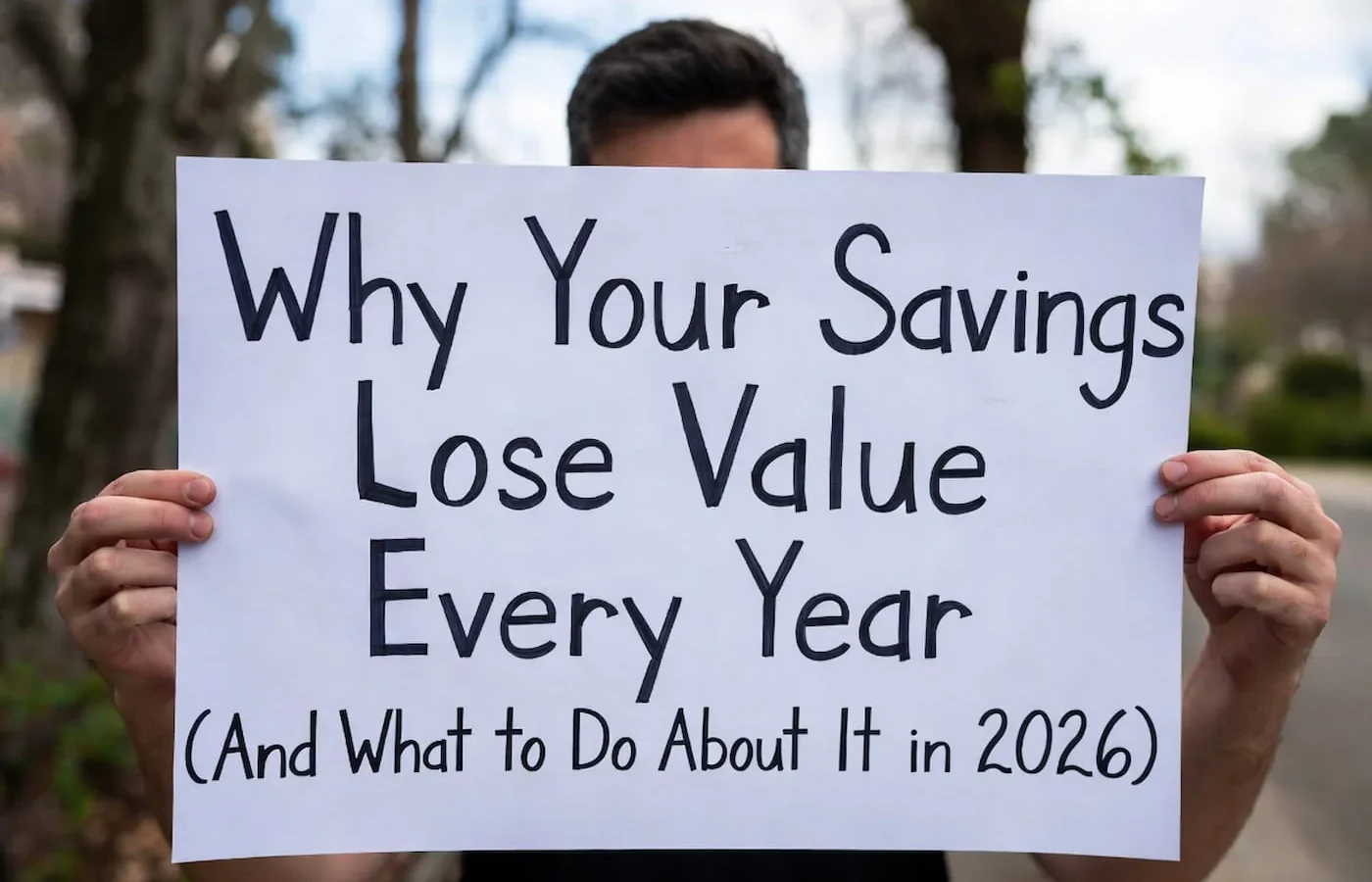
Why Your Savings Lose Value Every Year (And What to Do About It in 2026)
Key takeaway
Cash loses purchasing power whenever inflation exceeds the interest it earns, and the loss compounds silently because the nominal balance never falls. Over a decade at 3% inflation, money left in a low-yield account loses roughly a quarter of what it can buy. The defence is matching the instrument to the horizon.
Meet Sarah (and why her story is probably yours too)
Sarah is 38, works as an architect, and — like many professionals of her generation — has done what she was always told was “the responsible thing”: save.
Over the last seven years, she has been putting money aside every month. First $300, then $500, then $800 when she got promoted. In January 2026 she did something she had never done before: she opened her banking app, added up every account balance, and wrote the number down in a notebook.
$34,200.
She felt proud. It was more money than she had ever seen in one place. But two weeks later, while having dinner with an economist friend, she shared the figure expecting a congratulation. Her friend’s response froze her:
— “Sarah, that money is worth roughly $27,500 in 2020 dollars. You’ve lost almost $7,000 in real purchasing power without moving it from the account.”
Sarah had lost nothing. No one had stolen from her. No market had crashed. She had simply done what almost everyone does: left her money sitting still while the world around her kept getting more expensive.
If you’ve ever looked at your bank balance and thought “I’ve got a solid cushion”, this article is for you. You’re about to understand exactly how much money you’re losing without realizing it, why it happens, and the four real options you have in 2026 to fix it — even if you’ve never invested before.
The silent enemy: what inflation really is and why it’s hitting you hard
Inflation is the general rise in prices of goods and services across an economy. Put more bluntly: it’s what makes the same amount of money buy less stuff every single year.
In the United States, according to the Bureau of Labor Statistics, the annual inflation rate averaged around 2.7% in 2025, and the most recent data for 2026 is actually worse: the annual rate jumped to 3.3% in March 2026, the highest level since May 2024, driven primarily by rising energy costs linked to geopolitical conflict in the Middle East. Core inflation remains stubbornly above 2.5%.
Now take that number — 3.3% — and apply it to your bank balance.
If you have $20,000 sitting in a standard checking account paying 0% interest (like the vast majority of U.S. checking accounts), in one year those $20,000 will only buy what costs $19,340 today. You’ve lost $660 in real money without lifting a finger.
And that’s just one year. Inflation doesn’t reset — it compounds. At the extreme, it compounds into a currency people stop saving in at all: Argentine consumer prices rose 211% in 2023, and how that was brought down to 1.7% a month is its own story.
Cumulative inflation in the U.S. (2021–2025)
| Year | Annual inflation |
|---|---|
| 2021 | +4.7% |
| 2022 | +8.0% |
| 2023 | +4.1% |
| 2024 | +2.9% |
| 2025 | +2.7% |
| 5-year cumulative | ≈ +23% |
Source: U.S. Bureau of Labor Statistics
In other words: every $10,000 you had sitting in the bank in 2020 has the purchasing power of roughly $7,700 today. Almost a quarter of your money has silently evaporated.
And it’s not your fault. It’s inflation, the way the monetary system is designed, and one passive decision: doing nothing.
If you want to understand why these movements happen and how they shape the markets, our article on how interest rates impact your investment choices explains it in detail.
Why your bank is NOT going to solve this for you
Here comes the uncomfortable part. Traditional banks make money precisely because your cash sits still in their accounts. They have zero incentive to pay you a generous interest rate, and the numbers prove it.
What a traditional bank actually offers you in 2026:
- Standard checking account: 0% to 0.05% APY (what most people have)
- Standard bank savings account: 0.10% to 0.45% APY
- High-yield savings accounts (HYSAs): 3.5% to 4.5% APY — but only at online banks and with fluctuating rates
- Certificates of Deposit (CDs): 4% to 5% APY, but your money is locked up
Do you see the problem? Even in the best-case scenario, with a high-yield savings account at 4.5% APY, you’re barely keeping pace with inflation before taxes. After federal and state taxes on interest income, you’re likely still losing purchasing power — just more slowly. Worse: HYSA rates are variable and tend to drop the moment the Federal Reserve cuts rates, which is exactly what analysts expect throughout 2026.
The tax detail almost nobody tells you about
Interest earned on any savings account, HYSA, or CD is taxed as ordinary income — not at the lower long-term capital gains rate. Depending on your federal tax bracket and state of residence, that means Uncle Sam is taking anywhere from 22% to 37% of those interest payments.
Translation: if your HYSA pays you $1,000 in interest, you might only keep $650 to $780. Your real after-tax return is almost always below inflation.
Savings accounts and CDs are a partial defense against inflation, not a solution. They’re useful for parking short-term cash, but they won’t build wealth.
The 4 things you can actually do with your savings in 2026
Let’s get concrete. If you have, say, $30,000 saved today, these are your real options, ranked from worst to best expected return over 10 years (assuming a 2.5% average annual inflation rate going forward):
Option 1 — Leave it in the checking account (what 70% of people do)
- Expected return: 0%
- Purchasing power in 10 years: ≈ $23,400 (you’ve lost $6,600)
- Effort required: None
- Emotional outcome: Apparent peace of mind, real loss
Option 2 — High-yield savings account or CD
- Expected average return: 3% to 4.5% APY (gross, and likely to drop)
- Purchasing power in 10 years: ≈ $30,000 to $33,000 (breaking even or small gain)
- Effort required: Low, with plenty of fine print
- Emotional outcome: Feeling of “doing something”, while barely keeping up
Option 3 — Mutual funds or advisor-managed accounts through your bank or brokerage
- Expected historical return: 4% to 6% annually (net of fees)
- Purchasing power in 10 years: ≈ $36,000 to $42,000
- Effort required: Medium (you open the account and forget)
- Hidden problem: management fees (1% to 2.5% annually), front-loaded commissions, and products designed with fatter margins for the bank than returns for you
These are the “comfortable” option your financial advisor will push. They beat sitting in cash, but the fees quietly eat a huge chunk of your real return. If this is the road you’re considering, first read our guide on how to invest in the financial market the right way to understand what you should demand from any product before signing.
Option 4 — Automated investing and AI-powered managed systems
- Expected historical return (diversified actively-managed portfolios): 7% to 15% annually net, depending on risk profile
- Purchasing power in 10 years: ≈ $50,000 to $95,000
- Effort required: Low (you configure once, the system runs)
- What changed in 2026: you no longer need to be a pro to access this
This last option is the one that has seen the biggest revolution over the past three years. Platforms like AssetWhisper combine artificial intelligence, real-time market data, and battle-tested strategies so that any saver can invest in a diversified, automated, and transparent way — without having to learn technical analysis or stay glued to the markets.
The evolution of these platforms has run parallel to the rise of robo-advisors, which are increasingly being recommended precisely because they strip out the abusive fees and democratize access to strategies that were previously reserved for large institutional investors.
Visual comparison: what happens to $30,000 after 10 years
| Option | Nominal balance at 10 years | Real purchasing power | Real gain/loss |
|---|---|---|---|
| Sitting in checking (0%) | $30,000 | $23,400 | −$6,600 |
| HYSA (4% APY, before tax) | $42,000 | $32,700 | +$2,700 |
| Bank-managed fund (5% net) | $48,867 | $38,100 | +$8,100 |
| Automated diversified portfolio (10% net) | $77,812 | $60,700 | +$30,700 |
Illustrative simulation. Past performance does not guarantee future results. Actual returns depend on risk profile, system chosen, and market conditions.
The difference between “doing nothing” and “letting an automated system invest for you” over 10 years can mean more than $30,000 in real purchasing power. With the exact same starting capital.
“But I don’t know anything about investing” — the fear that’s costing you real money
Here’s the mental trap that paralyzes millions of people: they believe investing requires knowing technical analysis, reading financial reports, or spending hours staring at charts.
That was true 20 years ago. It is no longer true today.
The reality is that three mental obstacles are costing you money every year:
1. “I’m afraid of losing it all”
This is the most reasonable fear — and also the easiest to dismantle. Professional automated systems and portfolios are built with integrated risk management: per-trade loss limits, asset diversification, automatic stop-losses, and periodic rebalancing. “Investing on your own with $20,000” is not remotely the same as “subscribing to a diversified system that manages risk for you”.
Our guide on how to manage risk in your financial investments explains the exact mechanisms professionals use — mechanisms now available to every investor.
2. “I don’t have time to keep tabs on the markets”
Exactly. And that’s precisely why automated systems exist. You don’t have to watch anything. The system executes trades according to a proven strategy, you get a monthly summary, and you’re done. It takes less mental effort than paying a monthly bill.
3. “I make bad decisions under pressure”
This isn’t a personal weakness — it’s simply how the human brain is wired. The psychology of investing and how emotions affect decisions is one of the main reasons the average retail investor dramatically underperforms the market: we sell in panic when things crash and buy euphorically when it’s already too late. An automated system has no emotions. It sticks to the strategy without flinching, which is a massive advantage over the manual investor.
How a saver should actually act in 2026
If you have idle cash, the action plan is surprisingly simple. Three concrete steps:
Step 1 — Take an honest snapshot of your savings
Add up everything you have in checking, savings, CDs, and funds. Split that total into:
- Emergency fund: 3 to 6 months of your monthly expenses. This goes into an HYSA or short-term CD (must stay liquid).
- Investable capital: everything above that cushion.
Most people discover in this step that they have way too much cash sitting as “safety net” and far too little actually working for them.
Step 2 — Define your risk profile honestly
Your profile depends on your age, your income, your goals, and above all your emotional tolerance for watching your money fluctuate in value. The four classic profiles:
- Conservative: you prioritize capital preservation. You’ll accept returns of 4–6% per year.
- Moderate: you accept some volatility in exchange for higher returns. Target: 6–10% annually.
- Dynamic: you tolerate significant fluctuations to maximize growth. Target: 10–15% annually.
- Aggressive: you chase maximum returns, accepting deep drawdowns. Can exceed 15% annually.
Step 3 — Pick the vehicle that matches your profile
This is where automated systems and portfolios make the real difference. Instead of having to pick each stock, each ETF, each rebalancing decision… you subscribe to a complete system tailored to your profile, and everything else happens automatically.
For how these allocations are actually built, see the case for and against a 60/40 core and how to work out which risk level you can hold.
The bonus nobody tells you about: the mistakes that multiply the loss
If, instead of subscribing to a professional system, you decide to invest on your own without a clear method, you’re statistically very likely to fall into one of the most common mistakes in stock market investing: buying high due to FOMO, panic-selling at the lows, concentrating everything in one “hot” stock, never rebalancing…
Each of those mistakes alone can cost you 20% to 50% of your cumulative return. The real advantage of an automated system isn’t just convenience — it’s that it removes the emotional decisions that lose you money.
And if you’re worried about the current macro backdrop — trade wars, geopolitical conflicts, market volatility — our analysis of crisis-proof investments and resilient sectors during times of volatility will help you understand why professional diversification matters more than ever in 2026.
Frequently asked questions
How much money am I actually losing if I keep $10,000 sitting in the bank?
With an average annual inflation rate of 3% (a realistic scenario for the U.S. in 2026), you’ll lose approximately $300 in purchasing power in year one, about $600 over two years, and more than $2,500 over five years. In other words, a quarter of your money turns into smoke without you ever seeing a negative balance on your statement.
Isn’t it safer to keep it in the bank than to invest it?
It’s a feeling of safety, not a real one. Money in the bank is “nominally safe” (the dollars are still there) but it is guaranteed to be losing purchasing power every year. It’s like having a piggy bank with a hole: no one is robbing you, but money is leaking out. Regulated, diversified investment systems accept short-term volatility in exchange for preserving and growing your real wealth over the long term.
What’s the minimum amount to make automated investing worthwhile?
It depends on the platform, but modern systems let you start with accessible amounts (typically between $500 and $3,000). What really matters isn’t the starting amount — it’s consistency: a system returning 8% annually on $5,000 that you feed with small monthly contributions will build far more wealth than “waiting” until you have a big lump sum to invest.
What if the market drops right after I invest?
Professional systems are specifically designed for that scenario: they blend assets that behave differently (stocks, bonds, commodities, cash), apply stop-loss rules, and rebalance automatically. Historically — even including the worst crashes of the past 50 years — a diversified portfolio held for 10 years has produced positive real returns in 95% of rolling periods.
How do I know an automated system is legit and not a scam?
Three fundamental criteria: (1) the platform is regulated and funds are custodied by a registered broker, (2) the performance history is public, verifiable, and audits its own drawdowns (not just the upside), and (3) it doesn’t promise unrealistic returns. Any system guaranteeing “X% per month” is a clear red flag. Serious systems talk about annual returns with realistic margins.
Conclusion: the decision you can’t keep postponing
Let’s come back to Sarah. After that dinner with her economist friend, she didn’t freeze. She did what any rational person does upon discovering they’re bleeding money every month: she looked for an alternative that matched her knowledge level (low) and her time availability (almost none).
She picked a moderate-risk automated portfolio, placed $28,000 of her $34,200 there, kept the remaining $6,200 as an emergency fund in an HYSA at 4%, and set up automatic monthly contributions of $500.
She doesn’t follow the market. She doesn’t look at charts. She doesn’t read earnings reports. She gets a monthly summary via email, glances at it for two minutes, and goes on with her life.
Over the next 10 years, if the system produces an average annual return of 9% (realistic for a well-diversified moderate portfolio), Sarah will have turned her initial $28,000 plus her contributions into approximately $148,000. Compared to roughly $68,000 she’d have with the “bank account + manual saving” strategy.
The difference — $80,000 — is simply the result of refusing to let inflation eat her money.
The question you should be asking yourself today is not “do I want to invest?” but “how much more money am I willing to hand over to inflation before I actually act?”
AssetWhisper is a financial analysis platform powered by AI and automated investment systems. We do not provide personalized financial advice. Past performance does not guarantee future results. Before investing, evaluate your risk profile and personal goals.
Did you find this article useful? Share it with someone who has money sitting idle in the bank — they’ll probably thank you 10 years from now.