Meet Sarah (and why her story is probably yours too)

Sarah is 38, works as an architect, and — like many professionals of her generation — has done what she was always told was "the responsible thing": save.

Over the last seven years, she has been putting money aside every month. First $300, then $500, then $800 when she got promoted. In January 2026 she did something she had never done before: she opened her banking app, added up every account balance, and wrote the number down in a notebook.

$34,200.

She felt proud. It was more money than she had ever seen in one place. But two weeks later, while having dinner with an economist friend, she shared the figure expecting a congratulation. Her friend's response froze her:

— "Sarah, that money is worth roughly $27,500 in 2020 dollars. You've lost almost $7,000 in real purchasing power without moving it from the account."

Sarah had lost nothing. No one had stolen from her. No market had crashed. She had simply done what almost everyone does: left her money sitting still while the world around her kept getting more expensive.

If you've ever looked at your bank balance and thought "I've got a solid cushion", this article is for you. You're about to understand exactly how much money you're losing without realizing it, why it happens, and the four real options you have in 2026 to fix it — even if you've never invested before.


The silent enemy: what inflation really is and why it's hitting you hard

Inflation is the general rise in prices of goods and services across an economy. Put more bluntly: it's what makes the same amount of money buy less stuff every single year.

In the United States, according to the Bureau of Labor Statistics, the annual inflation rate averaged around 2.7% in 2025, and the most recent data for 2026 is actually worse: the annual rate jumped to 3.3% in March 2026, the highest level since May 2024, driven primarily by rising energy costs linked to geopolitical conflict in the Middle East. Core inflation remains stubbornly above 2.5%.

Now take that number — 3.3% — and apply it to your bank balance.

If you have $20,000 sitting in a standard checking account paying 0% interest (like the vast majority of U.S. checking accounts), in one year those $20,000 will only buy what costs $19,340 today. You've lost $660 in real money without lifting a finger.

And that's just one year. Inflation doesn't reset — it compounds.

Cumulative inflation in the U.S. (2021–2025)

YearAnnual inflation
2021+4.7%
2022+8.0%
2023+4.1%
2024+2.9%
2025+2.7%
5-year cumulative≈ +23%

Source: U.S. Bureau of Labor Statistics

In other words: every $10,000 you had sitting in the bank in 2020 has the purchasing power of roughly $7,700 today. Almost a quarter of your money has silently evaporated.

And it's not your fault. It's inflation, the way the monetary system is designed, and one passive decision: doing nothing.

If you want to understand why these movements happen and how they shape the markets, our article on how interest rates impact your investment choices explains it in detail.


Why your bank is NOT going to solve this for you

Here comes the uncomfortable part. Traditional banks make money precisely because your cash sits still in their accounts. They have zero incentive to pay you a generous interest rate, and the numbers prove it.

What a traditional bank actually offers you in 2026:

Do you see the problem? Even in the best-case scenario, with a high-yield savings account at 4.5% APY, you're barely keeping pace with inflation before taxes. After federal and state taxes on interest income, you're likely still losing purchasing power — just more slowly. Worse: HYSA rates are variable and tend to drop the moment the Federal Reserve cuts rates, which is exactly what analysts expect throughout 2026.

The tax detail almost nobody tells you about

Interest earned on any savings account, HYSA, or CD is taxed as ordinary income — not at the lower long-term capital gains rate. Depending on your federal tax bracket and state of residence, that means Uncle Sam is taking anywhere from 22% to 37% of those interest payments.

Translation: if your HYSA pays you $1,000 in interest, you might only keep $650 to $780. Your real after-tax return is almost always below inflation.

Savings accounts and CDs are a partial defense against inflation, not a solution. They're useful for parking short-term cash, but they won't build wealth.


The 4 things you can actually do with your savings in 2026

Let's get concrete. If you have, say, $30,000 saved today, these are your real options, ranked from worst to best expected return over 10 years (assuming a 2.5% average annual inflation rate going forward):

Option 1 — Leave it in the checking account (what 70% of people do)

Option 2 — High-yield savings account or CD

Option 3 — Mutual funds or advisor-managed accounts through your bank or brokerage

These are the "comfortable" option your financial advisor will push. They beat sitting in cash, but the fees quietly eat a huge chunk of your real return. If this is the road you're considering, first read our guide on how to invest in the financial market the right way to understand what you should demand from any product before signing.

Option 4 — Automated investing and AI-powered managed systems

This last option is the one that has seen the biggest revolution over the past three years. Platforms like AssetWhisper combine artificial intelligence, real-time market data, and battle-tested strategies so that any saver can invest in a diversified, automated, and transparent way — without having to learn technical analysis or stay glued to the markets.

The evolution of these platforms has run parallel to the rise of robo-advisors, which are increasingly being recommended precisely because they strip out the abusive fees and democratize access to strategies that were previously reserved for large institutional investors.


Visual comparison: what happens to $30,000 after 10 years

OptionNominal balance at 10 yearsReal purchasing powerReal gain/loss
Sitting in checking (0%)$30,000$23,400−$6,600
HYSA (4% APY, before tax)$42,000$32,700+$2,700
Bank-managed fund (5% net)$48,867$38,100+$8,100
Automated diversified portfolio (10% net)$77,812$60,700+$30,700

Illustrative simulation. Past performance does not guarantee future results. Actual returns depend on risk profile, system chosen, and market conditions.

The difference between "doing nothing" and "letting an automated system invest for you" over 10 years can mean more than $30,000 in real purchasing power. With the exact same starting capital.


"But I don't know anything about investing" — the fear that's costing you real money

Here's the mental trap that paralyzes millions of people: they believe investing requires knowing technical analysis, reading financial reports, or spending hours staring at charts.

That was true 20 years ago. It is no longer true today.

The reality is that three mental obstacles are costing you money every year:

1. "I'm afraid of losing it all"

This is the most reasonable fear — and also the easiest to dismantle. Professional automated systems and portfolios are built with integrated risk management: per-trade loss limits, asset diversification, automatic stop-losses, and periodic rebalancing. "Investing on your own with $20,000" is not remotely the same as "subscribing to a diversified system that manages risk for you".

Our guide on how to manage risk in your financial investments explains the exact mechanisms professionals use — mechanisms now available to every investor.

2. "I don't have time to keep tabs on the markets"

Exactly. And that's precisely why automated systems exist. You don't have to watch anything. The system executes trades according to a proven strategy, you get a monthly summary, and you're done. It takes less mental effort than paying a monthly bill.

3. "I make bad decisions under pressure"

This isn't a personal weakness — it's simply how the human brain is wired. The psychology of investing and how emotions affect decisions is one of the main reasons the average retail investor dramatically underperforms the market: we sell in panic when things crash and buy euphorically when it's already too late. An automated system has no emotions. It sticks to the strategy without flinching, which is a massive advantage over the manual investor.


How a saver should actually act in 2026

If you have idle cash, the action plan is surprisingly simple. Three concrete steps:

Step 1 — Take an honest snapshot of your savings

Add up everything you have in checking, savings, CDs, and funds. Split that total into:

Most people discover in this step that they have way too much cash sitting as "safety net" and far too little actually working for them.

Step 2 — Define your risk profile honestly

Your profile depends on your age, your income, your goals, and above all your emotional tolerance for watching your money fluctuate in value. The four classic profiles:

Step 3 — Pick the vehicle that matches your profile

This is where automated systems and portfolios make the real difference. Instead of having to pick each stock, each ETF, each rebalancing decision... you subscribe to a complete system tailored to your profile, and everything else happens automatically.

If you want concrete examples of how these portfolios are built and what separates a professional strategy from an amateur one, our guide on how AssetWhisper can transform your investment portfolio goes deep into the details.


The bonus nobody tells you about: the mistakes that multiply the loss

If, instead of subscribing to a professional system, you decide to invest on your own without a clear method, you're statistically very likely to fall into one of the most common mistakes in stock market investing: buying high due to FOMO, panic-selling at the lows, concentrating everything in one "hot" stock, never rebalancing...

Each of those mistakes alone can cost you 20% to 50% of your cumulative return. The real advantage of an automated system isn't just convenience — it's that it removes the emotional decisions that lose you money.

And if you're worried about the current macro backdrop — trade wars, geopolitical conflicts, market volatility — our analysis of crisis-proof investments and resilient sectors during times of volatility will help you understand why professional diversification matters more than ever in 2026.


Frequently asked questions

How much money am I actually losing if I keep $10,000 sitting in the bank?

With an average annual inflation rate of 3% (a realistic scenario for the U.S. in 2026), you'll lose approximately $300 in purchasing power in year one, about $600 over two years, and more than $2,500 over five years. In other words, a quarter of your money turns into smoke without you ever seeing a negative balance on your statement.

Isn't it safer to keep it in the bank than to invest it?

It's a feeling of safety, not a real one. Money in the bank is "nominally safe" (the dollars are still there) but it is guaranteed to be losing purchasing power every year. It's like having a piggy bank with a hole: no one is robbing you, but money is leaking out. Regulated, diversified investment systems accept short-term volatility in exchange for preserving and growing your real wealth over the long term.

What's the minimum amount to make automated investing worthwhile?

It depends on the platform, but modern systems let you start with accessible amounts (typically between $500 and $3,000). What really matters isn't the starting amount — it's consistency: a system returning 8% annually on $5,000 that you feed with small monthly contributions will build far more wealth than "waiting" until you have a big lump sum to invest.

What if the market drops right after I invest?

Professional systems are specifically designed for that scenario: they blend assets that behave differently (stocks, bonds, commodities, cash), apply stop-loss rules, and rebalance automatically. Historically — even including the worst crashes of the past 50 years — a diversified portfolio held for 10 years has produced positive real returns in 95% of rolling periods.

How do I know an automated system is legit and not a scam?

Three fundamental criteria: (1) the platform is regulated and funds are custodied by a registered broker, (2) the performance history is public, verifiable, and audits its own drawdowns (not just the upside), and (3) it doesn't promise unrealistic returns. Any system guaranteeing "X% per month" is a clear red flag. Serious systems talk about annual returns with realistic margins.


Conclusion: the decision you can't keep postponing

Let's come back to Sarah. After that dinner with her economist friend, she didn't freeze. She did what any rational person does upon discovering they're bleeding money every month: she looked for an alternative that matched her knowledge level (low) and her time availability (almost none).

She picked a moderate-risk automated portfolio, placed $28,000 of her $34,200 there, kept the remaining $6,200 as an emergency fund in an HYSA at 4%, and set up automatic monthly contributions of $500.

She doesn't follow the market. She doesn't look at charts. She doesn't read earnings reports. She gets a monthly summary via email, glances at it for two minutes, and goes on with her life.

Over the next 10 years, if the system produces an average annual return of 9% (realistic for a well-diversified moderate portfolio), Sarah will have turned her initial $28,000 plus her contributions into approximately $148,000. Compared to roughly $68,000 she'd have with the "bank account + manual saving" strategy.

The difference — $80,000 — is simply the result of refusing to let inflation eat her money.

The question you should be asking yourself today is not "do I want to invest?" but "how much more money am I willing to hand over to inflation before I actually act?"

AssetWhisper is a financial analysis platform powered by AI and automated investment systems. We do not provide personalized financial advice. Past performance does not guarantee future results. Before investing, evaluate your risk profile and personal goals.

Did you find this article useful? Share it with someone who has money sitting idle in the bank — they'll probably thank you 10 years from now.

Markets in May 2026 are doing something they almost never do: hitting all-time highs in the middle of a war, an oil shock, a generational gasoline price spike, and the most divided Federal Reserve vote since 1992. The S&P 500 just closed at a record 7,230, the Nasdaq broke 25,000 for the first time, and yet WTI crude is at $102, gold is at $4,600, and Spirit Airlines went bankrupt over the weekend.

If that combination feels unstable to you, your instinct is correct. Concentrated rallies during periods of macro stress are exactly the moments when sector selection matters most — when an index-level "buy" can hide enormous dispersion underneath.

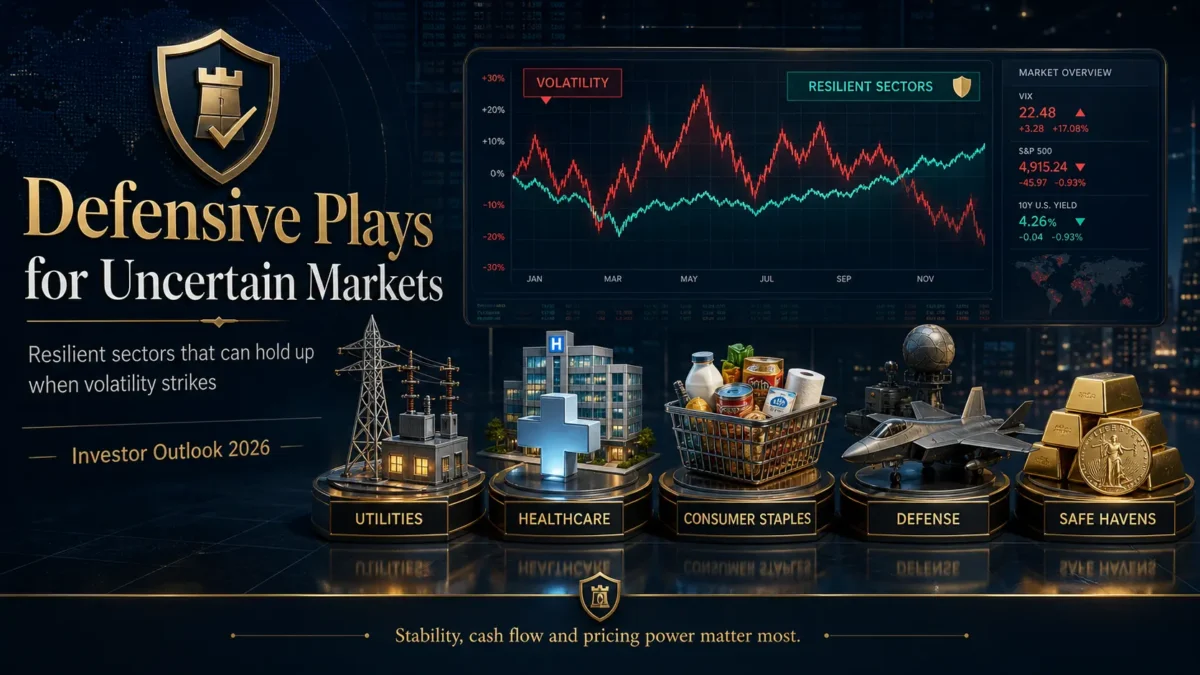
This is where crisis-proof investments become essential. Not as a way to predict the next downturn, but as a way to build a portfolio that compounds in either scenario — whether earnings keep growing through the conflict or the cracks widen and a real correction arrives.

This guide walks through the sectors that have historically held up best during periods of volatility, how each is positioned in the specific environment of mid-2026, and the practical rules for integrating them into your portfolio. It pairs naturally with our recent May 2026 Market Update, our framework on How to Manage Risk in Your Financial Investments, and our deep dive on Effective Strategies for Investment Hedging.

What Makes a Sector "Crisis-Proof"?

Before naming sectors, it is worth defining the term. A truly crisis-proof investment does not just survive volatility — it has structural characteristics that make stable performance the expected outcome, not the lucky one.

Three properties matter most:

Inelastic demand. People keep buying the product even when their income drops, their portfolios fall, or the macro environment turns hostile. This is the difference between toothpaste and luxury watches. One is bought weekly regardless of conditions; the other is the first thing cut from a household budget.

Predictable cash flows. The business converts demand into revenue and revenue into cash on a regular cadence. Companies with multi-year contracts, regulated rate bases, or subscription models compound through downturns because their cash flow does not whipsaw with sentiment.

Lower beta to the broader market. Beta is a measure of how much a stock moves relative to the index. Sectors with beta below 1.0 (utilities, staples, healthcare) tend to fall less in drawdowns and rise less in rallies — which is precisely the trade-off you want when reducing portfolio volatility.

A sector that combines inelastic demand, predictable cash flows, and below-average beta is structurally resilient. That is different from a sector that happens to have done well in the last cycle, which is the trap many retail investors fall into when chasing performance.

For a deeper foundation on why sector selection beats market timing, our piece on Common Mistakes in Stock Market Investing covers the most expensive errors investors make in exactly this kind of environment.

Why Crisis-Proof Sectors Matter Right Now (May 2026)

The 2026 setup is unusual because it stacks several risk factors on top of each other while equity benchmarks reach record highs. Specifically:

In this environment, owning the sectors that work regardless of which way the macro narrative breaks is not a defensive crouch — it is the single best risk-adjusted decision available. The full macro context is in our May 2026 Market Update.

The Six Crisis-Proof Sectors for 2026

These are the sectors that combine the structural properties of resilience with specific 2026 catalysts that make them especially attractive right now.

1. Healthcare

Healthcare is the textbook resilient sector and remains the cornerstone of any crisis-proof portfolio. The reason is structural: people get sick during recessions, during wars, during inflation spikes, and during elections. Demand for medical care is essentially independent of the business cycle.

What works in 2026:

What to be careful about:

The cleanest healthcare exposure for most investors is through diversified large-cap pharma and a healthcare-sector ETF, sized as a core allocation rather than a tactical bet.

2. Consumer Staples

Consumer staples include the products people buy weekly regardless of income, weather, or geopolitics: food, beverages, household supplies, personal care. The thesis is simple — when consumers tighten budgets, they keep buying toothpaste and bread, and they may even upgrade to private-label store brands operated by the same staples giants.

What works in 2026:

Where staples are challenged in 2026:

The Iran war has pushed gasoline up roughly 50% since late February, which is a direct margin pressure on packaged-goods companies through transportation costs and indirectly through reduced consumer disposable income. Staples are defensive, not immune. A company-by-company quality screen matters more in 2026 than at most points in the cycle.

This dynamic is exactly what we explore in Behavioral Finance: How Emotions Affect Investment Decisions — when consumers are stressed, their behavior changes, and that creates winners and losers within the same sector.

3. Utilities

Utilities are the sector that most closely resembles a regulated bond. Electricity, water, and natural gas providers operate under rate structures set by public utility commissions, which produces extraordinarily stable revenue and cash flow regardless of the macro environment.

What works in 2026:

The utilities sector has a once-in-a-generation tailwind right now: the AI data center power demand surge. Caterpillar's most recent earnings call specifically called out a record backlog driven by power generation equipment for AI data centers. Hyperscalers are signing 15- and 20-year power purchase agreements at scale, and the utilities serving the major data center corridors (Virginia, Texas, Phoenix, Atlanta) are seeing capex plans that look unusual for the sector.

This means utilities in 2026 are not just a defensive yield play — they are a growth-adjacent defensive, capturing some of the AI capex theme while retaining their bond-like income characteristics.

What to be careful about:

For income-oriented investors, utilities pair naturally with dividend-paying equities — a topic we cover in depth in The Advantages of Dividend Investing.

4. Energy and Energy Infrastructure (The 2026-Specific Resilience Trade)

Energy is not a traditional defensive sector — historically it is highly cyclical. But in the specific environment of 2026, with WTI at $102 and the 2026 earnings revisions for the energy sector running approximately 40% higher than estimates at the start of the year, energy has become a crisis-adjacent resilience play.

What works in 2026:

The cautionary lesson from Q1 2026 earnings:

The "war pushes oil up, integrated oil majors up" trade is too simple. Exxon and Chevron both beat Q1 earnings expectations but reported sharp profit declines (roughly -45% and -36% respectively) because higher crude prices do not translate linearly into integrated-company profitability. Refining margins, currency effects, and capital spending offset the topline benefit.

The takeaway: in energy, sub-sector matters as much as the overall sector call. Equipment, pipelines, and specialty refiners have been the cleaner expression of the 2026 tape than direct major-oil exposure.

5. Aerospace and Defense

This is the sector the original framework of "defensive investing" tends to overlook, but in 2026 it deserves a permanent seat at the table. Defense spending is one of the most procyclical-to-conflict cash flow streams in public markets, and government procurement budgets typically rise with geopolitical tensions and persist even after they ease.

What works in 2026:

What to be careful about:

This is one area where the technology lens is particularly useful: many of the most relevant defense names are software and AI plays as much as traditional industrials. The same trends we covered in Emerging Technologies in Financial Trading apply here — the line between "defense" and "technology" has blurred in ways that reshape sector classifications.

6. Real Estate Investment Trusts (REITs) — Selective Exposure Only

REITs are traditionally a resilient sector because real estate generates rental income across the cycle. In 2026, the picture is more nuanced because some REIT sub-sectors are riding tailwinds while others face structural headwinds.

What works in 2026:

What to avoid in 2026:

For the broader case for REITs as part of a diversified portfolio, our piece on Real Estate Investment Trusts (REITs): Generating Income from Real Estate is the deeper foundational read.

Building a Crisis-Proof Allocation in Practice

Knowing which sectors are resilient is one thing. Building a portfolio that actually captures that resilience is another. Here is the practical framework.

Start With a Defensive Sleeve, Not a Defensive Portfolio

The mistake most investors make when they start thinking about crisis-proofing is to overhaul their entire portfolio. This is almost always wrong. The right approach is to define a defensive sleeve — typically 20%–40% of your equity allocation — that is explicitly built around resilient sectors, while keeping your growth and core holdings intact.

A reasonable structure for a moderate-risk investor in 2026 might look like:

The exact percentages should match your risk tolerance, time horizon, and what you already own. The principle is what matters: explicitly define a portion of the portfolio whose job is to compound through downturns.

Use Fundamental Analysis, Not Story Stocks

Within each resilient sector, individual security selection still matters enormously. A "defensive sector" full of low-quality companies is not actually defensive. Apply the same fundamental discipline regardless of whether you are looking at growth tech or consumer staples:

For the deeper framework on this versus chart-based approaches, our piece on Technical Analysis vs Fundamental Analysis: Which Is Better? breaks down the trade-offs.

Diversify the Implementation

The simplest way to access resilient sectors at scale is through sector ETFs. These give you instant diversification within the sector and remove single-stock risk that can derail an otherwise sound thesis (see Spirit Airlines this past weekend — a four-decade business that ended over a Friday-Saturday, even though airlines were not part of the original "crisis-proof" thesis).

For investors looking to layer in thematic resilience, broader category ETFs covering sustainability, infrastructure, and quality factors can complement direct sector exposure. We cover the sustainability angle in Top ETFs for Sustainable and Green Sector Investments.

Rebalance Mechanically

The most underrated element of any defensive strategy is the rebalancing rule. When markets rip higher, your defensive sleeve will underperform — that is by design. The discipline is to rebalance back to target weights anyway, which forces you to sell high and buy low automatically. Most investors get this exactly backwards: they let winners run and sell laggards, which is the opposite of how compounding works through a full cycle.

A simple rule — rebalance whenever any allocation drifts more than 5 percentage points from target, or at least quarterly — captures most of the benefit without requiring sophisticated decision-making in the moment.

Common Mistakes in Building a Crisis-Proof Portfolio

The framework is simple. The execution is where most investors fail. Here are the most expensive mistakes to avoid.

Confusing "Defensive" With "Safe"

Defensive sectors have lower beta. They are not bulletproof. A consumer staples ETF can still draw down 15%–20% in a serious bear market. A utility can still cut its dividend if the regulatory environment turns hostile. The promise is less volatility, not zero volatility, and treating defensive holdings as risk-free leads to position sizing that is too aggressive.

Chasing Yield Without Understanding It

Some of the highest-yielding "defensive" stocks (mortgage REITs, certain MLPs, some tobacco names) carry concentrated risks that do not show up until they break. A 9% dividend yield in a sector where the average is 4% is almost always a warning sign, not a free lunch. The discipline in our piece on How to Identify Undervalued Assets and Maximize Your Gains applies cleanly here.

Ignoring Interest Rates

Defensive sectors — particularly utilities, REITs, and high-yield staples — are unusually sensitive to interest rates. The Fed's April 2026 dissent vote raised the probability that the central bank delivers fewer cuts than the market expected. That is a meaningful headwind for rate-sensitive defensives, and any allocation should be sized with that scenario explicitly in mind. Our framework in The Impact of Interest Rates on Investment Choices is the right starting point.

Letting Emotions Drive Sector Calls

The temptation to load up on defensives after a scare and dump them after a rally is the single most expensive behavior in this part of the market. Build the allocation when markets are calm, hold it through both volatility and exuberance, and let the discipline do its work. The mindset framework in How to Develop a Successful Investor Mindset is core to making this stick.

Beyond Sectors: Other Tools for Portfolio Resilience

Sector selection is the most accessible lever for retail investors, but it is not the only one. The fuller toolkit includes:

Hedging strategies. Options-based protection, volatility products, and currency hedges all play roles in sophisticated portfolios. The trade-off is cost — most hedges are insurance, and insurance is expensive over long horizons. Our deeper coverage is in Effective Strategies for Investment Hedging.

Algorithmic and AI-driven defensive overlays. Modern portfolio construction increasingly uses AI to dynamically adjust exposures based on risk indicators. The technology is real and improving fast — we wrote the comprehensive guide in AI Trading Agents in 2026 and broader algorithmic frameworks in Algorithmic Trading Strategies for 2026.

Dollar-denominated alternatives. The GENIUS Act has dramatically reshaped how investors think about cash management and yield. Compliant stablecoins and tokenized Treasury products now offer high-quality short-duration exposure with new operational properties. We unpack the regulatory and investment implications in The GENIUS Act and Stablecoin Regulation in 2026.

Robo-advisors with defensive tilts. For investors who want professional-grade portfolio construction without the operational complexity, modern robo-advisors offer well-designed defensive allocations. Our analysis of when these make sense is in The Rise of Robo-Advisors: Why They Are Highly Recommended.

How AssetWhisper Approaches Crisis-Proof Investing

Every framework in this guide is built into AssetWhisper's research stack. We continuously monitor sector earnings revisions, factor rotations, regime shifts, and the specific signals that distinguish genuinely resilient companies from those that just look defensive in calm markets.

Our weekly market reports surface exactly the kinds of cross-sector dynamics this 2026 environment requires — the AI capex broadening into utilities and industrials, the sub-sector dispersion within energy, the sensitivity of defensive yields to a divided Fed. Same philosophy as our AI trading agent stack: explainable AI applied to real markets, with the reasoning made visible.

Crisis-proof investing is not about predicting crises. It is about building a portfolio whose default state is resilience — so that when crises do arrive (and they always do), you are already positioned, already disciplined, and already compounding.

Discover how AssetWhisper transforms your investment process and put institutional-grade resilience analysis to work in your portfolio today.

Frequently Asked Questions

What are the most crisis-proof sectors in 2026?

Healthcare, consumer staples, and utilities remain the structural cornerstones of crisis-proof investing. In the specific environment of 2026, selective exposure to energy infrastructure (especially pipelines and refiners), aerospace and defense, and AI-adjacent utilities and data center REITs add resilience without sacrificing growth.

Should I sell my growth stocks and move into defensive sectors?

No. The right approach is to define a defensive sleeve (typically 20%–40% of equity allocation) that complements your core and growth holdings, not to wholesale rotate. Wholesale rotations almost always result in selling at the wrong time and missing recoveries. The discipline is allocation design, not market timing.

Are utilities still a good investment with the Fed not cutting rates?

Utilities are interest-rate sensitive, so a "fewer cuts" environment is a modest headwind for the sector's relative yield. But the AI data center power demand thesis is a structural earnings tailwind that more than offsets that headwind for well-positioned operators. The net case for utilities in 2026 is stronger than the headline yield comparison suggests.

How do I know if a "defensive" stock is actually defensive?

Three quick checks: (1) Has the company maintained or grown earnings through the last two recessions? (2) Is its beta materially below 1.0? (3) Does it have demonstrated pricing power (the ability to raise prices without losing volume)? A stock that fails any of these is not actually defensive, regardless of what sector it sits in.

What percentage of my portfolio should be in defensive sectors?

For a moderate-risk investor in 2026, 20%–30% of the equity allocation in explicit defensive sectors is reasonable. More for risk-averse investors or those near retirement; less for younger investors with longer time horizons. The right number depends on your specific situation, but having some explicit defensive exposure is appropriate for nearly all investors right now.

Are bonds still a defensive asset in 2026?

Yes, but with a twist. Short-duration Treasuries (1-3 years) yielding above 4% are genuinely attractive defensive assets. Longer-duration bonds carry meaningful interest rate risk if the Fed delivers fewer cuts than expected, which became more likely after the April 2026 dissent vote. Calibrate duration accordingly.

How does the Iran war change crisis-proof investing?

It elevates two specific themes: energy infrastructure (pipelines, refiners, midstream) and aerospace/defense. Both have been significant earnings beneficiaries of the conflict and benefit from structural shifts in geopolitical posture that will outlast any individual ceasefire. Both should be considered legitimate parts of a 2026 defensive sleeve.

Is gold still part of a crisis-proof portfolio?

Yes, more than at any point in two decades. Gold has compounded 60%+ in 2025 and is currently trading around $4,600. Central bank demand is structural and growing. For most diversified portfolios, a 5%–10% allocation in 2026 is appropriate — not as a market call but as a real diversifier whose price is largely uncorrelated with risk assets.

Conclusion

Crisis-proof investing in 2026 is not about hiding from risk. It is about building a portfolio whose foundations are strong enough to compound through any plausible scenario the macro environment can produce. With markets at all-time highs, a war in progress, oil at $102, gold at $4,600, and the most divided Fed in a generation, that foundation matters more than at almost any point in the cycle.

The sectors that work — healthcare, staples, utilities, selective energy and defense, quality REITs — combine inelastic demand with predictable cash flows and below-average sensitivity to the broader market. The execution that works — defensive sleeves rather than wholesale rotations, fundamental analysis rather than story stocks, mechanical rebalancing rather than emotional timing — is the same in every cycle, only more important when the macro setup is unusual.

Build the allocation when markets are calm. Hold it through both volatility and exuberance. Let the discipline do its work. That is how portfolios compound through whatever 2026 has left to throw at them — and the cycles after that, too.


Want continuous, AI-powered analysis of resilient sectors and the broader macro environment? Discover how AssetWhisper transforms your investment process and put institutional-grade research to work in your portfolio today.

In today's unpredictable financial landscape, mastering effective strategies for investment hedging has become crucial for both novice and seasoned investors. As market volatility continues to challenge even the most robust portfolios, understanding and implementing these hedging techniques can mean the difference between weathering economic storms and suffering significant losses. This comprehensive guide will explore various effective strategies for investment hedging, providing you with the tools to protect your assets and optimize your investment returns.

Understanding the Basics of Investment Hedging

Before delving into specific strategies, it's essential to grasp the fundamental concept of hedging. Investment hedging is a risk management technique used to offset potential losses in investments by taking an opposite position in a related asset. The primary goal of hedging is not to generate profits but to minimize or eliminate the risk of adverse price movements.

Diversification: The Foundation of Effective Hedging

One of the most fundamental effective strategies for investment hedging is diversification. By spreading investments across various asset classes, sectors, and geographical regions, investors can reduce their exposure to any single risk. Here's how to implement this strategy:

Options Strategies for Hedging

Options provide flexible and powerful tools for implementing effective strategies for investment hedging. Here are some popular options strategies:

a) Protective Puts Buying put options on stocks you own provides downside protection. If the stock price falls, the put option's value increases, offsetting potential losses.

b) Covered Calls Selling call options on stocks you own can generate additional income and provide a small hedge against downside risk.

c) Collar Strategy Combining protective puts with covered calls creates a "collar," limiting both potential losses and gains.

Using Futures Contracts for Hedging

Futures contracts are another effective tool for investment hedging, particularly for commodities and currencies. These agreements allow investors to lock in prices for future transactions, protecting against adverse price movements.

Inverse ETFs and Short Selling

For more advanced investors, inverse ETFs and short selling can be effective strategies for investment hedging:

Currency Hedging for International Investments

When investing in foreign markets, currency fluctuations can significantly impact returns. Effective strategies for investment hedging in this context include:

Fixed Income Strategies for Hedging

Bonds and other fixed-income securities can play a crucial role in hedging strategies:

Alternative Investments as Hedging Tools

Incorporating alternative investments can enhance your hedging strategy:

Dynamic Hedging Strategies

For more active investors, dynamic hedging involves continuously adjusting hedge positions based on market conditions:

The Role of Cash in Hedging

Maintaining a cash reserve is one of the simplest yet effective strategies for investment hedging:

Conclusion:

Mastering effective strategies for investment hedging is essential for building a resilient portfolio in today's volatile markets. By employing a combination of diversification, options strategies, futures contracts, and alternative investments, investors can significantly mitigate risks while positioning themselves for long-term growth. Remember, the key to successful hedging lies in understanding your risk tolerance, investment goals, and the specific risks associated with your portfolio.

As you implement these strategies, it's crucial to regularly review and adjust your hedging approach to ensure it remains aligned with your investment objectives and market conditions. Consider consulting with a financial advisor to tailor these effective strategies for investment hedging to your unique situation and to stay informed about emerging trends and techniques in risk management.

If there is one variable that quietly governs the price of every asset on your screen, it is the interest rate. Bonds, stocks, real estate, commodities, gold, even crypto — none of them are valued in a vacuum. They are valued relative to what cash earns, and what cash earns is set by central bank policy.

In May 2026, that relationship is more visible than it has been in years. The Federal Reserve has held its benchmark target at 3.50%–3.75% for three consecutive meetings, but it is doing so with the most divided FOMC vote since October 1992 — 8 to 4, with one governor wanting cuts and three regional presidents pushing back against any easing bias. The 10-year Treasury yields about 4.39%. Gold sits near $4,600. The S&P 500 closed Friday at an all-time high of 7,230.12, and the equity risk premium — the extra yield investors demand for owning stocks instead of risk-free bonds — is essentially zero.

Every one of those facts is a function of where rates are and where the market thinks they're going. Understanding that machinery is the difference between investors who navigate cycles deliberately and investors who get whipsawed by them.

This guide walks through what interest rates actually are, how the Fed sets them, how each major asset class responds, and — most usefully — how to translate the current 2026 rate environment into specific portfolio decisions. It pairs naturally with our latest Market Update for May 2026 and serves as the foundation for the rate-sensitive frameworks in Crisis-Proof Investments and Effective Strategies for Investment Hedging.

What Interest Rates Actually Are

An interest rate is two things at once: the price you pay to borrow money, and the price you receive for lending it. Every other definition flows from those two ideas.

In the United States, the most important short-term rate is the federal funds rate — the rate banks charge each other for overnight loans of reserves. The Federal Reserve sets a target range for this rate (currently 3.50%–3.75%) and uses open-market operations to keep it there. Almost every other rate in the economy — credit cards, mortgages, auto loans, corporate bonds, money market yields — is anchored, directly or indirectly, to the federal funds rate.

Long-term rates, in contrast, are set by the market. The 10-year Treasury yield reflects investors' collective expectations about the future path of short-term rates, plus a "term premium" for the additional risk of locking up money for a decade. When the 10-year is at 4.39% with the fed funds at 3.50%–3.75%, the curve is gently upward-sloping — a sign that the market expects rates to remain broadly stable rather than to plunge.

Understanding this distinction matters because short rates and long rates do not always move together. A central bank can cut the fed funds rate even as long-term yields rise, if the market believes the cuts will reignite inflation. That dynamic was visible in late 2024 and shaped much of the 2025 portfolio environment we cover in Why Savings Lose Value: What to Do.

The Fed in 2026: Why a Divided Central Bank Matters

You cannot talk about interest rates in 2026 without addressing the historic split inside the Federal Reserve. At the April 29 FOMC meeting — Chair Jerome Powell's last before his term expires May 15 and Kevin Warsh takes over — the committee voted 8-4 to hold rates steady. That alone was the most divided FOMC decision since October 1992.

The four dissents broke in opposite directions:

The trio's reasoning was strikingly direct. Hammack noted that the Iran-driven oil shock adds broad-based inflationary pressure. Logan said the next move could plausibly be a hike or a cut. Kashkari argued that issuing forward guidance in a moment of high geopolitical uncertainty is itself the wrong posture.

This matters far beyond Fed-watcher minutiae. It tells investors three things:

The "one cut by year-end" base case is fragile. With three regional presidents publicly resisting easing-bias language, the bar for a cut has risen.

The Fed Chair transition itself is a market variable. Kevin Warsh inherits a divided committee where the chair has only one vote. His ability to build consensus quickly will shape the rate path more than his own preferences will.

Forward guidance is now contested terrain. Markets had grown used to a Fed that signaled its next move clearly. That is no longer the case, which raises volatility in rate-sensitive assets.

These dynamics are why the framework in this article is more than academic. The same rate environment can mean very different things depending on whether the market believes the Fed has its next move teed up.

How Interest Rates Affect Each Major Asset Class

Every asset class has its own sensitivity to rates. Get the mechanics right and the rest of portfolio construction becomes much easier.

Bonds: The Most Direct Relationship

Bonds and interest rates have an inverse mechanical relationship. When new bonds are issued at higher yields, the market price of older, lower-yielding bonds falls so that their yield-to-maturity matches what's available now. When new yields fall, older bonds become more valuable.

The magnitude of the move is captured by duration — a measure of how much a bond's price changes for a given change in rates. As a rule of thumb, a bond with a duration of 7 years will lose roughly 7% of its value if interest rates rise by 1 percentage point, and gain roughly 7% if rates fall by the same amount.

In the 2026 environment, this creates clear positioning logic:

Within bonds, credit quality matters too. Investment-grade corporates yield more than Treasuries because they carry default risk; high-yield ("junk") bonds yield more still because the default risk is higher. In a slowing economy, credit spreads widen — meaning lower-quality bonds underperform — which is a separate risk from pure rate movements.

Stocks: A More Complex Picture

Stocks respond to rates through three channels, and each cuts differently across sectors.

Channel one — discount rates. Stocks are valued by discounting future cash flows back to the present. When rates rise, the present value of those future cash flows falls. This hits growth stocks — companies whose earnings are expected to materialize years from now — much harder than value stocks, whose earnings are largely happening today. The recent dispersion within the S&P 500 is partly a story about which companies are most affected by this discounting math.

Channel two — borrowing costs. Companies that rely on debt to fund expansion face higher interest expense when rates rise, which compresses margins and slows growth. Highly leveraged businesses (some real estate, certain consumer brands, parts of biotech) feel this most. Cash-rich, low-debt companies (much of mega-cap tech) barely feel it.

Channel three — sector economics. Some sectors benefit from higher rates. Banks earn more on their net interest margin when rates rise. Insurance companies invest premiums in fixed income, so higher yields mean higher investment income. This is one reason financials have outperformed in parts of the rate-hiking cycle.

In 2026 specifically, the S&P 500's near-zero equity risk premium — the forward earnings yield is essentially equal to the 10-year Treasury yield — is the most important rate-related fact about the stock market. It means investors are accepting equity volatility for the same theoretical return as risk-free bonds. That is not by itself a sell signal, but it is exactly the condition where downside surprises become most expensive. We unpack this in detail in our May 2026 Market Update.

The sector framework we use at AssetWhisper sorts stocks by their interest rate beta — how much they tend to move when rates change — which we discuss alongside fundamental analysis in Technical Analysis vs. Fundamental Analysis.

Real Estate and REITs: Among the Most Rate-Sensitive Assets

Real estate is rate-sensitive on both ends. Higher mortgage rates reduce affordability and slow housing transactions, putting pressure on prices. Higher cap rates (the inverse of valuation multiples) reduce commercial property values directly. And REITs, which finance a large share of their assets with debt, face higher refinancing costs when rates rise.

The mechanics work cleanly in reverse too. When rates fall, mortgage payments shrink, transaction volumes pick up, cap rates compress, and property values rise. This is why real estate has historically been one of the strongest beneficiaries of cutting cycles.

In May 2026, with mortgage rates anchored above 6% and the Fed openly divided on its next move, real estate is in a holding pattern. The case for REITs depends entirely on the rate path — a clean cutting cycle would unleash significant upside; a stuck-at-current-levels scenario keeps them fairly valued; a renewed inflation problem and rate hike would hurt. We dive deeper into this asset class in our guide on Real Estate Investment Trusts (REITs).

Commodities: An Indirect but Powerful Channel

Commodities respond to rates through three indirect channels:

Currency effects. Higher U.S. rates typically strengthen the dollar, which makes dollar-priced commodities more expensive for foreign buyers and dampens demand. The reverse is happening in 2026 — the dollar has weakened against a basket of trade-weighted currencies even with rates on hold, partly because the market is pricing in eventual cuts and partly because of geopolitical shifts in reserve preferences.

Inflation expectations. Commodities are real assets, and they tend to perform well when inflation expectations rise. Rate decisions that fall behind the inflation curve are bullish for commodities; aggressive hiking that crushes inflation expectations is bearish.

Opportunity cost. Gold and other non-yielding commodities compete with bonds for capital. When real rates (nominal rates minus inflation) are high, gold's appeal weakens. When real rates fall — either because nominal rates drop or because inflation rises faster than rates — gold's appeal increases.

Gold's extraordinary 2025 performance (roughly 60%+ returns, crossing $4,000 per ounce in October) and continued strength in 2026 above $4,600 reflects exactly this dynamic combined with central bank buying. J.P. Morgan Global Research projects investor and central bank gold demand to average around 585 tonnes per quarter through 2026. Even as the Fed holds, structural demand keeps the bid under gold. This is the framework we develop in our piece on hedging — see Effective Strategies for Investment Hedging for the full playbook.

Cryptocurrency and Stablecoins: An Increasingly Rate-Sensitive Asset Class

Crypto used to trade on its own narrative cycle, largely disconnected from rates. That changed materially in 2024–2026 as institutional adoption deepened and the asset class developed real yield-bearing instruments.

In 2026, the rate connection runs through three channels:

For investors with crypto exposure, the rate environment is now a first-order portfolio variable, not a footnote.

How Interest Rates Reshape Portfolio Construction

The traditional 60/40 portfolio (60% stocks, 40% bonds) was built around the assumption that stocks and bonds move in opposite directions during stress. That assumption broke down during 2022, when both fell sharply, and it remains fragile in any environment where inflation surprises drive the central bank's policy.

In 2026, three portfolio-construction implications matter most.

The 60/40 Is No Longer Self-Diversifying

When inflation is the dominant macro variable, stocks and bonds move together — both fall when rates rise faster than expected; both rise when rates fall faster than expected. The "natural hedge" of bonds within a 60/40 portfolio works much better in growth-driven cycles than in inflation-driven ones.

The fix is not to abandon 60/40, but to add a third bucket of real diversifiers — assets with genuinely different drivers. This includes gold and broad commodities (which we covered above), market-neutral strategies, managed futures, and certain alternative investments. A modernized portfolio for 2026 looks closer to 55% stocks, 30% bonds, 15% real diversifiers than to the classic 60/40.

Duration Risk Has Become Asymmetric

A 4.39% 10-year is the highest entry yield for long-duration bonds in nearly two decades. Historically, that has been a great signal to add duration. But in 2026, the entry math is more complicated. If the Fed cuts twice as expected, long bonds rally substantially. If oil-driven inflation forces a delay or even an unwind of cuts, long bonds underperform sharply.

The practical answer: barbell the bond portfolio. Keep meaningful exposure to short-duration Treasuries (locking in 4%+ yields with low risk) and add intermediate-duration bonds (5-10 year) for the rate-cut optionality, while limiting exposure to 20-30 year bonds where the asymmetry is worst.

Quality and Cash Flow Beat Multiple Expansion

Three years of mega-cap-led equity gains have been driven primarily by multiple expansion — investors paying higher prices for the same dollar of earnings — rather than by superior earnings growth. With the equity risk premium at near-record lows, the next leg up needs to come from earnings, not multiples.

That makes companies with strong balance sheets, durable cash flow, and pricing power especially attractive. They can grow earnings even if multiples compress, which is exactly the cushion you want in a stuck-at-current-levels rate environment. The framework for finding them sits at the intersection of fundamentals and valuation discipline — see How to Identify Undervalued Assets for the full method.

Strategic Playbooks by Investor Type

The right response to today's rate environment depends on who you are.

Conservative Income Investors

This is genuinely a good moment for you. With short Treasuries above 4%, intermediate Treasuries near 4.4%, and high-quality dividend stocks yielding 3%+, you can build a portfolio with a respectable income stream and contained downside. The key disciplines are diversifying across maturities (the barbell approach above) and resisting the temptation to chase yield into lower-credit-quality bonds where defaults could spike if growth slows. Combine this with the Advantages of Dividend Investing for a more complete income strategy.

Growth-Oriented Investors

Higher rates raise the bar that growth stocks must clear. The companies that work in this environment are the ones whose growth is durable and self-funded — not the ones who need cheap capital to keep their model alive. Concentrate exposure in proven cash-flow compounders, treat unprofitable growth as a smaller satellite position, and remember that AI-driven capex is now showing up in industrial and utility earnings, not just software. Our AI ETFs guide and AI Trading Agents deep dive cover the broader theme.

Tactical Traders

The rate environment is tactically rich because the Fed is openly divided. Every speech from a regional Fed president now has the potential to move yields. Watch the spread between two-year and ten-year Treasuries (the "2s10s curve") — steepening typically signals upcoming cuts; flattening signals the market expects cuts to be delayed. The framework in The Sharpe Ratio is more useful than headline returns when comparing strategies across rate regimes.

Long-Term Buy-and-Hold Investors

You probably should not change much. Your edge is time, not timing. Rebalance to your target weights, lean slightly into the asset classes that have been hit hardest by the rate cycle (intermediate-duration bonds and real estate), and maintain a small allocation to real diversifiers. The Successful Investor Mindset framework remains the most important variable.

New Investors Building a First Portfolio

Start with a low-cost, diversified core (broad index funds, intermediate Treasuries, a small REIT allocation) and dollar-cost average in over 6–12 months. Resist the urge to optimize for current rates — the goal is a portfolio that works across multiple rate regimes, not one tuned perfectly for May 2026. Robo-advisors are particularly well-suited for this stage of investing; we cover them in The Rise of Robo-Advisors.

Tools for Managing Interest Rate Risk

Beyond asset allocation, several specific tools help control rate risk in a portfolio.

TIPS (Treasury Inflation-Protected Securities). TIPS are Treasury bonds whose principal adjusts with inflation. They protect purchasing power in environments where inflation surprises higher, which is exactly the scenario the dissenting Fed presidents are warning about.

Floating-rate bonds and bank loans. These instruments pay yields that reset periodically based on a reference rate, so their prices barely move when rates change. They are useful for income-focused investors who want yield without duration risk.

Interest rate derivatives. Sophisticated investors use futures, options, and interest rate swaps to hedge specific rate exposures. These instruments require expertise — small mistakes get expensive — but they offer surgical control over rate risk that ordinary cash bonds cannot.

Cash and money market funds. With money market yields above 4%, cash is no longer the drag on portfolio returns it was during the zero-rate era. A meaningful cash buffer (10-20% of investable assets) is a legitimate strategic position, not a failure of conviction.

The broader framework for combining these tools is in our piece on How to Manage Risk in Your Financial Investments, and the specific hedging mechanics are detailed in Effective Strategies for Investment Hedging.

What to Watch in the Rate Cycle

Three signals will tell you when the rate environment is shifting.

The Fed Chair transition. Kevin Warsh's first communications as chair, expected after May 15, will set the tone for the second half of 2026. Watch for whether he leans dovish (toward Miran's preference for cuts) or hawkish (toward the Hammack/Kashkari/Logan caution).

Inflation prints. With the Iran war driving energy prices, the next several CPI reports are unusually important. March CPI rose 3.3% year over year, the highest reading since May 2024. A continued upward drift would close the door on cuts; a sharp reversal would open it wide.

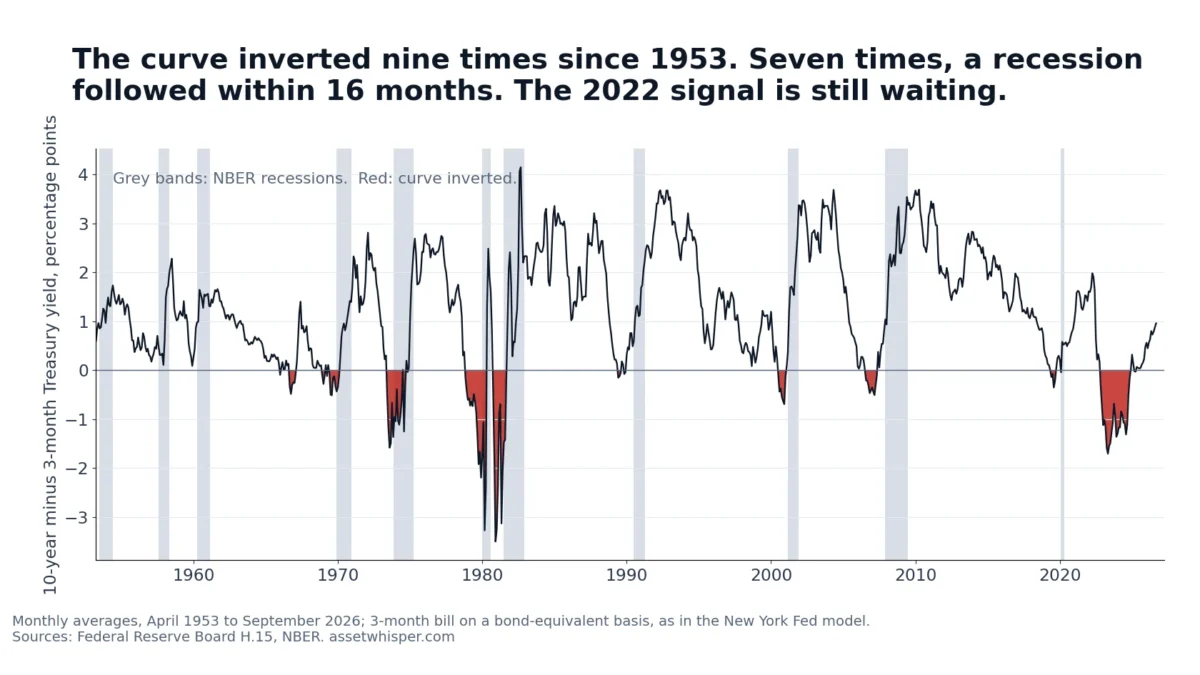
Yield curve dynamics. The shape of the Treasury curve aggregates the views of every bond investor on the planet. Watch for the 2s10s spread — meaningful steepening typically precedes cutting cycles by months. The curve has been gently positively sloped through April; what happens to it in May tells you what the market thinks about the new chair.

These are the same signals AssetWhisper's research stack monitors continuously, integrated with our emerging technologies in financial trading framework and feeding the weekly market reports that translate macro into specific positioning.

Common Mistakes Investors Make in Rate Cycles

Three patterns repeat in every rate cycle, and they are all expensive.

Chasing yield without understanding credit risk. When rates are high, investors hunt for "extra yield" by buying lower-quality bonds, emerging market debt, or complex products they don't fully understand. This works until it doesn't, and the unwind is fast. We covered this category of error in detail in Common Mistakes in Stock Market Investing — the rate version is the same trap dressed differently.

Trying to time the bottom in long bonds. Every rate cycle produces a wave of investors trying to call the peak in yields and pile into long-duration Treasuries. Sometimes it works. More often, the peak takes longer than expected, the entry was premature, and the duration drawdown is painful. The barbell approach above is designed precisely to avoid this trap.

Letting fear drive panic-selling during volatility. Rate-driven volatility produces sharp drawdowns in bonds and stocks alike. Investors who react emotionally — selling at lows, buying back too late — destroy their long-term returns. The discipline of Behavioral Finance: How Emotions Affect Investment Decisions is the antidote.

How AssetWhisper Tracks the Rate Environment

Every framework in this article is built into AssetWhisper's research process. Our weekly market reports synthesize Fed communications, yield curve dynamics, credit spreads, and the asset-class implications into specific portfolio recommendations — exactly what investors need when the central bank is openly divided and the rate path is genuinely uncertain.

The same explainable-AI philosophy we apply in our AI trading agent stack and our main investment platform is what makes this work: more data, better organized, with the reasoning made visible so you can adjust to your specific situation.

In a rate environment this contested, the cost of ignoring the macro is higher than usual, and the value of a research process that does not get distracted by headlines is higher still.

Frequently Asked Questions

What is the current Federal Reserve interest rate?

As of May 2026, the federal funds target range is 3.50%–3.75%, held at the April 29 FOMC meeting after three consecutive pauses. The 10-year Treasury yield is around 4.39%.

Why are interest rates so important to investors?

Interest rates determine the return on the safest asset (cash and Treasuries), which is the benchmark every other investment is judged against. They also affect borrowing costs for companies, mortgage rates for real estate, and currency values for commodities. Almost every asset price reflects some combination of these channels.

What investments do well when interest rates rise?

Generally: short-duration bonds, floating-rate instruments, financials (especially banks), value stocks with strong cash flow today, and TIPS. Sectors with high debt loads or growth that depends on cheap capital tend to underperform.

What investments do well when interest rates fall?

Generally: long-duration Treasuries (price appreciation), growth stocks (lower discount rate), real estate and REITs (lower borrowing costs and cap rates), and gold (lower opportunity cost).

Should I buy bonds at current yields?

Short-duration Treasuries above 4% are attractive for cash-equivalent holdings with minimal rate risk. Intermediate Treasuries (5–10 year) at around 4.39% offer reasonable yield plus some upside if the Fed cuts. Long-duration bonds (20–30 year) carry asymmetric risk in the current environment and should be sized carefully.

How does the divided Fed affect my portfolio?

The 8-4 dissent vote at the April 29 FOMC meeting — the largest since 1992 — means the rate path is genuinely uncertain. That increases volatility in rate-sensitive assets and raises the value of diversification, quality tilts, and a clear written rebalancing plan. It also makes the Fed Chair transition (Powell to Warsh on May 15) a meaningful market variable on its own.

Are TIPS a good investment in 2026?

TIPS are particularly relevant when inflation surprises higher than expected. With the Iran war driving energy prices and the Fed openly divided about whether inflation will stay sticky, a moderate TIPS allocation (5–10% of fixed income) is a reasonable hedge against the scenario where cuts are delayed or reversed.

How do interest rates affect cryptocurrency?

In 2026, crypto trades increasingly like a risk asset and responds to rates the way the Nasdaq does. Additionally, yield-bearing stablecoin wrappers (USDY, sUSDS) effectively pass through Treasury yields to holders, making crypto cash-management strategies more rate-sensitive than they used to be. See our deep dive on the GENIUS Act and Stablecoin Regulation for the full framework.

Conclusion

Interest rates are the gravity of finance. They pull on every asset, shape every valuation, and determine the trade-off between safety and growth that sits at the heart of every portfolio decision. In May 2026, that gravity is being argued about openly inside the Federal Reserve for the first time in decades, which means the cost of ignoring it has rarely been higher.

The framework that works across rate cycles is durable: understand which assets are most rate-sensitive and why, diversify across drivers and not just across labels, manage duration deliberately rather than by accident, and let the Fed's communications inform your portfolio without dictating it. Combine that discipline with a clear written plan and you will navigate the next cycle — whatever it brings — far better than investors who treat rates as background noise.

The work of monitoring all of this in real time is exactly what AssetWhisper is built to do. The signal in any rate environment is the same: own quality, manage duration, hedge what you cannot predict, and let compounding do the work.


Want continuous, AI-powered analysis of the rate environment and what it means for your specific portfolio? Discover how AssetWhisper transforms your investment process and put institutional-grade research to work today.

The world of investing can be thrilling, offering the potential for significant gains. However, it's equally important to acknowledge and manage the inherent risks involved. Understanding how to navigate these risks is crucial for long-term financial success. Here's a guide to help you manage risk in your investment portfolio.

1. Diversification: Don't Put All Your Eggs in One Basket

One of the most fundamental risk management strategies is diversification. This involves spreading your investments across different asset classes (stocks, bonds, real estate, ETFs, etc.) and sectors. By diversifying, you reduce the impact of any single investment's poor performance on your overall portfolio.

If you want to take diversification a step further, explore effective strategies for investment hedging to protect your capital when markets turn against you.

2. Asset Allocation: Find Your Balance

Asset allocation is the process of dividing your investments among different asset classes based on your risk tolerance and financial goals. A well-balanced portfolio might include a mix of growth-oriented assets like stocks and stable income producers such as bonds, dividend-paying equities, REITs for real estate exposure, or sustainable and green-sector ETFs.

New to this? Start with our guide on how to invest in the financial market the right way to set up your first allocation correctly.

3. Risk Tolerance: Know Your Comfort Zone

Your risk tolerance is your ability and willingness to withstand fluctuations in the value of your investments. It's essential to invest in a way that aligns with your comfort level. If you're risk-averse, a more conservative portfolio might be suitable.

Building the right psychological foundation matters as much as the numbers — our article on how to develop a successful investor mindset walks you through it. To measure risk-adjusted return objectively, the Sharpe Ratio is one of the most useful tools you can add to your toolkit.

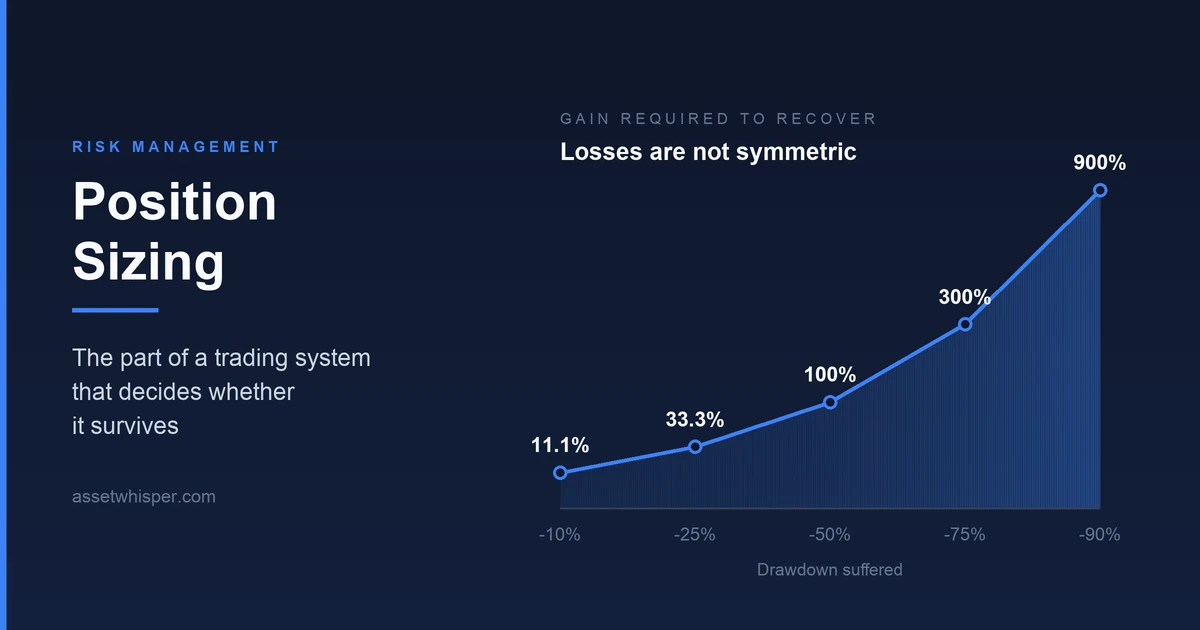
4. Regular Portfolio Review: Stay on Track

Markets and your financial goals can change over time. It's crucial to review your portfolio regularly to ensure it still aligns with your objectives and risk tolerance. Rebalancing may be necessary to maintain your desired asset allocation.

If manual reviews feel overwhelming, see how AssetWhisper can transform your investment portfolio with AI-driven monitoring and rebalancing signals.

5. Stop-Loss Orders: Limit Your Losses

A stop-loss order is an instruction to sell a security when it reaches a predetermined price, designed to cap your loss on a position. While stop-losses can't guarantee you won't lose money (especially during gap-downs), they are one of the simplest ways to enforce discipline.

Skipping or misusing stop-losses is one of the most common mistakes in stock market investing — worth reading before you place your next trade.

6. Research and Due Diligence: Informed Decisions

Before investing in any asset, thorough research is essential. Understand the company, industry, and potential risks involved. A solid analytical framework combines both technical and fundamental analysis — each tells you something the other misses.

The real edge comes from knowing how to identify undervalued assets and maximize your gains, which is where fundamental research pays off most.

7. Stay Informed: Keep Your Finger on the Pulse

Financial markets are dynamic. Stay informed about economic trends, geopolitical events, central bank decisions, and company news that could impact your investments. For example, understanding the impact of interest rates on investment choices can reshape the way you position your portfolio in any given cycle.

It also pays to watch the structural shifts — read our overview of emerging technologies in financial trading to anticipate where the next waves of opportunity and risk are forming.

8. Long-Term Perspective: Ride Out the Waves

Investing is often a long-term game. While short-term fluctuations are inevitable, maintaining a long-term perspective helps you weather market volatility instead of reacting to every headline.

Long-term investors often favor compounding cash flows — the advantages of dividend investing speak directly to this approach. And when volatility spikes, having exposure to crisis-proof, resilient sectors can make the difference between staying invested and panic-selling at the worst moment.

9. Emotional Discipline: Avoid Panic Selling

Emotional decisions — such as panic selling during downturns or chasing hot stocks at market tops — can be devastating to your portfolio. Stick to your investment plan and avoid impulsive moves driven by fear or FOMO.

This is exactly what behavioral finance teaches us about how emotions affect investment decisions: the biggest risk in your portfolio is often the person managing it.

10. Professional Guidance: Seek Expert Advice

If you're unsure about managing your investments or need personalized support, consider consulting a financial advisor. Modern investors also have a middle-ground option: robo-advisors, which are becoming highly recommended for their low cost, automated rebalancing, and data-driven allocation.

Final Thoughts

Keep three principles in mind:

By understanding and implementing these risk management strategies — diversification, disciplined allocation, honest self-assessment, and emotional control — you significantly increase your chances of reaching your financial goals while minimizing avoidable losses.

Ready to put this into practice? Explore how AssetWhisper can transform your investment portfolio and turn risk management from a worry into a system.