2026 US Midterm Elections and Markets: What History Says — and What Could Happen With Trump
Key takeaway
Midterm years usually drag before the vote and rally after it; since 1950 the S&P 500 has risen in the twelve months after all 19 midterms. 2026 has already broken the first half, up 12.5% to September 24, so the question is whether the second half holds with the Fed tightening and oil above $100.
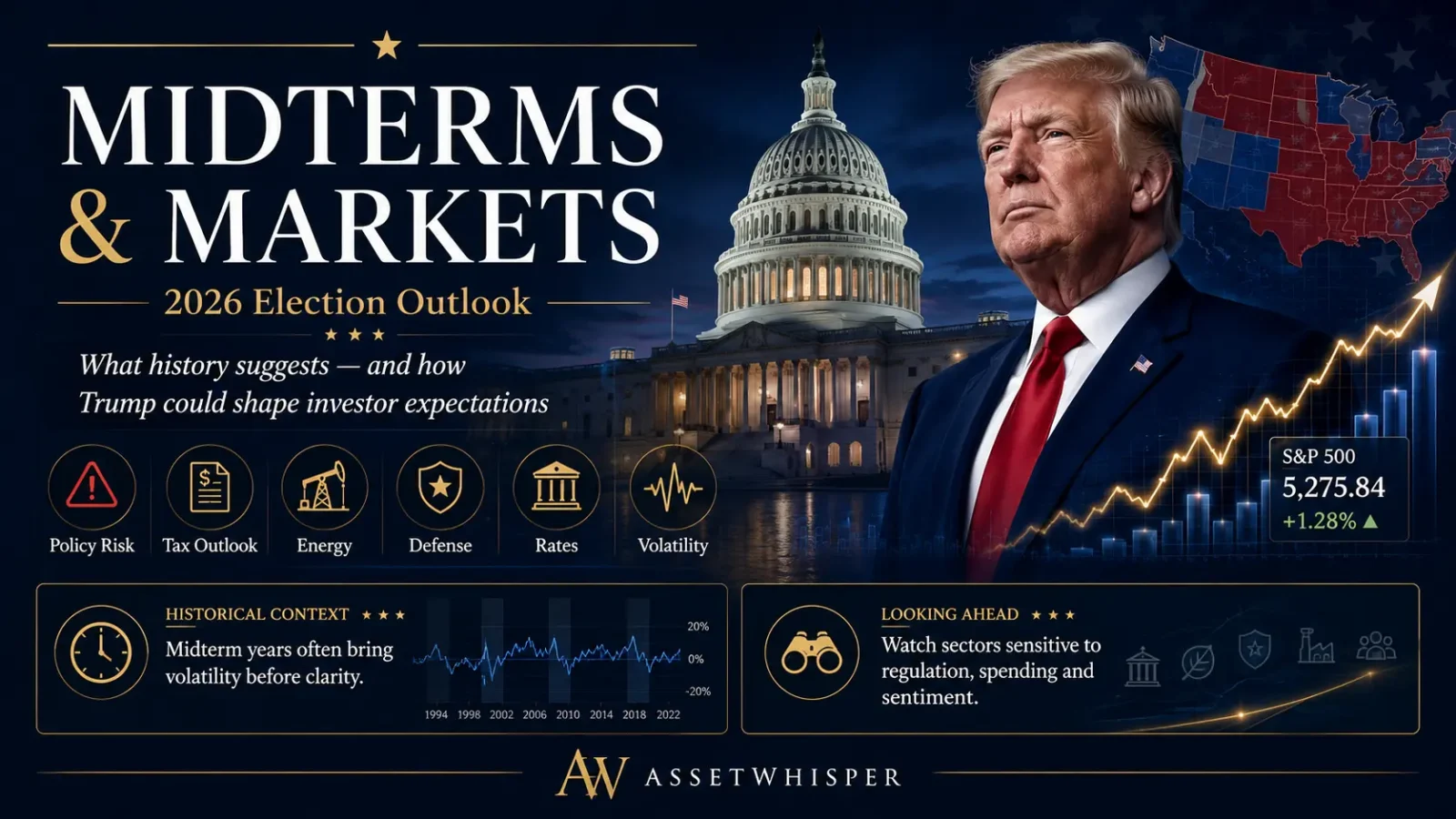
On November 3, 2026, American voters will head to the polls for one of the most consequential midterm elections in recent memory. All 435 seats in the House of Representatives, 35 seats in the Senate (33 regular and two special elections) and 36 state governorships are on the ballot, and the outcome will reshape what is politically possible for the remaining two years of the Trump administration. For investors, the stakes go beyond which party controls Capitol Hill. The result will influence the trajectory of tariffs, taxes, regulation, deficit spending, and the policy framework underpinning everything from technology to energy to defense.
The temptation, in any election cycle, is to treat the vote itself as the variable that determines portfolio outcomes. History tells a more useful story, and it has two halves that are routinely lumped together. The weak half is the “muted year before the vote”: U.S. Bank’s analysis of 31 midterm elections from 1900 to 2025 finds the S&P 500 averaged 2.9% in the twelve months before midterms against 8.9% for all years, but its own t-test could not show that the difference is a recurring pattern. The strong half is the year after: the same study finds an average of 12.4%, and in our own calculation on S&P 500 price data since 1950, the index rose in the twelve months after every one of the 19 midterm elections. 2026 is a live test of the distinction. To September 24 the S&P 500 is up 12.5% on the year, better than 16 of those 19 midterm years at the same date. The weak half has not shown up. Whether the strong half does is the question for the next twelve months.
This article unpacks what the historical pattern actually shows, where the race stands in late September, what is genuinely different about the 2026 cycle, the three plausible scenarios for what happens with Trump and Congress, the sector-level implications of each, and how disciplined investors can position a portfolio without letting partisan emotion drive financial decisions.
| S&P 500 price return | Midterm years, 1950–2022 (19) | Benchmark | 2026 |
|---|---|---|---|
| January 1 to September 24 | Mean −1.1%, median +3.0%; positive in 11 of 19 | Other years 1950–2025: mean +7.8%, median +9.2% | +12.5% |
| 12 months before election day | Mean +3.8%, median +6.3%; positive in 12 of 19 | All 12-month windows 1950–2025: mean +9.4%, median +10.8% | +12.4% from November 3, 2025 to September 24, 2026 |
| September 24 to December 31 | Mean +5.8%, median +7.4%; positive in 16 of 19 | Other years: mean +3.2%, median +3.4% | Pending |
| 12 months after election day | Mean +15.1%, median +14.5%; positive in 19 of 19 (lowest +1.1%, 1986) | All 12-month windows: mean +9.4%, positive 74.6% of the time | Pending |
The practical consequence: the pre-election slump is the part of the pattern that 2026 has already broken, and it was always the statistically weaker part. The post-election record is stronger, but it rests on 19 observations, and a strong run into the vote leaves less room for the relief rally that usually follows uncertainty resolving.
The Calendar and What Is Actually at Stake
Midterm elections take place at the midpoint of every US presidential term. On the ballot in 2026: all 435 voting members of the House, 35 Senate seats, 36 state governorships (39 counting three territories), and an enormous number of state legislative and local races that, while less covered, shape regulatory and fiscal policy at the state level. For markets, three specific stakes deserve particular attention.
The legislative ceiling on the Trump agenda. The administration entered 2026 with control of both chambers of Congress, which has allowed it to pursue tariff policy, tax legislation, immigration enforcement, energy expansion, and regulatory rollback at pace. A midterm result that maintains Republican control would extend that runway. A result that hands either chamber — particularly the House — to Democrats would sharply constrain what can be passed legislatively for the remaining two years of the term, leaving the administration more reliant on executive authority and trade-policy tools.
The fiscal trajectory. The composition of Congress shapes the next budget cycle, the trajectory of the federal deficit, the renewal of expiring tax provisions, and the response to any future economic shock. With deficits already near historic highs as a share of GDP and interest costs on federal debt at multi-decade highs, the fiscal stance the next Congress adopts will feed directly into bond markets, the dollar, and equity valuations. Understanding how that backdrop interacts with rates is exactly the framework explored in our analysis of the impact of interest rates on investment choices.
Investigative and oversight power. The party that controls a chamber controls its committees, its subpoena power, and the political environment around the administration. The 2026 outcome will influence the likelihood and intensity of investigations, oversight hearings, and other political actions that can affect perceived risk premia in US assets. This is a real consideration for markets, separate from any specific legislative agenda.
These three dimensions — legislative, fiscal, and oversight — interact in ways that make midterm elections one of the genuine political variables that markets do try to price. The harder question, addressed below, is how much that pricing actually matters for long-term investors.
Where the Race Stands in September 2026
The current majorities. According to the Clerk of the House, Republicans hold 218 seats, Democrats 214, with one independent and two vacancies. A majority of the full House is 218. In the Senate, Republicans hold 53 seats to 47 for Democrats and the two independents who caucus with them. Of the 35 Senate seats on the ballot, 22 are held by Republicans (including both special elections, in Ohio and Florida) and 13 by Democrats; Democrats need a net gain of four seats for a majority, because the Vice President breaks 50–50 ties. Several states have also redrawn their House maps mid-decade, so the 2024 results are a rougher guide to 2026 than usual.
The generic ballot. The generic congressional ballot asks voters which party they want to control Congress, without naming candidates. The three most-cited aggregates agree on direction and roughly on size:
| Aggregate | Democrats | Republicans | Margin | As of |
|---|---|---|---|---|
| RealClearPolitics average | 50.6% | 41.9% | D +8.7 | Polls fielded September 8–22, 2026 |
| Silver Bulletin average | — | — | D +8.1 (D +8.8 with its likely-voter adjustment); D +6.7 on September 1 | Latest update, page accessed September 25, 2026 |
| Decision Desk HQ average | 49.1% | 41.1% | D +8.0 | September 24, 2026 |
FiveThirtyEight, the other aggregator investors used to follow, no longer publishes: ABC News closed it in March 2025. Two cautions apply to all of these numbers. A national margin does not convert mechanically into seats, because it depends on where the votes are and on the district maps. And polling averages have missed in both directions in past midterms.
Presidential approval. The RealClearPolitics average of President Trump’s job approval stands at 38.8% approve and 59.7% disapprove across polls fielded September 8–23, 2026. Approval is one of several inputs that historically correlate with the size of midterm losses, alongside inflation, employment, and the political environment.
None of this is a forecast. Six weeks is long enough for a campaign to move, and the markets section below does not depend on who wins.
The Historical Pattern: Muted Before, Strong After
Before turning to 2026 specifically, it is worth understanding the broad statistical pattern that governs midterm years, because it provides the baseline against which the current cycle should be judged.
The “Drag” Before the Vote
Multiple studies have documented that S&P 500 returns in the months leading up to midterm elections tend to be weaker than the long-run average. U.S. Bank Asset Management Group Research, reviewing 31 midterm elections from 1900 through 2025, found that the index averaged 2.9% in the twelve months before midterms versus 8.9% for all years in the study. Our own calculation on S&P 500 price data since 1950 points the same way: a mean of 3.8% in the twelve months before election day, against 9.4% for all twelve-month windows. Calendar-year returns show the same shape: from January 1 to September 24, midterm years since 1950 averaged −1.1% against +7.8% in other years.
The intuitive explanation is uncertainty. Markets price expectations about the future, and the closer an election gets without clarity on its outcome, the wider the range of policy scenarios that investors must mentally hedge against. In 2026, though, the options market is not pricing much of it yet. The VIX closed at 15.67 on September 24, below its 2026 median close of 17.36 and far below its 2026 high close of 31.05 on March 27, set during the first-quarter sell-off.
It is worth being intellectually honest about the strength of this pattern. U.S. Bank’s own t-test did not show that midterm elections consistently changed returns, and it notes that several weak pre-election years were driven by non-political shocks such as the 1974 stagflation, the 2002 tech crash, and the 2022 inflation cycle. Our figures agree: the difference between the pre-election year and all twelve-month windows gives a t-statistic of about −1.4, which is not significant, and the individual outcomes range from −28.8% (1974) to +28.9% (1954). The pattern should be held loosely rather than treated as destiny — and 2026, up 12.4% in the pre-election window so far, is a reminder of why.
The Rally After the Vote
The post-midterm pattern is the more robust of the two, and the one investors should focus on. U.S. Bank’s analysis shows the S&P 500 averaged 12.4% in the twelve months after midterm elections. On data since 1950, we find a mean of 15.1% and a median of 14.5%, with a gain in all 19 cycles; the weakest was +1.1% after the 1986 election and the strongest +33.2% after 1954. Measured against all twelve-month windows, the difference gives a t-statistic of about 2.8 — though the benchmark windows overlap, which overstates significance, and 19 observations are a small sample.
Academic work supports the direction. Kam Fong Chan and Terry Marsh, in the Journal of Financial Economics (2021), find that equity premiums, mutual fund flows and real investment growth are significantly higher in the months following midterm elections, and that midterms matter more for asset prices than presidential elections — consistent with lower discount rates once political uncertainty falls. A simple way to see the concentration: from 1950 to 2025, the twelve months after each midterm made up 25.1% of trading days but delivered 43.6% of the S&P 500’s cumulative log price gain.
Why the rebound? Three reasons are usually cited. First, uncertainty resolves — investors no longer need to price competing policy scenarios, and risk premia compress. Second, administrations often shift toward pro-growth messaging and legislative initiatives in the third year of a term, partly to bolster legacies and partly to position for the next presidential cycle. Third, the calendar simply moves further from the next presidential election, temporarily reducing political-economy noise.
Volatility Around the Event
Layered on top of the average return pattern is a volatility pattern. Implied volatility has tended to rise into Election Day and fade as results are digested, and the fourth quarter of midterm years has often been strong: from September 24 to year-end, midterm years since 1950 rose in 16 of 19 cases, with a mean of 5.8%. The exceptions matter — 2018 fell 14.1% over the same stretch. The same logic underlies professional hedging strategies that buy protection ahead of known event risks and let it roll off once the event passes.
A Critical Honest Caveat
Before going further, it is worth pausing on something every serious analysis of this topic ends up acknowledging: elections, by themselves, are not the dominant driver of long-term US equity returns. Corporate earnings, Federal Reserve policy, productivity growth, recessions, and innovation cycles have all historically mattered more than which party held Congress.
Capital Group’s May 2026 review of more than 90 years of S&P 500 data reaches the same conclusion from the other side: control of Congress has had little impact on investment returns, which makes it hard to argue that any particular configuration is “best” for stocks. U.S. Bank’s statistical tests point the same way for the midterm calendar itself.
The implication is important. The midterm cycle is a useful pattern to be aware of, but it is not a substitute for the fundamentals-driven framework that actually compounds wealth over decades. Investors who let election anticipation drive large portfolio decisions tend to underperform investors who stay invested through the cycle.
What Is Genuinely Different in 2026
Every cycle insists it is unique, and every cycle is partly right. Several features of the 2026 backdrop deserve specific attention.
An unusually crowded macro overlay. The 2026 midterm cycle is not unfolding in a stable economic environment. The war with Iran and the disruption to shipping through the Strait of Hormuz have kept energy prices high: Brent crude futures closed at $106.60 on September 24, against $72.48 at the end of February and a 2026 high close of $118.35 on March 31. Inflation pressure has pushed the Federal Reserve, now chaired by Kevin Warsh, to raise its policy rate by a quarter point to 3.75%–4.00% on September 16, 2026, in a unanimous vote — a tightening move seven weeks before a midterm. The S&P 500 fell 9.1% from its January 27 close to its March 30 low, then recovered to a record close of 7,798.99 on August 13. Gold futures closed at $4,298 on September 24, below their 2026 high close of $5,318 in late January. For what this regime means for a stock-bond core, see our analysis of portfolio construction in 2026.
Approval ratings well below the level associated with holding seats. With job approval averaging below 40% in late September, the president enters the final weeks of the campaign in a weaker position than incumbents whose parties limited their midterm losses. Approval is one input, not a verdict; the economy, turnout and candidate quality all matter.
Historic House retirements. As of September 3, 2026, Ballotpedia counts 60 House members not seeking re-election — 23 Democrats and 37 Republicans — against 52 at the same point of the 2018 cycle, 49 in 2022 and 45 in 2024. Seventeen of the Republicans and 15 of the Democrats are retiring from public office outright; most of the rest are running for the Senate, a governorship or another office. Open seats are generally harder for a party to defend than seats with incumbents.
A live tariff and trade-policy debate. The one-year US–China trade truce agreed in October 2025 was due to expire on November 10, 2026 — a week after the vote. On September 24, as President Xi Jinping began a state visit to Washington, Treasury Secretary Scott Bessent said the two sides had agreed to extend it by two months, to January 10, 2027. Tariffs, supply chains, and the broader trade architecture have become central campaign issues, which means election outcomes carry direct implications for the sectors most exposed to trade.
An AI-driven equity market near all-time highs. The S&P 500 closed 1.2% below its record on September 24, with concentration in a handful of AI-related mega-caps. Entering the vote near records is a different starting condition from entering at the bottom of a cycle. Investors should size political risk against valuation risk, not in isolation.
The Historical Headwind: Why Trump’s Party Faces Tough Odds
History is striking in its consistency on one point: the sitting president’s party almost always loses ground in midterm elections. Using the American Presidency Project’s seat data for the 23 midterms from 1934 to 2022, the president’s party lost an average of 27 House seats and 3.4 Senate seats. It gained House seats only three times — 1934, 1998 and 2002. The Senate is less one-sided: the president’s party gained Senate seats in seven of those 23 midterms, including 2018 and 2022.
Several forces drive this. New administrations enact policy that energizes the opposition more than it satisfies the incumbent party’s base. Turnout drops in midterms, and the most motivated voters — often those frustrated with the current administration — punch above their weight. Approval ratings tend to decline from the post-inauguration honeymoon period. And the out-of-power party has a natural messaging advantage: it is easier to campaign against governance choices than to defend them.
The implication for 2026 is straightforward without being partisan. The Republican Party faces the same baseline headwind that every incumbent party faces in midterms, and the September polling averages, approval numbers and retirement count are consistent with that baseline rather than an exception to it. None of this is a forecast — polling averages have been wrong before, and the Senate map, where most contested seats are Republican-held but many are in states the president carried, is a different contest from the House — but the base rate matters when sizing political-risk exposure in a portfolio.
It is equally important to note what this pattern does not predict. The size of expected House losses says nothing about whether the administration’s economic agenda will succeed, whether markets will rally or fall, or whether the next two years will be productive or paralyzed. Those questions depend on countless variables beyond Election Day.
Three Scenarios for November and What Each Means for Markets
Disciplined portfolio construction does not bet on a single political outcome. It maps the plausible scenarios, considers how each would affect different parts of the portfolio, and ensures the overall mix performs acceptably across the range. With that framing, three broad scenarios deserve attention.
Scenario One: Republicans Hold Both Chambers
Less likely on the historical base rate and on current polling averages, but not impossible — midterms have produced surprises before, and a generic-ballot lead does not translate one-for-one into House seats. In this scenario, the administration retains the ability to pass legislation, extend or renew tax provisions, and pursue its tariff and energy agenda without major procedural obstacles.
Market implications: Continuation of the current policy trajectory — sustained pressure on China and supply-chain-sensitive sectors, ongoing energy expansion, a deregulation-friendly environment for financials and traditional energy producers. Continued risk that tariff escalation feeds inflation, complicating Fed policy at a time when the Fed has just raised rates. Lower political-risk premium in US assets, at least in the short term, because policy uncertainty is reduced.
Sectoral effects: Likely net positive for traditional energy, defense, financials, and companies aligned with the administration’s regulatory agenda. Continued pressure on import-dependent sectors and on consumer-facing companies exposed to tariff-driven inflation.
Scenario Two: Divided Government (One Chamber Flips)
The historical base-case scenario. The House is the more likely flip given the typically larger swings in House composition and the narrow current majority; the Senate requires a net gain of four seats. Under divided government, major legislation requires bipartisan compromise, executive action becomes more prominent, and oversight intensifies.
Market implications: Markets have historically welcomed political gridlock with Democratic presidents and a Republican Congress, though the pattern is more mixed with a Republican president and a Democratic chamber. The reduction in legislative throughput tends to be priced as moderately positive for sectors that fear new regulation or tax increases, but as moderately negative for sectors that depend on new spending or policy support. The dollar and Treasuries often gain on the perception that fiscal trajectories will moderate.
Sectoral effects: Reduced odds of major new corporate tax legislation in either direction. Tariff policy continues to flow through executive authority, so trade-sensitive sectors remain exposed regardless. Healthcare, education, and energy policy debates become more politically charged and volatile.
Scenario Three: Democrats Win Both Chambers
Less common historically because it requires flipping both chambers in the same cycle, and the Senate map makes it the harder half. In this scenario, the administration faces an opposition-controlled Congress for its final two years.
Market implications: A higher political risk premium in US assets, at least initially. Expanded probability of investigations, oversight hearings, and other actions that affect risk perception. Legislative agenda largely frozen, with executive action and trade policy becoming the primary tools available to the administration. Volatility typically elevated during the adjustment period as markets recalibrate.
Sectoral effects: Increased policy uncertainty for energy, financials, and defense. Potentially less near-term tariff escalation if congressional pushback intensifies, which would be supportive for consumer-facing and import-dependent sectors. Healthcare and technology could face higher regulatory scrutiny depending on the specific congressional agenda.
The central point of mapping these scenarios is not to forecast which will occur, but to recognize that a well-constructed portfolio should be able to absorb any of them. Concentration in sectors that depend on a single scenario being correct is the kind of risk that serious risk management frameworks are designed to prevent.
What About Trump Specifically? Three Things Investors Should Know
The question of “what could happen with Trump” deserves a direct, analytical answer, separated cleanly from partisan framing. Three points matter for portfolios.
First, midterm losses do not remove a sitting president. Whatever the November outcome, Donald Trump’s term runs to January 20, 2029. Midterms shape the legislative environment around the presidency; they do not end it. Investors should not confuse a difficult midterm cycle with a change of administration.
Second, congressional losses change the policy toolkit, not the policy intent. A president facing an opposition Congress shifts more activity into the tools that do not require legislation — executive orders, regulatory action, trade policy, and the use of agencies and appointments. This administration has shown comfort with that mode of governance, which means the policy direction would likely persist even with reduced legislative throughput. The exact mix shifts; the underlying agenda is more stable.
Third, oversight and investigation risk is real but historically priced. A House controlled by the opposition party would be expected to pursue an active oversight agenda, including subpoenas, hearings, and investigations. Markets have historically priced this kind of friction as a modest risk-premium increase rather than as a catastrophic event. The exception is when political conflict intersects with credit-relevant decisions — debt ceiling fights, government shutdowns, or impasses that affect Treasury auctions — where the market impact can be sharper. Investors should distinguish between political noise that affects sentiment and political action that affects financial plumbing; only the second category warrants meaningful portfolio adjustments.
Critically, none of the three points above tells an investor to lean their portfolio toward a specific outcome. They simply clarify what midterm results actually mean and do not mean. The discipline of separating real financial implications from political noise is one of the highest-value skills any investor can develop, and it is at the core of the long-term investor mindset that compounds wealth across decades.
How Disciplined Investors Should Actually Position
Given the historical patterns, the macro overlay, and the range of plausible outcomes, what should a prudent investor actually do over the next six months? The answer rests on five principles.
Stay Invested Through the Uncertainty
The single most expensive midterm-year mistake is selling stocks before the election with the intention of “buying back after.” In the 19 midterm cycles since 1950, the S&P 500 rose over the twelve months after the vote every time, and it rose from late September to year-end in 16 of 19. Investors who exit before the vote frequently miss the inflection point and chase a moving target on the way back in. The cost of sitting on the sidelines has typically exceeded the cost of riding through the volatility — though “typically” is not “always”, and 2018 is the recent counterexample for the final quarter.
Diversify Across the Outcome Distribution
A portfolio that performs well under one scenario and badly under the others is a portfolio that depends on correctly predicting the election. Genuine diversification means holding assets that respond differently to different political outcomes — defensive sectors alongside cyclicals, international exposure alongside domestic equities, fixed income alongside stocks, and selective allocations to assets like gold that have historically held up in periods of elevated political and geopolitical risk.
Use Hedges for the Tail Risks
For investors with concentrated equity exposure, the volatility that can arrive in the run-up to Election Day is exactly the environment for which protective strategies are designed. Protective puts, defined-outcome strategies, and modest allocations to assets with negative correlation to political risk can convert an unmanageable tail risk into a budgeted cost. The economics of hedging always look unappealing in calm markets and indispensable in crisis ones — which is why protection is cheaper to put in place while implied volatility is low, as it is in late September 2026, than after it has jumped.
Size Positions to Survive the Bad Scenario
Position sizing is the discipline that determines whether a wrong call is a setback or a catastrophe. If a portfolio is so concentrated in sectors that depend on a specific midterm outcome that an unfavorable result would impair long-term plans, the position is too large regardless of how confident the investor feels. Correct sizing leaves room for being wrong, which is the single most important property of a portfolio designed to compound across multiple cycles. Honestly assessing what type of investor you are — and what level of drawdown you can actually tolerate — is the indispensable first step in this calibration.
Anchor to Fundamentals, Not Politics
The most durable insight from a century of midterm-cycle analysis is also the most useful: corporate earnings, monetary policy, productivity, and economic cycles have historically mattered more for stock returns than which party controlled which chamber. In 2026 that means watching the Fed’s new tightening path, oil and the Strait of Hormuz, and earnings from the AI-heavy top of the index at least as closely as the polls.
Behavioral Traps Specific to Election Years
Election cycles are behavioral minefields, and 2026 will be no exception. Four traps deserve special attention.
Partisan portfolio bias. Academic research has documented that investors’ willingness to take risk fluctuates with whether their preferred party holds power. Investors of all political affiliations tend to perceive markets as riskier when the opposing party is in charge and safer when their own party holds power. Both perceptions are mostly wrong. Letting political preferences drive risk-taking is one of the most common mistakes in stock market investing, and it costs real money over full cycles.
Confirmation bias around outcomes. Investors tend to seek out commentary that confirms their preferred political outcome and dismiss commentary that contradicts it. The result is portfolios built on selective information. The antidote is actively seeking out the strongest argument for the political outcome you find least likely or least desirable, and engaging with it seriously.
Headline-driven trading. Election cycles produce a flood of polling data, debate moments, scandals, and rally appearances, each of which feels urgent in the moment. Most of these headlines move markets by small amounts that are quickly reversed. Investors who trade each twist accumulate transaction costs and behavioral errors without improving outcomes. A deeper understanding of what behavioral biases actually cost is the most reliable defense.
Cash-paralysis bias. Some investors react to election uncertainty by moving heavily to cash, intending to “wait until things settle down.” The problem is that things never fully settle down — there is always another election, conflict, or crisis ahead — and cash held for too long loses purchasing power to inflation. Sitting in cash through the typical post-midterm rally is one of the most expensive forms of risk management because it converts a temporary discomfort into a permanent return drag.
Final Thoughts: History as Guide, Discipline as Edge
The November 3, 2026 midterm elections will be one of the most-watched political events of the year, and the final six weeks will produce more headlines, polling data, and partisan commentary than any investor could reasonably process. Almost none of it will matter for long-term portfolio outcomes.
What will matter is the underlying historical pattern, and which half of it you trust. The pre-election drag is statistically weak, and 2026 has ignored it: the S&P 500 is up 12.5% on the year. The post-election rally is the sturdier half — positive in all 19 cycles since 1950 — but it rests on a small sample, and 2026 arrives at the vote with the index near a record, oil above $100 and a Fed that has just raised rates.
For the Republican Party, the historical headwinds facing every incumbent party are clear: the president’s party has lost House seats in 20 of the 23 midterms since 1934, by an average of 27 seats. The September 2026 polling averages, approval ratings and retirement numbers are consistent with that headwind. None of this is a forecast, and polls can move in six weeks. It is simply the baseline against which the actual outcome will be measured.
For investors, the disciplined response is to neither bet on a single political outcome nor retreat to cash in anticipation of volatility. It is to maintain genuine diversification, size positions to survive any of the three plausible scenarios, hedge the tail risks that are elevated around election events, and anchor every decision to the fundamentals that have historically driven equity returns over decades — corporate earnings, monetary policy, productivity, and innovation. Elections will come and go. The discipline that compounds wealth through all of them is the same.
Frequently asked questions
When are the 2026 US midterm elections?
Tuesday, November 3, 2026. All 435 House seats, 35 Senate seats (33 regular and two special elections, in Ohio and Florida), 36 state governorships and a large number of state and local races are on the ballot. The new Congress begins its session in January 2027.
What do the polls say about the 2026 midterms?
In late September 2026, the major averages of the generic congressional ballot show Democrats ahead by about eight points: D +8.7 in the RealClearPolitics average (polls fielded September 8–22), D +8.1 in Silver Bulletin’s latest average and D +8.0 in Decision Desk HQ’s as of September 24. President Trump’s job approval averages 38.8% in the RealClearPolitics average. A national lead does not convert directly into seats, and polls can move before November 3.
How do midterm elections typically affect the stock market?
Returns have tended to be muted before the vote and stronger after it. U.S. Bank’s study of 31 midterms from 1900 to 2025 finds an average of 2.9% in the twelve months before and 12.4% in the twelve months after. On S&P 500 price data since 1950, we find a mean of 3.8% before and 15.1% after, with gains in all 19 post-election years. The pre-election weakness is not statistically significant; the post-election strength is more consistent, but the sample is small.
Is the stock market following the midterm pattern in 2026?
Only half of it so far. The S&P 500 rose 12.5% from December 31, 2025 to September 24, 2026, better than 16 of the 19 midterm years since 1950 at the same date, so the usual pre-election drag has not appeared. The index did fall 9.1% between late January and late March before recovering to a record in August. Whether the post-election rally follows will depend on earnings, the Fed and energy prices as much as on the vote.
Could Trump be removed from office or impeached after the midterms?
Removal requires impeachment by the House and conviction by two-thirds of the senators present — 67 if all 100 vote. No president has ever been removed this way. If Democrats win the House, the probability of impeachment proceedings rises, but conviction would require substantial support from both parties in the Senate. Markets have historically treated impeachment proceedings as disruptive rather than catastrophic when removal is not realistically on the table. Investors should not let the possibility of investigations drive major portfolio reallocations.
Should I move to cash before the November 2026 midterms?
History argues against it. Since 1950 the S&P 500 has risen in the twelve months after every midterm election and from late September to year-end in 16 of 19 midterm years, so investors who move to cash before the vote have usually missed gains. The better tools are diversification, position sizing and, where concentration is high, hedging — not tactical cash positioning around a single date.
How does party control of Congress affect long-term stock returns?
Less than most investors believe. Capital Group’s May 2026 review of more than 90 years of S&P 500 data concludes that control of Congress has had little impact on investment returns. Corporate earnings, Federal Reserve policy, productivity growth, and innovation cycles have all historically mattered more than the partisan composition of Congress.
Sources
- S&P 500 (^GSPC) and Cboe VIX (^VIX) daily closes, Brent (BZ=F) and gold (GC=F) front-month futures, via Yahoo Finance, January 1949 to September 24, 2026. All S&P 500 figures are price returns (excluding dividends), computed by AssetWhisper; election-day anchors use the last close on or before election day. The calculation can be reproduced from the data cited.
- U.S. Bank Asset Management Group Research, How midterm elections affect the stock market, July 16, 2026 (31 midterm elections, 1900–2025).
- Chan, K. F. and Marsh, T. (2021). Asset prices, midterm elections, and political uncertainty. Journal of Financial Economics, 141(1), 276–296.
- The American Presidency Project, UC Santa Barbara, Seats in Congress gained/lost by the president’s party in mid-term elections, 1934–2022; averages computed by AssetWhisper.
- Capital Group, How U.S. midterm elections may affect markets, May 13, 2026 (key takeaways).
- RealClearPolitics, 2026 generic congressional vote and President Trump job approval, accessed September 25, 2026; Silver Bulletin, generic ballot average, accessed September 25, 2026; Decision Desk HQ, generic ballot polling average, September 24, 2026.
- Office of the Clerk, U.S. House of Representatives, party breakdown, accessed September 25, 2026; Ballotpedia, United States Senate elections, 2026 and House incumbents not running for re-election in 2026 (as of September 3, 2026).
- Federal Reserve, FOMC statement, September 16, 2026.
- CNBC, U.S.-China trade truce extended for two months, September 24, 2026.
AssetWhisper does not manage portfolios, run accounts or publish trade signals. What it publishes is the reasoning behind decisions like this one: how a core allocation behaves when the macro regime changes, how much to stake on any single view, and which level of risk you can actually hold through a bad year.
Related reading
- Bear markets: depth, duration and recovery — what the declines that elections get blamed for actually look like.
- Portfolio hedging strategies — what protection around a known event costs.
- Crisis-proof investments — the sectors that have held up in volatile periods, and why.
- The 10-year Treasury and real yields — the rate backdrop the next Congress inherits.
- Behavioral finance biases, measured — why the plan you keep beats the prediction you make.
- How to invest the right way — the fundamentals-first framework this article keeps returning to.
This article is general information, not personalised investment advice, and it takes no position on any party or candidate. It does not take into account the financial situation, objectives or risk tolerance of any individual reader. Polling figures are as published by the named aggregators on the dates shown and will change before the election. Historical returns are S&P 500 price returns computed from the data cited above; they describe past periods, rest on small samples, and do not predict future results. Capital is at risk.