Nvidia’s Jensen Huang Scandal: Key-Person Risk, the Board’s Probe and What Investors Can Check
Key takeaway
Jensen Huang, the alleged spy link and Nvidia's board probe: what is reported, what the stock did against chip peers and what investors can check.
Nvidia is the world’s second most valuable listed company (BBC) and the main supplier of AI chips, so a crisis around its founder is a portfolio question for millions of index-fund holders who never chose to buy the stock. In four days, Jensen Huang admitted an extramarital affair, his board opened an independent investigation, a shareholder sued, a senator called for his resignation, three House committee chairs asked him for a closed-door briefing, and, on the evening of 11 November, The Wall Street Journal reported that the board is preparing to remove him.
This article sets out what has been reported, who is investigating what, what the stock has done, and what an investor can check next. The allegations are not proven. Nothing here is a buy or sell signal or a price forecast.
Status: written at 7 p.m. New York time on 11 November 2026. At that point Nvidia had not announced any decision about its chief executive.
What happened, in order
| Date (2026) | Event | Source |
|---|---|---|
| 29 Oct | The New York Times reports that US officials believe Alice Huang, a businesswoman linked to Singapore-based Megaspeed, an Nvidia customer, had a close relationship with Jensen Huang. Nvidia called his contacts with her “not unusual or unexpected”. | TechCrunch |
| 4–5 Nov | The chairs of the House China, Foreign Affairs and Intelligence committees ask Huang for a closed-door briefing on 18 November, with a reply due by 11 November. | House Select Committee on China |
| 8 Nov | Huang tells employees “I was unfaithful to my wife”. The board opens an independent investigation and says it has “no reason to believe” national security or Nvidia secrets were compromised. | Nvidia, Nvidia board |
| 9 Nov | President Trump says the FBI is looking into the matter and that Huang told him he did not know she was a spy. China’s foreign ministry calls the spy allegation groundless. A securities class action is filed. Huang withdraws from the ElevenLabs Summit and the Anthropic CEO Forum. | BBC, complaint, TechCrunch |
| 10 Nov | The independent directors hire Joon H. Kim, a former acting US Attorney for the Southern District of New York, and Wachtell, Lipton, Rosen & Katz. Senator Kevin Cramer and Larry Kudlow, a Fox Business host and former National Economic Council director, call for Huang to step down. | Nvidia board, Politico via Business Insider |
| 11 Nov | The New York Times reports a second relationship, with a company executive who reported to Huang, citing five people who worked at Nvidia; Nvidia, Huang and the executive have not confirmed it. The Wall Street Journal reports the board is preparing to oust him and could meet as soon as that day. | Reuters |
The central allegation comes from US intelligence assessments described by The New York Times: that Alice Huang, also known as Huang Le, a former managing director of Megaspeed with no family relation to Jensen Huang, was working for China’s Ministry of State Security. No charges against her have been reported. She has not commented publicly, and Megaspeed has said there is no evidence of illicit chip transfers or other illegal activity (AP via NBC). Reuters said it could not determine her whereabouts to seek comment (Reuters via GMA). China called the allegation “groundless speculation, and a smear against China” (Al Jazeera). On 31 October, Singapore’s Ministry of Home Affairs said its government had not investigated her over alleged intelligence ties, while police said their investigation into Megaspeed is ongoing.
What the stock did
Daily closes for NVDA, with our calculations from Yahoo Finance data:
| Session | Close | Change | Context |
|---|---|---|---|
| Thu 5 Nov | $181.60 | −9.26% | Market-wide AI sell-off after the midterm elections; the Nasdaq fell 5.5% |
| Fri 6 Nov | $186.64 | +2.78% | Last close before Huang’s memo |
| Mon 9 Nov | $178.67 | −4.27% | First session after the memo and the board’s statement |
| Tue 10 Nov | $168.89 | −5.47% | Lowest close since 30 March 2026 |
| Wed 11 Nov | $173.73 | +2.87% | Rebound during the session; about 8% lower after hours following the Journal report |
The two-day fall to 10 November was 9.5%. With the 24.1 billion shares Nvidia reported in its latest 10-Q, that is roughly $430 billion of market value. After hours on 11 November, the stock traded at $159.95 around 5:35 p.m., according to Bloomberg. The closing high of 2026 was $239.24 on 6 October; the 11 November close was 27.4% below it.
A price fall does not tell you how much of it is the scandal. The 5 November drop hit the whole sector, and the stock had been falling since early October. The useful comparison is against chip stocks that faced the same market but not the same governance problem:
| Close of 6 Nov to close of 11 Nov | Change |
|---|---|
| Nvidia (NVDA) | −6.9% |
| VanEck Semiconductor ETF (SMH), which itself holds Nvidia | +9.3% |
| Invesco QQQ (Nasdaq-100) | +5.2% |
| Broadcom (AVGO) | +17.5% |
| AMD | +23.1% |
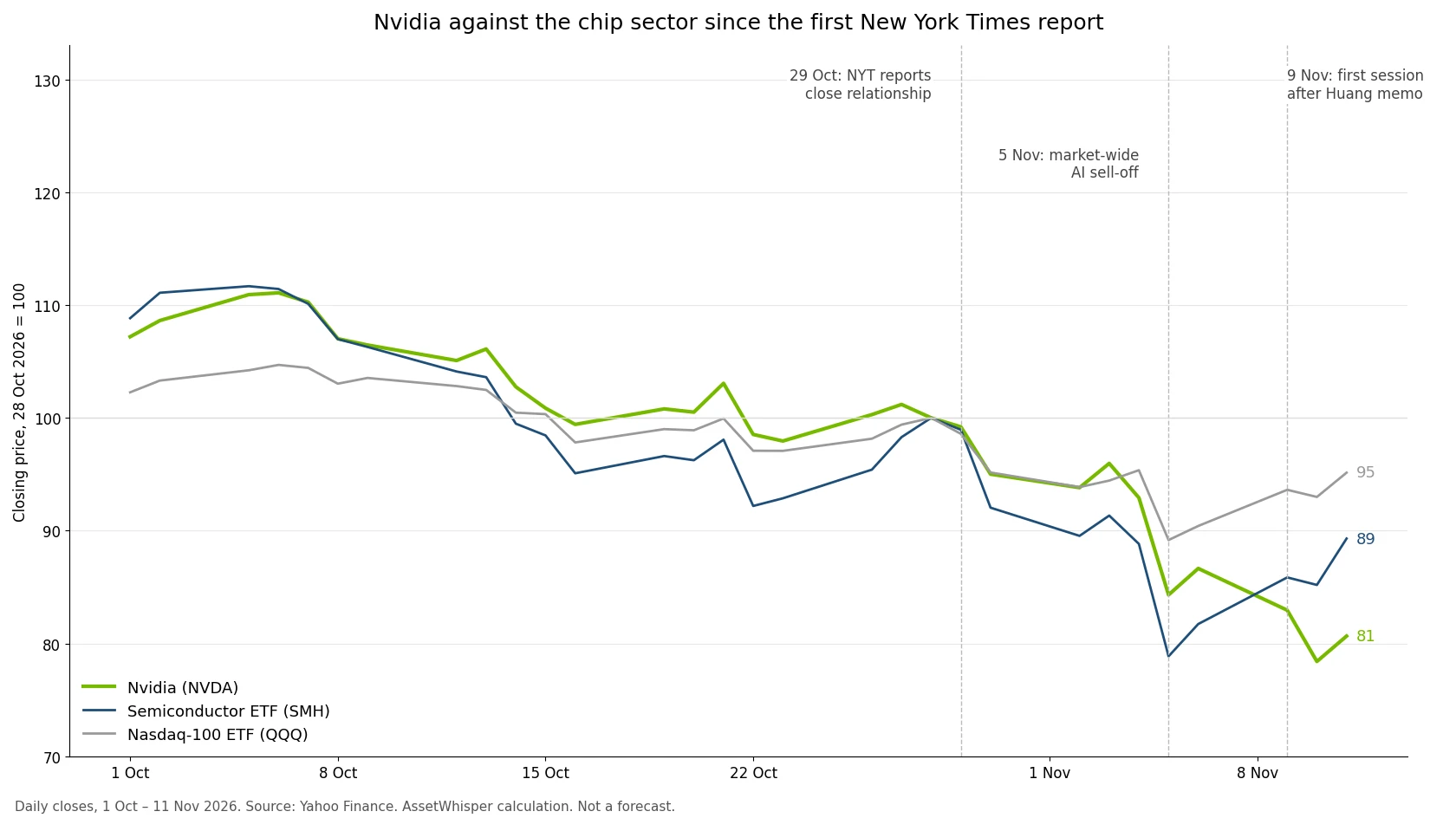
In three sessions Nvidia lagged the semiconductor ETF by about 16 percentage points. Part of that gap reflects the sector’s rebound from the 5 November sell-off, which had hit SMH harder than Nvidia (−11.2% against −9.3%), and chip stocks also rallied on 10 and 11 November after CoreWeave’s results. Measured from 4 November, the gap is about 14 points. It is consistent with a governance discount, but it does not measure one, and it can change in either direction with news.
Key-person risk: why the founder matters to the price
Key-person risk is the loss of value a company suffers when one individual leaves suddenly. It is highest when three things coincide, and at Nvidia all three are visible in public records:
- No named successor. Huang told Bloomberg in 2023: “Our company was built so that I know how to run it. So for as long as I’m running it, that’s all that matters” (CNN).
- A flat structure. He has said he has about 60 direct reports, and the company has no obvious successor (TechCrunch).
- The CEO as the company’s political channel. Huang, an ally of President Trump, has repeatedly pressed Washington to let Nvidia expand its business in China (TechCrunch).
Precedents exist for boards removing a chief executive over a relationship, but they are imperfect guides:
| Case | What happened | Stock on the day |
|---|---|---|
| Intel, 21 Jun 2018 | Brian Krzanich resigned after an investigation found a past consensual relationship with an employee; CFO Bob Swan became interim CEO | −2.4% (Reuters) |
| McDonald’s, 3 Nov 2019 | Steve Easterbrook was fired for a consensual relationship with an employee; Chris Kempczinski was named CEO the same day | −2.7% the next session (The Guardian) |
Both were hired managers, and both boards named a replacement the same day. Neither involved a founder who has run the company for 33 years, nor a national-security inquiry. Nvidia’s first session after the memo (−4.27%, while SMH rose 5.05%) was already larger than either one-day reaction, before any decision.
Governance: who is investigating what
| Who | What | Status at 11 Nov |
|---|---|---|
| Nvidia’s independent directors | Whether Huang was the target of a foreign intelligence effort | Led by Joon H. Kim and Wachtell Lipton; no end date and no commitment to publish findings |
| FBI | Described by President Trump as “looking into it” | The FBI declined to comment to the BBC |
| Justice Department | Criminal investigation into Alice Huang and Megaspeed | Reported by NBC News |
| Three House committees | Nvidia’s counter-espionage protocols and Huang’s contacts with Alice Huang | Chairmen said a subpoena is likely if he does not agree to a briefing (TechCrunch) |
| Shareholders | Kistenmacher v. Nvidia, a proposed securities class action in the Northern District of California, class period 9 Oct 2025 – 8 Nov 2026 | Not certified; lead-plaintiff motions due 8 January 2027 (Business Wire) |
One sequencing point deserves attention. On 8 November the board stated its “confidence in Jensen and his leadership team” in the same release that opened the investigation. Three days later, according to the Journal, it was preparing to remove him, although the board has published no findings. Jeffrey Sonnenfeld and Steven Tian of Yale argued in Fortune that the board’s deference to Huang, including declaring confidence before a single interview, could expose directors to oversight (Caremark) suits in Delaware’s Chancery Court. Whatever the board decides, the order of its statements is likely to feature in any litigation.
China and export rules: where the exposure actually is
Nvidia’s direct sales to China are now small. In the quarter to 26 July 2026, revenue from customers headquartered in China, including Hong Kong, was $7.88 billion of $96.22 billion, or 8.2% (10-Q; a customer’s headquarters is not the same as where chips end up). H200 shipments to China were less than 1% of data-center revenue, (10-Q), and the company put no China data-center compute revenue in its outlook (Q2 call).
The larger exposure is regulatory: rules on who may buy Nvidia chips outside China, and how the company must prove where they go. Reuters reported that the allegations are likely to help three bills:
- AI OVERWATCH Act: would give Congress power over advanced AI chip exports to China and other countries of concern.
- Chip Security Act: would require companies to track their chips abroad to combat smuggling.
- MATCH Act: would push US allies to stop selling chipmaking equipment to China.
All three are in the Senate version of the annual defense bill (NDAA), and House Democratic leader Hakeem Jeffries, who is expected to become Speaker when the new Congress is sworn in on 3 January, said he would work to keep them in the final text (Korea Times/Reuters). NDAA provisions are often changed or dropped in negotiation, so inclusion is not passage. For investors, the Chip Security Act matters most for cost and process, because its tracking requirement would cover chips sold abroad generally, not only in China.
What we know and what we don’t
We know:
- Huang admitted being unfaithful to his wife and said he will cooperate with the board’s investigation.
- The board hired outside counsel and said, on 8 November, it had no reason to believe secrets or national security were compromised.
- US officials, according to The New York Times, believe Alice Huang worked for China’s Ministry of State Security. China denies it.
- Nvidia reports third-quarter results on 17 November; the analyst Q&A is limited to analysts and institutional investors (Nvidia).
We don’t know:
- Whether any Nvidia information or technology was compromised.
- Whether the second reported relationship is true; it has not been confirmed.
- Whether the board will act, when, or who would lead the company; Nvidia has not commented on the Journal’s report.
- The scope of the FBI’s involvement, or whether the board will publish its findings.
- Whether the export bills survive the NDAA negotiation.
What an investor can check
- A Form 8-K. A change of chief executive must be disclosed under Item 5.02, normally within four business days. That filing, not press reports, is the confirmation.
- The 17 November results. Whether management comments on leadership, compliance and customer verification, and whether guidance changes.
- The relative gap. Nvidia’s move against a sector ETF strips out moves shared with the sector. A gap that keeps widening is consistent with the market pricing the governance problem more heavily; one that closes is consistent with the opposite. Neither proves the cause.
- Your own concentration. The S&P 500 and the Nasdaq-100 weight companies by market value, so a company of Nvidia’s size is one of their largest holdings and an index investor holds this risk without choosing it. Our risk management guide shows how to measure single-stock exposure inside funds.
- The NDAA text when the conference version is published, especially the chip-tracking provisions.
Sources
- Nvidia: Huang’s message to employees, board statement (8 Nov), independent directors (10 Nov), 10-Q for the quarter to 26 Jul 2026
- The Wall Street Journal: Nvidia is preparing to oust CEO Jensen Huang; Reuters: summary of the WSJ and NYT reports, export-control bills
- BBC: Trump says FBI investigating; Al Jazeera: China’s response
- TechCrunch: timeline, Congress, cancelled appearances
- Politico via Business Insider (Cramer, Kudlow); Bloomberg via The Japan Times (after-hours price)
- Kistenmacher v. Nvidia, complaint; Singapore Ministry of Home Affairs
- Prices: Yahoo Finance daily closes; calculation script
2026-11-12-nvidia-huang-scandal.calc.py
Related reading
- The AI economy’s two bills — the financing cost behind the October chip sell-off.
- The AI bull market and the 1999 comparison — what concentration in a few names means for index investors.
- The Trump-Xi summit and the G2 reset — the trade backdrop to the export-control fight.
- Investment risk management — position sizing and diversification with numbers.
Educational content. Not investment advice.