Trump-Xi Beijing Summit 2026: What the G2 Reset Means for Your Portfolio
Key takeaway
The May 2026 Beijing summit was the first state visit to China by a sitting US president in nearly nine years, and it touched five issues that move markets: tariffs, technology export controls, agriculture, currency and Taiwan. For most portfolios the right response is position sizing, not repositioning around a single diplomatic event.
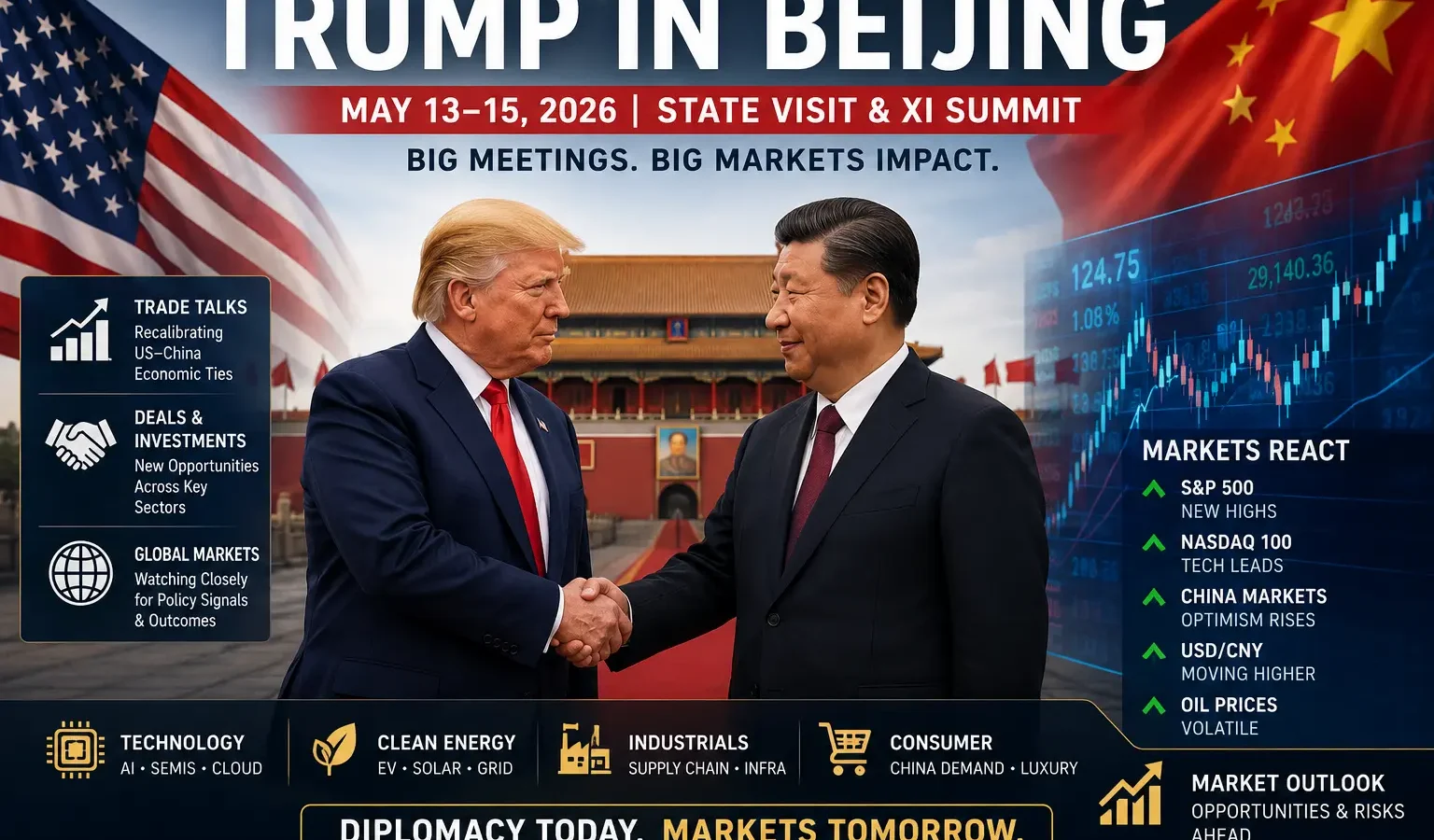
On the morning of May 14, 2026, President Donald Trump met President Xi Jinping at the Great Hall of the People in Beijing, opening a two-day summit that markets around the world have been pricing in for weeks. It is the first state visit to China by a sitting US president in nearly nine years, the last being Trump’s own visit in November 2017, and it arrives at one of the most consequential moments for the global economy in recent memory. The two countries — together with the European Union — account for roughly 60% of global GDP, and the framework they set over these two days will shape trade, technology, and capital flows well beyond 2026.
For investors, this is not a story to watch passively on the news. The summit sits at the intersection of nearly every macro theme that matters right now: the fragile US–China trade truce struck in October 2025, China’s tightening grip on rare earth exports, the unresolved Iran war and the Strait of Hormuz blockade, the AI race between the world’s two largest economies, and the question of Taiwan. Each of these threads runs directly through portfolios — through semiconductor supply chains, energy prices, currency markets, defensive sectors, and the risk premium embedded in nearly every asset class.
This article breaks down what actually happened, what is on the table, what the early signals tell us, and — most importantly — how prudent investors should think about positioning a portfolio around an event whose outcome remains genuinely uncertain. The goal is not to predict the communiqué. It is to build a portfolio that performs reasonably across the range of plausible outcomes.
What Actually Happened: The Summit in Context
Understanding the market implications requires understanding the backdrop, because this summit is the product of a turbulent eighteen months in US–China relations rather than a standalone diplomatic event.
The relationship reached a low point in April 2025, when sweeping US tariffs — which at their peak pushed effective rates past 140% on some Chinese goods — triggered immediate retaliation from Beijing. China was the first major economy to strike back against what the administration branded its “Liberation Day” tariffs. Critically, Beijing did not respond only with counter-tariffs. It reached for what analysts have come to call its “break glass” tool: restrictions on the export of rare earth elements and the permanent magnets that depend on them. That move set off multiple rounds of escalating negotiation that ultimately produced a one-year trade truce in October 2025 — a truce now scheduled to expire in the fall of 2026.
Trump and Xi first met during Trump’s second presidency at the Busan summit in late October 2025, a meeting that thawed relations enough to stabilize markets and led Trump to begin referring to the two countries as the “G2.” The Beijing visit was originally planned for April 2026 but was postponed to May after the outbreak of the Iran war and the US and Israeli strikes that followed.
On arrival, the pageantry was visible but more restrained than the lavish 2017 reception, when Xi hosted Trump for a private dinner in the Forbidden City and unveiled some $250 billion in business deals. This time, the welcome ceremony and bilateral meeting at the Great Hall of the People carried what the White House called “tremendous symbolic significance,” and Trump and Xi also visited the Temple of Heaven together. By the close of the first day, Beijing’s official English-language readout stated that both sides had agreed to pursue a “constructive China–US relationship of strategic stability” as a guiding framework for the next three years and beyond. Xi, for his part, invoked the “Thucydides Trap” — the historical pattern in which a rising power and an established power slide toward conflict — and warned that mishandling the Taiwan question could put the relationship in serious jeopardy.
The framing matters for investors. A summit that produces a stated commitment to “strategic stability” is, at the margin, risk-positive. A summit overshadowed by explicit warnings about clashes and conflict is a reminder that the structural tensions have not gone away. Both things are true at once, and that is precisely why a single-outcome bet is the wrong way to position.
The Five Issues That Matter for Markets
The summit agenda is broad, but five specific issues carry the most direct weight for portfolios. Each deserves its own assessment.
1. Tariffs and the Trade Truce
The most market-sensitive question is whether the October 2025 truce gets extended before its fall 2026 expiration. Traders heading into the summit broadly expected some form of truce extension, and the base-case expectation is that neither side wants the disruption of a renewed tariff spiral while both economies are absorbing the inflationary shock of the Iran war and elevated energy prices.
An extension would be incrementally positive for risk assets, particularly for multinationals with China-exposed supply chains and for sectors sensitive to input costs. A breakdown — or a failure to reach clarity before the deadline — would reintroduce a tail risk that markets have largely set aside since late 2025. The asymmetry here is worth noting: extension is mostly priced in, so the upside surprise is limited, while a negative surprise could move markets sharply. That asymmetry is a textbook case for understanding how to manage risk in your financial investments rather than chasing the consensus trade.
2. Rare Earths and Critical Minerals
If tariffs are the headline, rare earths are the structural story. China dominates the global supply of rare earth elements and the permanent magnets built from them — inputs that underpin everything from semiconductors and electric vehicles to advanced defense systems. Even after the October 2025 truce, Chinese customs data has indicated that exports of several critical minerals remained roughly 50% below where they were in the twelve months before Beijing imposed export controls in April 2025.
Both sides have an interest in keeping these materials flowing, and a deal to stabilize rare earth exports is among the more plausible concrete outcomes of the summit. For investors, this theme cuts across multiple sectors. It touches semiconductor and AI-related equities, where magnet and chip supply chains are critical. It touches the clean-energy complex, since rare earths are essential to wind turbines and EV motors — a dynamic relevant to anyone holding ETFs focused on sustainable and green sector investments. And it touches the small universe of non-Chinese mining and processing companies, whose valuations swing sharply on every shift in the policy outlook.
3. The Iran War and Energy Prices
The Iran war and the blockade of the Strait of Hormuz have driven a historic surge in energy prices, fueling inflation worries worldwide and weighing on global growth. The US has sought to pressure Beijing to help bring the conflict to a close, and China hosted Iran’s foreign minister shortly before the summit — a development that briefly raised hopes of progress, sent oil prices lower, and lifted equities.
Most analysts caution that a breakthrough on Iran is unlikely to emerge directly from the Beijing talks; Beijing has played up its role as a global mediator while shying away from concrete commitments. For investors, the key point is that energy prices remain the transmission belt between geopolitics and inflation, and inflation remains the transmission belt between energy and central bank policy. Any summit signal that meaningfully changes the odds of de-escalation would ripple through oil, then through inflation expectations, then through bond yields and equity valuations. This is the same causal chain explored in our May 2026 market update on records, war, oil, and gold.
4. The AI Race
Artificial intelligence has become a central point of strategic competition. The US has produced cutting-edge AI models, but many remain expensive to run, while China has pressed its own advantages in deployment and cost. Export controls on advanced chips, the rare earths needed to manufacture them, and the broader question of technological decoupling all sit on the summit agenda. The presence of the Nvidia CEO in Trump’s delegation underscores how tightly the AI supply chain is bound up in US–China diplomacy.
For investors already navigating an AI-driven equity market, the summit adds a geopolitical variable on top of the valuation questions raised by figures like Paul Tudor Jones. The interaction is important: an AI bull market that is also exposed to supply-chain and export-control risk is a different risk profile than one driven purely by earnings. Understanding both dimensions is part of developing a resilient investor mindset.
5. Taiwan
Taiwan is the issue most likely to generate genuine volatility, precisely because it is the area where the two powers’ interests are least reconcilable. Xi’s explicit warning about the consequences of mishandling Taiwan was the sharpest moment of the first day. Markets generally treat Taiwan as a low-probability, high-severity tail risk — the kind of event that does not affect day-to-day pricing but would dominate everything if it escalated. Given Taiwan’s central role in global semiconductor manufacturing, any deterioration in the diplomatic temperature around the island is something portfolio risk managers monitor closely even when it is not driving headlines.
The Business Delegation Signal
One underappreciated signal from this summit is the composition of the delegation. A group of prominent US executives joined Trump’s trip, reportedly including the leaders of Tesla, Apple, BlackRock, Boeing, and Nvidia. The presence of these executives — particularly after a period in which engaging with Beijing had become politically sensitive for American companies — sends a signal that the business climate may be thawing.
Traders have specifically anticipated outcomes such as an extension of the tariff truce and large commercial purchases, including Boeing aircraft orders. Some analysts have speculated that Trump, who favors large headline announcements, could unveil a commitment by China to purchase a substantial additional volume of American goods. Whether or not a specific dollar figure materializes, the direction of travel matters: visible cooperation between the world’s two largest economies tends to compress the geopolitical risk premium embedded in global equities, at least temporarily.
Investors should be careful, however, not to over-extrapolate from optics. Headline deal announcements have a history of looking larger at the podium than they prove to be in execution. The 2017 visit produced a reported $250 billion in deals, and the subsequent years nonetheless saw the relationship deteriorate into a full trade war. Optics are a real short-term market input, but they are not a substitute for the structural analysis that separates strategic from reactive investing.
How the Summit Could Move Specific Asset Classes
Translating geopolitics into portfolio terms requires thinking through the transmission mechanisms for each major asset class. The summit does not move markets directly — it moves expectations, and expectations move prices.
Equities. A constructive outcome — truce extension, rare earth stability, visible cooperation — would tend to support global equities by reducing the risk premium, with particular benefit to multinationals, semiconductors, industrials with China exposure, and export-heavy sectors. A confrontational outcome would do the reverse, hitting the same sectors hardest. Within equities, the dispersion matters more than the index level: China-exposed names will move far more than domestically focused defensive sectors.
Bonds and rates. The summit’s main channel into fixed income runs through inflation. If the talks reduce the odds of further trade disruption or improve the Iran outlook, inflation expectations could ease, which would be supportive for bonds. If they raise the temperature, the inflation-through-tariffs channel reopens. The relationship between these dynamics and yields is exactly why the impact of interest rates on investment choices remains one of the most important frameworks for any investor to internalize.
Commodities. Energy is the most summit-sensitive commodity, given the Iran overlay. Industrial metals and rare earths would respond directly to any supply-chain announcements. Gold, as a geopolitical and inflation hedge, tends to behave inversely to diplomatic progress in the short term — good summit news can soften the safe-haven bid, while a breakdown would strengthen it.
Currencies. The US dollar and the Chinese yuan are both directly in play. Trade and capital-flow expectations feed straight into the exchange rate, and a meaningful shift in the relationship’s trajectory would register in currency markets quickly.
Sector dispersion. Perhaps the most actionable point: the summit’s effect will be highly uneven across sectors. Semiconductors, clean energy, industrials, agriculture, defense, and aerospace each have direct exposure to specific summit outcomes, while utilities, domestic consumer staples, and healthcare are relatively insulated. This dispersion is the raw material for both risk and opportunity.
How Prudent Investors Should Position
The single most important principle for navigating an event like this is also the most counterintuitive: the goal is not to predict the outcome correctly. The goal is to construct a portfolio that performs acceptably across the full range of plausible outcomes. Professional risk managers think in probability distributions, not point forecasts.
Resist the Urge to Trade the Headline
Summits generate a flood of real-time headlines, and each one tempts investors into reactive trades. The problem is that headline-driven trading is a structurally losing game for most individual investors: by the time a headline is on the screen, the market has often already moved, and the next headline frequently reverses the last one. The first day of this very summit produced both a cooperative joint readout and a sharp warning on Taiwan — a whipsaw in a single news cycle. Investors who trade each twist tend to accumulate transaction costs and behavioral errors. Understanding how emotions affect investment decisions is the first line of defense against this trap.
Diversify Across the Outcome Distribution
Genuine diversification means holding assets that respond differently to different summit outcomes. An equity-heavy portfolio concentrated in China-exposed multinationals is effectively a single directional bet on a good outcome. Adding defensive sectors, some fixed income, geographic diversification beyond the US–China axis, and a modest allocation to hedges creates a portfolio that does not depend on the summit going any particular way. This is the core logic behind crisis-proof investments and resilient sectors during periods of volatility.
Use Hedges for the Tail Risks
The summit’s tail risks — a breakdown on Taiwan, a collapse of the trade truce, an escalation rather than a de-escalation of the Iran war — are low-probability but high-severity. That profile is exactly what hedging instruments are designed for. Protective puts, defensive positioning, and selective exposure to assets that benefit from volatility can convert an unmanageable tail risk into a known, budgeted cost. The economics of portfolio hedging strategies always look unattractive in calm markets and indispensable in crisis markets — which is why they must be put in place before the crisis, not during it.
Size Positions to Survive the Bad Outcome
Position sizing is the discipline that determines whether a wrong call is a setback or a catastrophe. If a portfolio is so concentrated in summit-sensitive names that a confrontational outcome would cause a permanent impairment of capital, the position is too large regardless of how confident the investor feels. The correct size for any geopolitically exposed position is one where the bad outcome is survivable and the portfolio can wait for recovery. This principle connects directly to honestly assessing what type of investor you are and what level of drawdown you can actually tolerate.
Keep the Long Horizon in View
Finally, it is worth remembering that summits are episodic and investing is continuous. The US–China relationship has moved through cooperation, confrontation, trade war, truce, and reset within a single decade. A long-term investor’s job is not to win each episode but to compound steadily through all of them. The frameworks that make this possible — sound asset allocation, risk management, behavioral discipline, and the patience to let a diversified portfolio work — matter far more than the outcome of any single diplomatic meeting.
The Investment Themes to Watch After the Summit
Beyond the immediate market reaction, the summit will sharpen several medium-term themes that thoughtful investors should track.
Supply-chain reconfiguration. Whatever the summit produces, the structural reality of China’s dominance in rare earths and critical minerals will keep driving investment into supply-chain diversification — alternative mining jurisdictions, processing capacity outside China, recycling technologies, and substitution research. This is a multi-year capital-allocation theme, not a single trade.
Defense and strategic industries. The combination of the Iran war, Taiwan tensions, and critical-mineral vulnerability has elevated defense and strategic-industrial spending across multiple economies. This theme intersects with the broader category of emerging technologies in financial trading and the real economy.
The AI supply chain as a geopolitical asset. The AI race is no longer just a technology and earnings story; it is a national-strategy story. That reframing affects how investors should think about valuation, risk, and concentration in AI-related ETFs and individual semiconductor names.
Currency and reserve dynamics. Every major US–China summit feeds into the slow-moving conversation about the dollar’s role, reserve diversification, and the long-term architecture of the global monetary system — a conversation that also touches the development of central bank digital currencies.
Volatility as a regime, not an event. Perhaps the most durable takeaway is that geopolitical volatility has become a persistent feature of the investing landscape rather than an occasional interruption. Portfolios built for the low-volatility 2010s need to be re-examined for a world where summits, conflicts, and trade disputes are recurring inputs. Tools like the Sharpe ratio help quantify whether a portfolio is actually being compensated for the risk it carries in this environment.
Frequently Asked Questions
What is the Trump-Xi Beijing summit and why does it matter for investors?
It is a two-day state visit and summit held in Beijing on May 14–15, 2026 — the first visit by a sitting US president to China in nearly nine years. It matters for investors because the US and China, together with the EU, account for roughly 60% of global GDP, and the summit’s agenda covers trade, tariffs, rare earth supply chains, the AI race, the Iran war, and Taiwan — issues that flow directly into equity valuations, bond yields, commodity prices, and currency markets.
Will the summit lead to a US-China trade deal?
Heading into the summit, traders broadly expected an extension of the October 2025 trade truce rather than a comprehensive new deal, along with the possibility of large commercial purchases such as Boeing aircraft orders. Most analysts caution that a sweeping “grand bargain” is unlikely; the more realistic outcome is incremental stabilization. The first day produced a stated commitment from both sides to pursue a “constructive relationship of strategic stability,” which is a positive framing, but the structural tensions remain unresolved.
How could the summit affect the stock market?
The summit affects markets primarily by moving the geopolitical risk premium. A constructive outcome — truce extension, rare earth stability, visible cooperation — would tend to support global equities, especially China-exposed multinationals, semiconductors, and industrials. A confrontational outcome would hit those same sectors hardest. The effect is highly uneven across sectors, with domestic defensive sectors relatively insulated.
Why are rare earths such an important part of the summit?
China dominates global supply of rare earth elements and the permanent magnets made from them, which are essential to semiconductors, electric vehicles, wind turbines, and advanced defense systems. After imposing export controls in April 2025, China’s exports of several critical minerals remained roughly 50% below prior levels. A deal to stabilize these exports is one of the more plausible concrete summit outcomes and would affect technology, clean energy, and mining investments worldwide.
Should I change my portfolio because of the summit?
The prudent approach is generally not to make large directional bets on a specific summit outcome, but rather to ensure your portfolio is diversified enough to perform acceptably across the range of plausible results. That means avoiding excessive concentration in summit-sensitive sectors, maintaining geographic and asset-class diversification, considering hedges for tail risks, and sizing positions so that an adverse outcome is survivable.
How does the Iran war factor into the Trump-Xi summit?
The Iran war and the Strait of Hormuz blockade have driven energy prices sharply higher, fueling global inflation concerns. The US has pressed China to help bring the conflict to a close, and China hosted Iran’s foreign minister shortly before the summit. However, most analysts believe a breakthrough on Iran is unlikely to come directly from the Beijing talks. Energy prices remain the key channel through which the conflict affects inflation, interest rates, and ultimately equity and bond valuations.
What does the presence of US CEOs on the trip signal?
A delegation of prominent US executives — reportedly including the leaders of Tesla, Apple, BlackRock, Boeing, and Nvidia — joined the trip. Their presence signals a potential thaw in the US–China business climate after a period when engaging with Beijing had become politically sensitive for American companies. Investors should treat this as a meaningful but limited signal, since headline deal announcements have historically looked larger at the podium than they proved in execution.
How should long-term investors think about geopolitical events like this?
Long-term investors should treat summits as episodic inputs rather than defining events. The US–China relationship has cycled through cooperation, trade war, truce, and reset within a single decade. The frameworks that drive long-term success — sound asset allocation, disciplined risk management, behavioral control, and patience — matter far more than correctly predicting any single diplomatic outcome. The objective is to compound steadily through all regimes, not to win each individual news cycle.
Final Thoughts: Strategic Calm in a Geopolitical Storm
The Trump-Xi summit in Beijing is a genuinely significant event — the first US presidential visit to China in nearly a decade, convened at a moment when trade, technology, energy, and security tensions are all live simultaneously. The first day’s commitment to a “constructive relationship of strategic stability” is a constructive signal, and the parallel warnings on Taiwan are a reminder that the structural rivalry has not been resolved and will not be resolved in two days.
For investors, the temptation is to treat the summit as a binary event to be traded — bullish on a deal, bearish on a breakdown. That framing is a mistake. The summit’s outcome is genuinely uncertain, the headlines will whipsaw, and the real economic effects will unfold over months and quarters, not hours. The investors who navigate this well will not be the ones who guessed the communiqué correctly. They will be the ones whose portfolios were already built to withstand a range of outcomes: diversified across sectors and geographies, hedged against the tail risks, sized to survive the bad scenario, and anchored to a long-term plan that does not depend on any single meeting.
Geopolitical volatility is no longer an occasional interruption to a calm investing environment. It is the environment. The summits, the conflicts, the trade disputes, and the supply-chain shocks are recurring features of the landscape, and portfolios need to be constructed accordingly. The investor’s edge in this world is not superior forecasting. It is superior preparation.
AssetWhisper does not manage portfolios, run accounts or publish trade signals. What it publishes is the reasoning behind decisions like this one: which sectors hold up when the macro picture turns, what hedging can and cannot do, and whether the classic core allocation still works.
Related Reading on AssetWhisper: