The AI Economy’s Two Bills: $100 Oil, AI Financing Costs and the PHP, Node.js and Java Alerts
Key takeaway
US stocks split as Brent settled at $116.72 and AI financing costs came into focus, while PHP2Shell, a Node.js RCE and the eMudhra certificate compromise exposed another cost of the AI economy.

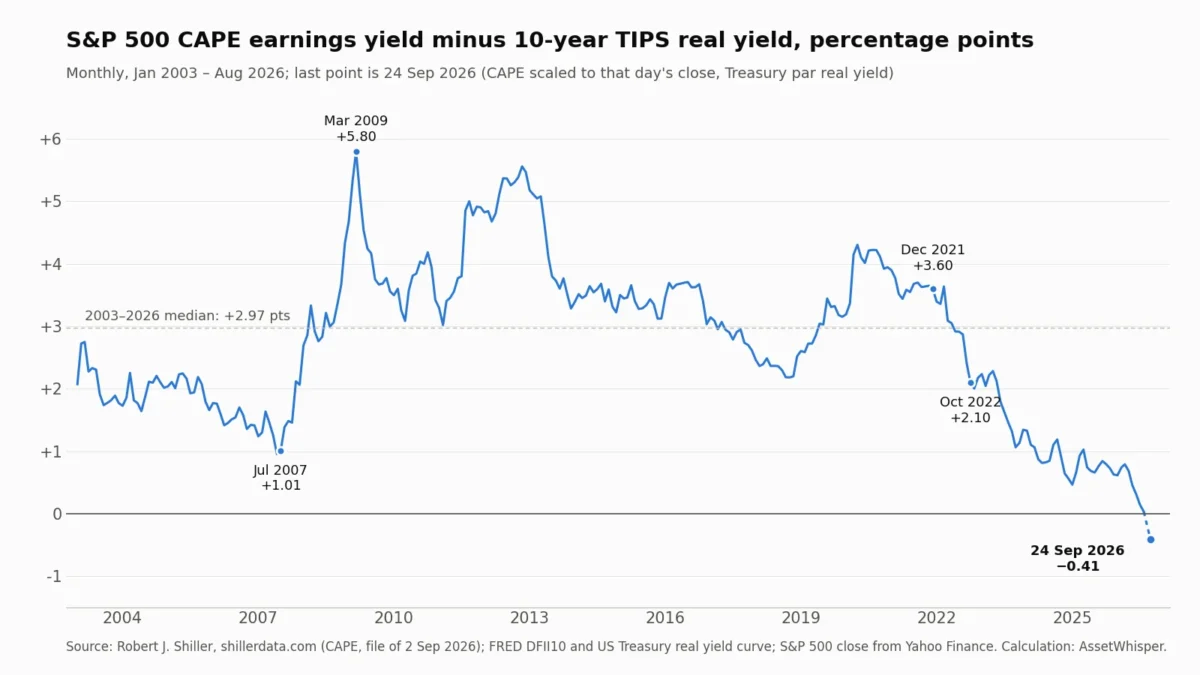
The AI economy received two bills this week. On Wall Street, investors questioned how companies will finance a historic infrastructure build-out while oil settled above $100 and the 10-year Treasury yield hovered near 5%. In server rooms, PHP and Node.js shipped emergency fixes for remote-code-execution flaws, and Java, Rust and Go pulled trust from compromised certificates. Several of those flaws were found with AI models. These are different risks, but they share one question: how much capital will technology need simply to keep growing, and to keep operating safely?
Numbers first, adjectives last. Nothing here is a buy or sell signal.
The scoreboard: a split week, not a crash
| Index | Close, 23 Oct 2026 | Friday | Week |
|---|---|---|---|
| S&P 500 | 7,623.68 | −0.52% | −0.5% |
| Nasdaq Composite | 25,955.34 | −0.21% | −0.7% |
| Dow Jones Industrial Average | 52,215.16 | −1.23% | +0.4% |
| Russell 2000 | 2,775.90 | −0.29% | about +2% |
Closes from the Associated Press; weekly changes for the three large indexes from CNBC. The Russell 2000 weekly gain appears in one syndicated version of the AP table and we could not confirm it elsewhere, so treat it as approximate.
The dispersion is the story. The Nasdaq posted its second straight weekly loss after falling 4.48% the week before, its worst week since June. The Dow posted its third straight weekly gain, carried by defensive stocks. Small caps rose. This was a market repricing one assumption, the cost of financing AI, rather than selling everything.
Friday itself was weak underneath: NYSE decliners outnumbered advancers 1.97 to 1, and the Nasdaq printed 61 new 52-week highs against 299 new lows (AP).
Thursday: the first bill, AI’s financing cost
The week’s largest move came on Thursday, 22 October: the Nasdaq fell 2.60% and the S&P 500 1.21%, the Nasdaq’s biggest one-day drop since June. AP tied the slide to concerns about the cost of financing heavy AI spending.
The trigger was a good quarter with an expensive footnote. Meta’s third-quarter results, released on 21 October:
| Meta, Q3 2026 | Figure |
|---|---|
| Revenue | $64.60 billion, +26% year on year |
| Capital expenditure in the quarter | $34.91 billion |
| Free cash flow | −$2.12 billion |
| 2026 capex outlook | $135–145 billion (previously $130–145 billion) |
| One-off legal charge | $9.89 billion (settlement with 52 state attorneys general) |
| Cash and marketable securities | $82.45 billion |
Revenue is growing at 26%, and the company still spent more cash than it generated in the quarter. The legal charge distorts reported profit, but the negative free cash flow comes from the build-out itself. Meta can absorb that: it has an advertising business and $82 billion in cash. Not everyone in the AI supply chain can.
On Friday, Morgan Stanley cut its price target on CoreWeave from $99 to $70, citing funding risk rather than demand. The bank estimates the company may need $24 billion to $37 billion of new debt to reach about 3.3 GW of active capacity by the end of 2027 (Investing.com, TipRanks). The cut came a day after the Thursday sell-off, so it is a symptom of the same concern, not its cause.
The mechanism matters more than the target. A company does not borrow at the Treasury rate. Its cost of debt is roughly the reference rate plus a credit spread, and the spread is widest for the borrowers that depend most on new financing. With the 10-year yield near 5%, each step of that chain tightens:
- Reference rates and credit spreads rise.
- Financing a new data center costs more.
- The expected margin on each project shrinks.
- Projects are delayed or scaled down, and the suppliers that priced in the full build-out feel it.
Kristina Hooper of Man Group summarised it for AP: the market is pausing over the possibility of less AI data-center spending next year than projected. The exposure is not uniform:
| Type of company | Main risk from higher financing costs |
|---|---|
| Hyperscalers (Meta, Alphabet, Microsoft, Amazon) | Return on incremental capex; free cash flow |
| Neoclouds (CoreWeave and peers) | Access to debt, cost of debt, utilisation of new capacity |
| Chipmakers | Order cycle if capex plans are cut |
| Power and energy suppliers | Demand forecasts and the cost of expansion |
| Cybersecurity vendors | Turning higher demand for protection into profitable revenue |
Private markets point the other way. Anthropic’s last funding round, announced on 28 May, valued it at $965 billion (Bloomberg), and press reports discuss a possible listing at a higher figure. Those IPO numbers are estimates, not prices. The gap between private marks and public scepticism is the tension to watch.
Oil above $100, yields near 5%, a Fed boxed in
| Market | Settlement, 23 Oct 2026 | Change on the day |
|---|---|---|
| WTI crude | $103.27 | +$3.80 (+3.8%) |
| Brent crude | $116.72 | +$3.55 (+3.1%) |
Settlements reported by Rio Times and The Nation; Brent’s was its highest since late April. The rise followed Houthi attacks on Saudi energy infrastructure and a tanker spill off the UAE, on top of fears of a prolonged US–Iran confrontation. The S&P 500 energy sector closed at a record, and SLB rose 6.7% after beating third-quarter estimates.
The macro data explain why the Federal Reserve is stuck:
- S&P Global flash composite PMI: 57.6, still firm expansion. Manufacturing at 56.0, a 53-month high; new orders at 58.2, the strongest since March 2022.
- Output prices: 59.8, the highest since August 2022. Companies are passing costs on.
- University of Michigan sentiment: 48.0, near a record low, with one-year inflation expectations at 4.7%.
An economy running hot, prices accelerating and consumers gloomy. The Fed raised its target range to 3.75%–4.00% in September; it is expected to hold this week, and the market’s real question is December.
Elsewhere: AT&T and T-Mobile fell more than 6% (Verizon −1.6%) on a report that SpaceX is seeking thousands of cell sites for a fourth US wireless carrier, and Crown Castle rose 10%. American Express fell 3.9% despite raising its profit forecast and announcing a 5% workforce cut.
The second bill: the web stack, in the same 48 hours
Between 20 and 21 October, three of the most widely deployed server platforms published security fixes. They are two different kinds of failure.
Failure 1: memory and processing bugs (PHP, Node.js)
PHP2Shell (CVE-2026-109618 and CVE-2026-109619). Two flaws in how PHP handles memory exhaustion and fatal errors which, together, allow unauthenticated remote code execution. They affect PHP 5.4 through 8.5, and PHP runs roughly 69% of websites whose server language is known, WordPress among them. The PHP maintainers scored them 9.2 on CVSS 4.0; the research firm watchTowr scored them 10.0. Fixed releases are 8.5.12, 8.4.27, 8.3.36 and 8.2.35; the end-of-life 7.4 to 8.1 lines received source patches only. CISA urged immediate patching.
The timeline is the uncomfortable part. Amazon’s honeypots recorded exploitation attempts on 17 October, four days before the patches were published on 21 October. Whether any of those attempts succeeded has not been established. Cloudflare deployed emergency firewall rules, and several government sites, Wikimedia services and, briefly, the Internet Archive went offline as a precaution.
Node.js. The 21 October security release fixes ten vulnerabilities. Four are rated High, the highest rating in the release; none is Critical. The most serious, CVE-2026-111497, is an out-of-bounds write in the Brotli decoder that could lead to remote code execution. Others affect DNS name handling and TLS hostname checks. Fixed versions are 22.23.4, 24.22.1 and 26.12.1. Node.js 20 and older are end-of-life and receive no fix.
Failure 2: broken trust in certificates (Java, Rust, Go)
The Java alert and the Rust advisories are the same incident. On 20 October, eight intermediate certificate-authority keys of eMudhra (which issues certificates under the emSign brand) were disclosed as compromised: the keys had been generated with insufficient randomness and could be reconstructed from the public certificates (The Hacker News). Anyone holding them could impersonate an HTTPS server to software that still trusted those certificates.
Browsers blocked them within days. The remaining exposure is in software that carries its own trust store:
- Java (CVE-2026-91403). Oracle issued an out-of-band Security Alert rated CVSS 9.1 in JSSE, Java’s TLS layer. It is not a remote-code-execution flaw; it lets an attacker in the middle of a connection pass as a trusted server. Note the versions carefully: Oracle lists Java SE 8u511, 11.0.33, 17.0.21, 21.0.13, 25.0.5 and 27.0.1 as affected. The fixed builds published on 21 October are 8u511 b32, 11.0.33.0.2, 17.0.21.0.2, 21.0.13.0.2, 25.0.5.0.2 and 27.0.1.0.2. Other JDK vendors number their builds differently, so check your vendor’s advisory or the
blocked.certsfile rather than the version string. Oracle reported no active exploitation. - Rust (RUSTSEC-2026-0381 to 0383): fixed in webpki-roots and webpki-root-certs 1.0.10 and rustls-webpki 0.103.16.
- Go (1.27.3 and 1.26.10), Python’s certifi and the major Linux
ca-certificatespackages shipped the same distrust.
What AI did, and what it did not do
Two claims are often merged. They should be kept apart.
AI-assisted discovery: documented. One of the PHP flaws was found by Ryan Austin of the security firm Calif using OpenAI’s GPT-5.6 Sol, within OpenAI’s “Patch the Planet” programme; researchers at Wiz found and reported both flaws independently, also using AI models and their own tooling. The Node.js advisory credits the Brotli bug to researchers at OpenAI Codex Security. A PHP core developer had noticed the underlying out-of-memory behaviour in a 2024 audit, and it was never fixed.
AI-assisted exploitation: plausible, not shown. Exploitation attempts began before disclosure, but nothing published so far shows that attackers used AI, or that their attempts succeeded.
Even with that distinction, three things change in measurable ways:
- The discovery rate is rising. If models can audit decades-old C code inside language runtimes, more weeks like this one are likely. Security spending behaves less like a discretionary project and more like a recurring cost line.
- The patching window is shrinking. Attempts started four days before the fix existed. Policies written around “patch within 30 days” assume a gap that, in this case, did not exist.
- End-of-life software has a cost. PHP 7.4 to 8.1 got source code only and Node.js 20 got nothing. Running legacy runtimes now means paying for migration or carrying a risk that has no line in the budget.
Where the value of AI is showing up
Thursday’s sell-off asked whether AI spending earns a return. This week’s vulnerabilities offer a partial, unglamorous data point, but it needs three separate columns:
- Revenue generated by AI: what customers pay for models and compute. This is what the capex has to earn back.
- Demonstrable productivity: work done faster or cheaper, such as auditing code that humans had already reviewed and missed.
- Losses avoided: breaches that did not happen because a flaw was found first. Real, but hard to measure, and not revenue.
Vulnerability discovery sits mostly in the second and third columns. It shows AI producing value. It does not, by itself, justify hundreds of billions in data-center spending.
The more important shift is that AI is speeding up both sides of the security equation: finding defects and the need to fix them. Investors face a harder test as a result. They have to separate AI spending that creates durable cash flows from spending that only keeps increasingly complex systems running.
What to watch next week
- Fed decision (Wednesday): a hold is expected; the statement’s language on December is the actual event.
- Advance Q3 GDP: economists expect about 3.0% annualised growth, driven by consumers and AI investment.
- Alphabet, Microsoft and Amazon earnings, with roughly a third of the S&P 500 reporting. Third-quarter earnings growth is tracking above 32% (LSEG I/B/E/S). The line to read is capex guidance, and how it will be financed.
- US midterm elections: 3 November.
For anyone running the platforms above, the number that matters this weekend is the runtime version actually running in production, not the one in the lock file.
Related reading
- The 10-year Treasury at 5% — why the rise came from real yields rather than inflation.
- Equity risk premium and real yields — what higher real yields do to stock valuations.
- The AI bull market and the 1999 comparison — what the dot-com cycle does and does not tell us.
- The 2026 midterms and markets — what history says about election years.
- Bear markets since 1950 — how deep and how long.
This article is general information, not personalised investment advice. It does not take into account the financial situation, objectives or risk tolerance of any individual reader, and the same text is distributed to all readers. Market data describe the dates stated and change continuously; several outlets published slightly different closing prints. Past performance does not indicate future results. Capital is at risk.