Is 60/40 Still Alive? Portfolio Construction in 2026
Key takeaway
The 60/40 portfolio was never a magic ratio — it was a bet that stocks and bonds move in opposite directions. That bet stopped paying in 2022. Here is what actually changed, and the four checks that matter more than the number.
The short answer: no, 60/40 is not dead — but the reason it worked for two decades is gone, and that changes how you should build it. The 60/40 portfolio was never a magic ratio. It was a bet that when stocks fall, bonds rise. That bet stopped paying in 2022, and understanding why matters more than picking a new number.
What actually broke in 2022
The classic 60/40 portfolio holds 60% equities and 40% bonds. Its appeal was never the returns of the bond sleeve. It was the correlation: for most of the period between roughly 2000 and 2021, stocks and high-quality government bonds tended to move in opposite directions. When equities sold off, bonds rallied, and the portfolio fell less than the market did.
In 2022, both fell at the same time. That was unusual — but it was not random. Stock-bond correlation is not a constant. It flips depending on what is driving markets:
- When growth is the dominant worry, bad news for equities is good news for bonds. Central banks cut rates, yields fall, bond prices rise. Correlation is negative, and 60/40 works as designed.
- When inflation is the dominant worry, the same news hurts both. Rising inflation pushes rates up, which compresses equity valuations and pushes bond prices down together. In 2026 the squeeze showed up in the equity risk premium over real yields, which rising TIPS yields pushed below zero on CAPE earnings. Correlation turns positive, and the diversification disappears exactly when you need it.
That second regime is not new. It was the norm through much of the 1970s and 1980s. What was unusual was the twenty-year stretch of reliably negative correlation that trained an entire generation of investors — and an entire generation of portfolio software — to treat 40% bonds as automatic protection.
So is the ratio wrong?
The ratio was always arbitrary. Nothing about 60/40 is mathematically special; it is a convention that became a default. Arguing about whether it should now be 70/30 or 50/30/20 misses the point.
The useful question is not “what is the right number” but “what job is each part of my portfolio doing, and is it still doing it?” A 60/40 portfolio has three jobs baked into it: grow capital, dampen drawdowns, and produce income. In the 2000–2021 regime, the bond sleeve did all three at once. Today it does them unevenly, so they are worth separating.
Three questions that replace “is 60/40 dead”
1. What is protecting me, and against what?
Duration — the sensitivity of a bond to interest-rate moves — is protection against a growth shock and a liability during an inflation shock. If your bond sleeve is entirely long-duration government debt, you are well hedged against a recession and poorly hedged against a repeat of 2022.
Diversifiers that behave differently under inflation include short-duration bonds, inflation-linked bonds, and real assets. None is free: short duration gives up the rally you would get in a recession, and real assets carry their own volatility.
2. Am I being paid to hold bonds again?
This is the part of the debate that changed most. For much of the 2010s, the bond sleeve offered almost no yield, so it was pure insurance with a negative carry. With yields meaningfully above zero, fixed income has a return case on its own merits rather than only a diversification case.
That is a real argument for holding bonds that did not exist five years ago — and it is often missing from articles declaring 60/40 dead.
3. What is my actual time horizon?
Correlation regimes last years, not decades. If your horizon is thirty years, a bad correlation year is noise. If you are drawing income from the portfolio within five, a simultaneous drawdown in both sleeves is the specific risk that ends plans — the sequence-of-returns problem.
The same allocation can be entirely reasonable for one investor and clearly wrong for another. This is why “is 60/40 dead” has no general answer.
What a considered 2026 allocation tends to look like
Not a recommendation — a description of how the debate has actually moved among practitioners:
- The equity sleeve is scrutinised for concentration. Broad index exposure is far more concentrated in a handful of very large companies than it was a decade ago. “Diversified equities” may be a less diversified position than the label suggests.
- The bond sleeve is split rather than treated as one block, typically by duration and by credit quality, so that the recession hedge and the income component can be sized separately.
- A third sleeve appears — real assets, commodities, or other diversifiers — sized small, explicitly to cover the inflation scenario the other two do not.
- Cash is treated as a position, not a residue, now that it earns something.
What has not changed: the evidence that most investors are better served by a simple allocation they will actually hold through a drawdown than by a sophisticated one they abandon at the bottom.
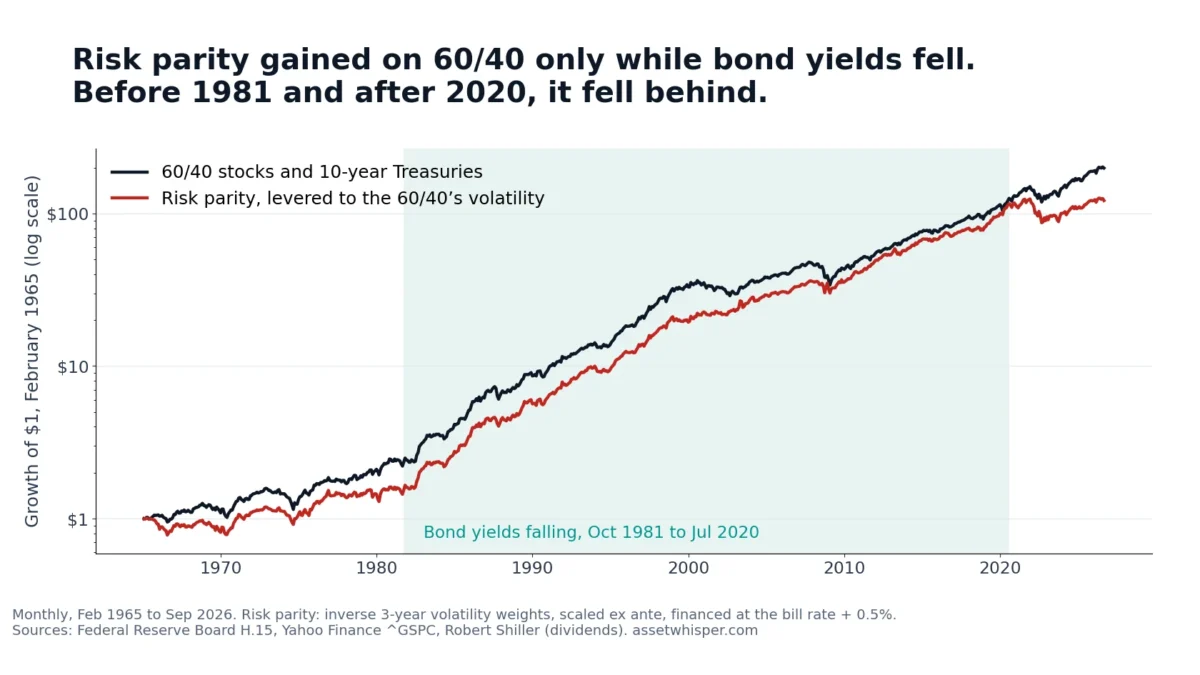
The most cited alternative to a fixed 60/40 is risk parity: more bonds, levered up to the same risk. We tested it on US stocks and Treasuries from 1965 to 2026 in risk parity and volatility targeting; it beat 60/40 only while yields were falling, and lost 28% in 2022.
Rebalancing is where the discipline lives
An allocation is a decision you make once. Rebalancing is the decision you make repeatedly, and it is where most of the practical benefit of having a target allocation comes from — it forces you to trim what has run and add to what has lagged, which is precisely what most investors will not do on instinct.
Two things make it work:
- A rule, set in advance. Either calendar-based (quarterly, annually) or threshold-based (when a sleeve drifts more than a set percentage from target). Either beats deciding in the moment.
- Awareness of the tax and cost drag. Rebalancing in a taxable account realises gains. Directing new contributions toward the underweight sleeve achieves much of the same effect without triggering a sale.
How to test your own allocation
Rather than asking whether 60/40 is dead, run your actual portfolio against these four checks:
- Concentration: what percentage of your total portfolio sits in your ten largest underlying holdings, looking through your funds rather than counting the funds themselves?
- Duration: what is the weighted average duration of your bond sleeve, and do you know what a one-percentage-point move in rates does to it?
- Correlation in practice: in the last two significant market drawdowns, did the parts of your portfolio you expected to diverge actually diverge?
- Drift: how far is your portfolio from its target allocation right now, and when did you last rebalance?
Most portfolios that feel diversified fail at least one of these. The first and fourth are the most common failures, and both are measurement problems rather than strategy problems — which means they are fixable without changing your investment approach at all.
The bottom line
60/40 is not dead. What died is the assumption that the ratio alone does the work. The portfolio was always a shorthand for a set of decisions about growth, protection, income and horizon, and for two decades a benign correlation regime let investors skip those decisions and still get the result.
That shortcut is gone. The decisions are still there, and they are worth making explicitly.
Frequently asked questions
Is the 60/40 portfolio dead?
No, but the reasoning behind it was widely misunderstood. 2022 was unusual because stocks and bonds fell together, which is exactly what the allocation is not supposed to do. That was a specific consequence of inflation and rapid rate rises, not evidence that diversification stopped working.
What actually happened in 2022?
Inflation forced central banks to raise rates quickly. Rising rates cut bond prices directly and compress equity valuations at the same time, so the two legs of the portfolio fell together. Bonds failed as a hedge because the shock came from the rate side rather than from a growth scare.
What should replace 60/40?
Usually the question rather than the ratio. What is the money for, when is it needed, and what loss can be absorbed without selling? A number that comes out of those three answers is defensible; the same number adopted because it is conventional is not.
Do bonds still diversify a portfolio?
Against growth shocks and deflation, yes — that is the scenario they are built for and they have kept working in it. Against inflation shocks, no, and they never did. The mistake was treating a conditional hedge as an unconditional one.
How often should I rebalance?
On a rule, whether calendar-based or threshold-based. The specific rule matters far less than having one, because rebalancing means selling what has performed and buying what has not, which nobody does willingly in the moment.
Is a higher equity allocation better for young investors?
Usually, since a long horizon lets a drawdown recover. But horizon is only one of the constraints: financial capacity and the tolerance to sit through a fall without selling both cap the allocation independently, and the binding one is whichever is tightest.
Disclaimer. This article is general information about portfolio construction and is not investment advice, nor a recommendation to buy or sell any security or to adopt any particular allocation. It does not take account of your objectives, financial situation or needs. Historical relationships between asset classes — including the stock-bond correlation discussed above — have changed before and can change again. The value of investments can fall as well as rise and you may get back less than you invested. Consider seeking advice from a licensed financial adviser before making investment decisions.
Setting the target is one decision; keeping it is another. How often you should rebalance covers what drift costs and why annual, past a five-point threshold, is the rule the evidence supports.
If the portfolio is paying for retirement, the allocation question turns into a spending question. The 4% rule at CAPE 40 tests every 30-year retirement since 1871 and shows why the bond sleeve decided the worst cases: it rescued the 1929 retiree and failed the 1966 one.