How Often Do Index Funds Rebalance? Index Rules and 12 Years of Fund Turnover
Key takeaway
Index funds do not rebalance on a timetable of their own: they trade when their index changes. For the main US indexes that means quarterly updates (only shares and float for the S&P, which has no scheduled reconstitution), a Russell reconstitution twice a year since 2026, and corporate events at any time.
Index funds do not rebalance on a timetable of their own: they trade when their index changes. For the main US indexes that means quarterly updates (only shares and float for the S&P, which has no scheduled reconstitution), a Russell reconstitution twice a year since 2026, and corporate events at any time.
In SEC filings for fiscal years 2014–2025, S&P 500 and total-market index funds turned over a median 3%–4% of their portfolio a year, Russell 1000 5%, small-cap index funds 14.5%–18%, and the Russell 2000 Value fund 27%. A momentum-factor fund turned over 115% and two active funds 28.5% and 38.5%.
People who search “how often do index funds rebalance?” usually want to know one of two things: whether an index fund is quietly trading all the time, and whether that trading costs them anything. The answer to both depends on the index, not on the fund manager. This article goes through the published rules of the five index families behind most US index funds, then measures what those rules produce in practice, using the portfolio turnover that thirteen funds reported to the SEC for every fiscal year from 2014 to 2025. Rebalancing your own mix of stocks, bonds and funds is a different question, covered in how often should you rebalance your portfolio?
The short answer, index by index
The table summarises the maintenance calendar each index provider publishes in its methodology. “Scheduled review” is when the list of companies or the weighting rules are re-applied; “between reviews” is what can still change at other times.
| Index family | Example funds | Scheduled review | Between reviews |
|---|---|---|---|
| S&P 500, 400, 600 | VOO, IVV, IJR | No scheduled reconstitution; share counts and float updated quarterly (third Friday of Mar, Jun, Sep, Dec) | Additions and deletions “as needed”, usually announced at least three business days ahead |
| CRSP US | VTI, VB, VBR | Quarterly reconstitution, phased in over five trading days | Corporate actions |
| Russell US | IWB, IWM, IWN | Twice a year from 2026: late June and the second Friday of December (annual, in June, before 2026) | Quarterly IPO additions; corporate actions |
| Nasdaq-100 | QQQ, QQQM | Annual reconstitution in December; quarterly rebalance of shares and weights, which can also remove members below rank 125 | Special rebalance if concentration limits are breached; fast entry of new top-40 companies |
| MSCI (GIMI) | MTUM and other MSCI-based funds | Quarterly index reviews in February, May, August and November | Corporate events “as they occur” |
A fund that fully replicates one of these indexes buys and sells around those dates. Between them, a market-capitalisation-weighted index fund does almost nothing: when a share price rises, the stock’s weight in the index and in the fund rises by exactly the same amount, so there is nothing to correct. That is the main reason the turnover numbers further down are so low.
What “rebalancing” means for an index fund
Four different things get called rebalancing, and they produce very different amounts of trading.
- Reconstitution changes which companies are in the index. In a size-based index, firms that have grown or shrunk past a breakpoint move in or out; in a committee-run index like the S&P 500, a company is added when another leaves.
- Share and float updates keep each company’s weight in line with the shares that are actually available to investors. Index providers weight by “float-adjusted” market value: S&P calls the adjustment the investable weight factor (IWF), the share of a company’s stock not held by insiders, governments or other strategic holders. When a company issues shares or buys back stock, its weight changes, and index funds trade to match.
- Weight rebalancing applies only to indexes that cap or modify weights. A pure market-cap index never needs it; the Nasdaq-100, which limits concentration, and equal-weight or factor indexes do.
- Corporate actions happen whenever companies decide: mergers, spin-offs, delistings, bankruptcies. When an index member is taken over for cash, the fund receives the cash and has to buy the replacement.
The first three happen on the provider’s calendar; the last one does not. That is why no major index fund has a single answer to “how often”: it trades in bursts on known dates and in small amounts on many other days.
The calendar, index by index
S&P 500, S&P MidCap 400 and S&P SmallCap 600
The S&P 500 is the one major US index with no reconstitution date at all. S&P Dow Jones Indices’ US methodology says of the S&P Composite 1500 (the 500, 400 and 600 together): “Changes to index composition are made on an as-needed basis. There is no scheduled reconstitution. Rather, changes in response to corporate actions and market developments can be made at any time.” Additions and deletions are announced with at least three business days’ notice, which can be shorter at the discretion of the index committee.
What is scheduled is the quarterly share and float update. Under S&P’s Equity Indices Policies & Practices methodology, non-mandatory share changes are reviewed quarterly and take effect “after the close of the third Friday of the third month in each calendar quarter” (March, June, September and December), and a float factor changes at that review only if there is a share change of at least 5% and the float adjustment moves by at least five points. Mandatory events such as mergers and stock splits have no minimum threshold and are applied when they happen. S&P also runs a freeze period, from the Tuesday before the second Friday of the rebalancing month to the third Friday, during which some smaller changes are held back until after the rebalance.
CRSP US indexes (most Vanguard US equity funds)
Vanguard’s Total Stock Market, Small-Cap and Small-Cap Value index funds track CRSP indexes. CRSP’s methodology guide lists a “quarterly reconstitution schedule” and says “quarterly index changes utilize a 5-day transition window”. CRSP describes the transition as moving 20% of the change in holdings from the current index to the new one each day. It also uses “packeting”: a company crossing from one size segment to another moves half of its holdings at the first ranking and the other half only if it is still beyond the band at the next quarterly ranking. Both rules exist to cut turnover and to spread trading across several days rather than one closing auction.
Russell US indexes: from once a year to twice
For decades the Russell 1000, Russell 2000 and Russell 3000 were reconstituted once a year, at the end of June. That changed in 2026. FTSE Russell’s March 2026 announcement says: “Although previously rebalanced on an annual basis, effective this year, the reconstitution of the Russell US Indexes will be held semi-annually in June and December.” The June 2026 reconstitution took effect after the close on 26 June, with rank day on 30 April. The first December reconstitution is scheduled for after the close on Friday 11 December 2026, with rank day on 30 October and preliminary lists on 13 November; FTSE Russell’s notice of 5 November 2025 moved it from November to the second Friday of December and kept the cut-off at the last business day of October. FTSE Russell calls it “the first December reconstitution in more than three decades”. Eligible IPOs are also added quarterly.
The Russell reconstitution is one of the biggest trading events of the year. FTSE Russell reports that $217.2 billion was traded across US exchanges at the close of the June 2025 reconstitution. Because every fiscal year in our data is from before December 2026, none of the Russell turnover figures below reflects the new semi-annual schedule.
Nasdaq-100
The Nasdaq-100 is reconstituted once a year, in December, and rebalanced quarterly, effective at the market open on the first trading day after the third Friday of March, June, September and December. The quarterly rebalance is not only about weights: at the March, June and September rebalances, members that have fallen below rank 125 are removed and replaced, and a non-member that ranks within the top 40 can be added, which can briefly take the index above 100 companies. Its methodology also allows a special rebalance at any time if, at the end of a day, one company’s weight exceeds 24% or the companies weighing more than 4.5% add up to more than 48%. That happened on 24 July 2023, when the largest technology companies had grown past the limit. Nasdaq later estimated the July 2023 special rebalance at roughly 12% one-way turnover, “higher than historical NDX scheduled rebalances”.
MSCI
MSCI’s Global Investable Market Indexes are reviewed four times a year, in February, May, August and November, according to MSCI’s July 2026 methodology summary, and corporate events “are generally implemented in the indexes as they occur”. Until recently MSCI ran two full reviews a year (May and November) and two lighter ones (February and August); its current methodology describes a transition to quarterly comprehensive reviews, without a date we could confirm. The November 2026 review is announced on 11 November and effective on 1 December 2026. Factor indexes built on MSCI parents, such as the momentum index behind MTUM, have their own selection rules on top.
How much index funds actually trade
A fund’s portfolio turnover rate, as reported to the SEC, is the lesser of its purchases and sales of securities over the fiscal year divided by the average value of its portfolio. A turnover of 3% means the fund replaced about 3% of its holdings during the year. We downloaded it from SEC EDGAR for thirteen funds: the figure each fund tags in the risk/return summary of its prospectus (form 485BPOS), and, as a check, the figure in its annual shareholder reports (form N-CSR) for fiscal 2024 and 2025. The two sources agreed in all 22 fund-years where both exist.
| Fund | Index | Median | Lowest | Highest | Fiscal 2025 |
|---|---|---|---|---|---|
| VOO (Vanguard 500) | S&P 500 | 3% | 2% | 4% | 2% |
| IVV (iShares Core S&P 500) | S&P 500 | 4% | 3% | 5% | 3% |
| VTI (Vanguard Total Stock Market) | CRSP US Total Market | 3% | 2% | 8% | 3% |
| IWB (iShares Russell 1000) | Russell 1000 | 5% | 3% | 6% | 3% |
| QQQM (Invesco Nasdaq-100)* | Nasdaq-100 | 6% | 5% | 27% | 6% |
| IJR (iShares Core S&P Small-Cap) | S&P SmallCap 600 | 16% | 11% | 25% | 25% |
| VB (Vanguard Small-Cap) | CRSP US Small Cap | 14.5% | 10% | 22% | 17% |
| IWM (iShares Russell 2000) | Russell 2000 | 18% | 15% | 23% | 18% |
| VBR (Vanguard Small-Cap Value) | CRSP US Small Cap Value | 17% | 12% | 26% | 25% |
| IWN (iShares Russell 2000 Value) | Russell 2000 Value | 27% | 23% | 35% | 28% |
| MTUM (iShares MSCI USA Momentum) | MSCI USA Momentum | 115% | 95% | 160% | 116% |
| VWNDX (Vanguard Windsor) | Active | 38.5% | 26% | 51% | 45% |
| AGTHX (Growth Fund of America) | Active | 28.5% | 24% | 36% | 32% |
*QQQM launched in October 2020, so it has five fiscal years (2021–2025); every other fund has twelve (2014–2025). Fiscal years end in December (Vanguard index funds), March (iShares, except MTUM), July (MTUM), August (QQQM, AGTHX) or October (Windsor). The figures are for the whole portfolio, which for VOO and VTI is shared with Vanguard’s mutual fund share classes of the same fund.
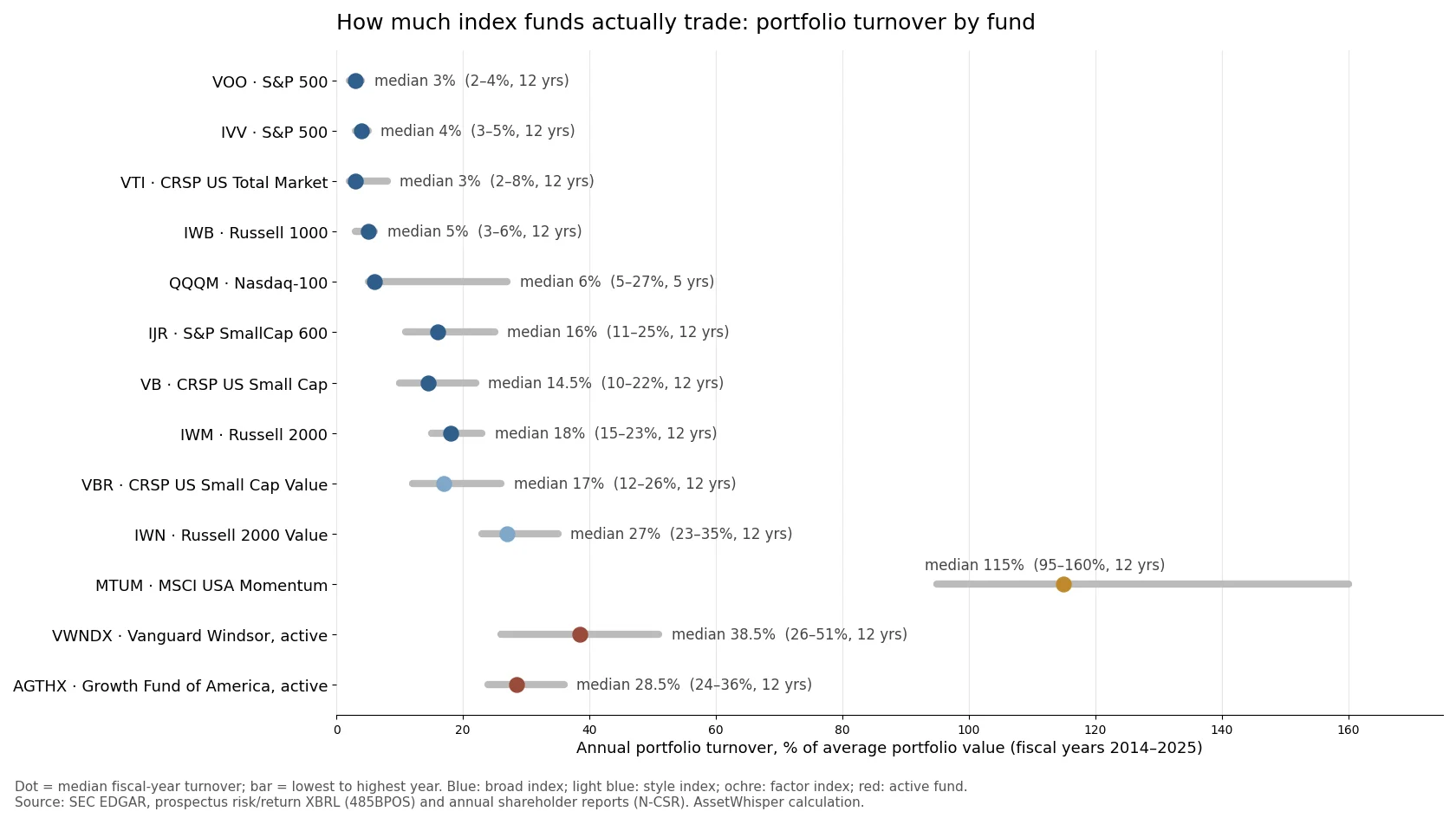
Three patterns stand out.
Large-cap index funds barely trade. VOO’s turnover was between 2% and 4% in every fiscal year from 2014 to 2025, and 2% in each of the last five. IVV, tracking the same index, ran at 3%–5%; the small gap between two funds holding the same 500 stocks reflects differences in fiscal year, cash flows and how each manager implements changes, not a different index. VTI’s highest year, 8% in fiscal 2020, is the only time one of the S&P 500, total-market or Russell 1000 funds exceeded 6%. The Nasdaq-100 fund, also large-cap, is the exception covered below.
Small-cap index funds trade several times as much. Small companies cross size breakpoints more often, get acquired more often, and leave the index when they grow into the mid-cap range. IWM’s turnover never fell below 15%; IJR reached 25% in fiscal 2024 and 2025. Style indexes add another layer of trading, because a stock can stay the same size and still switch between value and growth: the Russell 2000 Value fund ran at 23%–35%, against 15%–23% for the Russell 2000 itself.
Rule changes show up in the numbers. QQQM’s turnover was 5%–8% in four of its five fiscal years (8% in fiscal 2024) and 27% in the year to August 2023, the year that contains the July 2023 special rebalance. That one rule-driven event roughly quadrupled a year’s trading.
The contrast funds put this in perspective. Two long-established active funds turned over a median 28.5% and 38.5% a year, about as much as the Russell 2000 Value index fund (27%), more than the CRSP small-cap value fund VBR (17%), and far more than an S&P 500 fund. The momentum-factor fund, which follows a rules-based index but one designed to hold whatever has risen most, turned over a median 115%: more than its whole portfolio every year. “Index fund” describes how a fund picks its holdings, not how much it trades.
One caveat on ETF turnover
The turnover figure excludes some trading. Vanguard’s financial statements state that the rate “excludes the value of portfolio securities received or delivered as a result of in-kind purchases or redemptions of the fund’s capital shares, including ETF Creation Units”. ETFs can hand stocks being removed from the index to departing authorised participants instead of selling them, and that exchange does not count as turnover. The numbers above therefore measure the trading the fund did in the market, not every change in its holdings. They are comparable across these funds, but they understate the total amount of portfolio change at funds with large in-kind activity.
What the trading costs: the visible part and the hidden part
Index fund prospectuses tell investors that turnover has a cost that is not in the expense ratio. Vanguard’s wording is typical: “A higher portfolio turnover rate may indicate higher transaction costs and may result in higher taxes when Fund shares are held in a taxable account. These costs, which are not reflected in annual fund operating expenses or in the example, affect the Fund’s performance.”
The visible part: an illustration
No filing reports what each fund paid to trade, so we can only illustrate the order of magnitude. Assume each dollar bought or sold costs between 0.05% and 0.30% in spreads, commissions and market impact. The range is our assumption, not a measurement of these funds. For reference, Andrea Frazzini, Ronen Israel and Tobias Moskowitz, using $1.7 trillion of a large institutional manager’s live trades in 21 developed markets from 1998 to 2016, measured average market impact of 8.90 basis points per trade in large-cap stocks and 18.95 in small-cap stocks. The low end of our range is below their large-cap average; the high end is above every average they report, so it errs on the expensive side. Since turnover counts only one side, every dollar of turnover implies a purchase and a sale, so the cost is about twice turnover times the per-trade cost.
| Fund | Median turnover | At 0.05% a trade | At 0.30% a trade |
|---|---|---|---|
| VOO | 3% | 0.3 bp | 1.8 bp |
| IWM | 18% | 1.8 bp | 10.8 bp |
| IWN | 27% | 2.7 bp | 16.2 bp |
| MTUM | 115% | 11.5 bp | 69 bp |
One basis point (bp) is 0.01 percentage points a year. On this illustration, the trading an S&P 500 fund does to follow its index costs under two basis points a year, small next to even a low expense ratio. The cost scales with turnover, so it matters more for small-cap, style and factor funds.
The hidden part: the index effect
The larger cost, if there is one, does not come from commissions. It comes from everyone knowing what index funds will buy and when. If thousands of funds must buy a stock at the close on a published date, other traders can buy it first and sell it to them at a higher price, and the index itself records the higher price. Index funds track the index closely and still lose that return, because the index absorbs it too.
Antti Petajisto measured this for 1990–2005 and called it the “index turnover cost”. He estimated its lower bound at 21–28 basis points a year for the S&P 500 and 38–77 basis points a year for the Russell 2000, with both peaking in 2000: 65–82 basis points for the S&P 500 and 232–463 for the Russell 2000. Ananth Madhavan found significant returns around the Russell reconstitution from 1996 to 2002 and, in the words of the article’s published abstract, concluded that they “represent a significant cost to index funds that rebalance on the reconstitution date”.
The effect has since shrunk. Robin Greenwood and Marco Sammon report that the abnormal return on a stock added to the S&P 500 “has fallen from an average of 7.4% in the 1990s to less than 1% over the past decade”, that deletions averaged a return of only 0.1% between 2010 and 2020, and that a similar decline has occurred in other index families. Those estimates are for the past; they do not say what the effect will be after Russell’s move to two reconstitutions a year, or in the next special rebalance.
Some index rules work against this cost. CRSP says it spreads each quarterly change over five days to mediate market impact, and it moves size migrations in two halves. Russell publishes preliminary lists weeks ahead and updates them weekly. S&P’s additions are decided by a committee and announced only days before they take effect, which leaves less time to trade ahead; that is our reading, as S&P’s methodology does not state it as a purpose. Whether those rules leave more money with index-fund investors than a single fixed date would is not something turnover figures can show.
Index fund rebalancing is not your portfolio’s rebalancing
None of the trading above changes how much of your money is in stocks, bonds or anything else. An S&P 500 fund stays 100% in S&P 500 stocks whatever the market does. If you hold an equity index fund and a bond fund, the mix between them drifts as prices move, and the funds will not correct it for you. That decision, and the evidence on calendar versus threshold rules, is in how often should you rebalance your portfolio? Funds that do hold a fixed mix, such as target-date or balanced funds, rebalance between their parts under their own stated policies; this article does not cover them.
What this does not say
- It does not say low turnover makes a fund a better choice. Turnover is one cost among several; tracking error, fees and the index itself matter too.
- It does not measure what any fund paid to trade. The cost table is an illustration built on an assumed range, checked against published averages for institutional trades.
- It does not say the index effect is gone. The studies cited measure averages over past periods; a large, unusual event, like the July 2023 Nasdaq-100 special rebalance, can still move prices.
- It does not cover bond index funds, international index funds or funds that track their index by sampling rather than full replication.
- The Russell data predate the semi-annual schedule. Whether two reconstitutions a year raise or lower annual turnover for Russell funds will only show up in fiscal years ending after December 2026.
Frequently asked questions
How often does an S&P 500 index fund rebalance?
The S&P 500 has no scheduled reconstitution. Share counts and float factors are updated quarterly, effective after the third Friday of March, June, September and December, and companies are added or removed whenever the index committee decides, usually with at least three business days’ notice. Funds tracking it trade on those dates and when mergers or other corporate actions occur. VOO’s annual turnover was 2%–4% in fiscal years 2014–2025.
How often does the Russell 2000 reconstitute?
Since 2026, twice a year: in June (after the close on 26 June in 2026) and in December (scheduled for after the close on 11 December 2026). Until 2025 it was reconstituted once a year in June. Eligible IPOs are added quarterly. IWM’s turnover was 15%–23% a year in fiscal years 2014–2025, all under the annual schedule.
Do Vanguard index funds rebalance quarterly?
Most Vanguard US equity index funds track CRSP indexes, which are reconstituted quarterly with each change phased in over five trading days. Vanguard 500 tracks the S&P 500 and follows S&P’s calendar instead. Vanguard Total Stock Market’s turnover was 2%–8% a year in fiscal years 2014–2025; Vanguard Small-Cap’s was 10%–22%.
Does index fund rebalancing affect me as an investor?
Only indirectly. The trading happens inside the fund and its costs are reflected in the fund’s return, not charged separately; the prospectus warns that higher turnover may mean higher transaction costs and, in taxable accounts, higher taxes. For large-cap index funds the turnover is a few percent a year. It does not rebalance your own allocation between funds.
Why do small-cap index funds have higher turnover?
Small companies cross size breakpoints, get acquired and change style more often than large ones, so more of the index changes at each review. In our data, small-cap index funds had median turnover of 14.5%–18% a year, against 3%–5% for S&P 500, total market and Russell 1000 funds.
How we calculated this
- Data: SEC EDGAR, retrieved 2 November 2026. For each fund’s series we listed its 485BPOS filings since 2011 and its N-CSR filings since July 2024, downloaded each filing’s XBRL instance and read the element PortfolioTurnoverRate (risk/return summary of the prospectus, tagged by series) and InvestmentCompanyPortfolioTurnover (tailored shareholder report, tagged by share class and fiscal period). Every figure is printed with its accession number and URL in the script’s output.
- Fiscal years: a prospectus reports turnover “during the most recent fiscal year”, so each prospectus value is assigned to the last fiscal-year end before its filing date, using each fund’s fiscal-year end; where the annual report gives the same year, the two values matched in all 22 cases. When two prospectuses in the same fiscal year disagreed (one case, AGTHX fiscal 2014: 27% and 26%), the more frequent value is used and the other is listed in the output. A manual check against the financial highlights of the Vanguard Small-Cap Index Fund in its N-CSR for 2025 gave the same five figures.
- Window: every fund is cut at fiscal 2025 so that all cover the same years; AGTHX, whose fiscal year ends in August, has already reported 39% for fiscal 2026.
- Funds: VOO, IVV, VTI, IWB, QQQM, IJR, VB, IWM, VBR, IWN, MTUM, VWNDX and AGTHX, chosen to cover each index family and to provide a factor and two active contrasts. The figures are fund-level, so Vanguard ETF and mutual fund share classes of the same fund share one number.
- Medians are over fiscal years 2014–2025 (2021–2025 for QQQM). With twelve years, the median is the average of the sixth and seventh values.
- Cost illustration: 2 × median turnover × an assumed cost of 0.05% or 0.30% per dollar traded, compared with the average market impact measured by Frazzini, Israel and Moskowitz (2018, Table II). It is an assumption, not a measurement of these funds, and leaves out the index effect.
- Limits: turnover excludes in-kind creations and redemptions; it does not capture the index effect; thirteen funds are an illustration, not a survey; and the methodology rules quoted are those in force in 2026, which have changed over the period the turnover data cover. The script that downloads every figure and draws the chart is kept with this article’s working files.
Sources
- S&P Dow Jones Indices, S&P U.S. Indices Methodology (July 2026) and Equity Indices Policies & Practices (August 2026).
- CRSP, CRSP Market Indexes Methodology Guide (2026 edition) and Key Concepts.
- FTSE Russell, Russell US Semi-Annual Reconstitution – Schedule Update (5 November 2025); 2026 reconstitution schedule (2 March 2026); December 2026 reconstitution schedule (1 September 2026); June 2026 reconstitution summary.
- Nasdaq, Nasdaq-100 Index Methodology (April 2026); Special Rebalance announcement (7 July 2023); All About Index Concentration (16 November 2023).
- MSCI, Global Investable Market Indexes Methodology Summary (July 2026) and index review dates (12 August 2026).
- Antti Petajisto, “The index premium and its hidden cost for index funds”, Journal of Empirical Finance, 18(2), 2011, pp. 271–288.
- Robin Greenwood and Marco Sammon, “The Disappearing Index Effect”, Journal of Finance, 80(2), 2025, pp. 657–698.
- Andrea Frazzini, Ronen Israel and Tobias J. Moskowitz, “Trading Costs”, working paper, SSRN 3229719, 2018, Table II.
- Ananth Madhavan, “The Russell Reconstitution Effect”, Financial Analysts Journal, 59(4), 2003, pp. 51–64.
- Data: SEC EDGAR, fund prospectuses (form 485BPOS) and annual shareholder reports (form N-CSR) of the thirteen funds listed, retrieved 2 November 2026; Vanguard Index Funds, form N-CSR for 2025 (financial highlights).
Related reading
- How often should you rebalance your portfolio? — the other meaning of “rebalance”: your own asset mix.
- Index funds vs active management: what 25 years of scorecards show — how index funds compare with the active funds that trade more.
- How much risk does diversification remove? — what holding the whole market does and does not protect against.
- Lump sum vs dollar-cost averaging — the evidence on when to put money into a fund.
This article is general information, not personalised investment or tax advice. It does not take into account the financial situation, objectives, tax position or risk tolerance of any individual reader, and the same text is distributed to all readers. Fund names are used to illustrate how index rules translate into trading and are not recommendations to buy or sell any fund. Historical turnover describes the past and is not a forecast. Capital is at risk.