May 2026 Market Update: Stocks Hit Records as War, Oil, and Gold Reshape the Investment Landscape
Key takeaway
Equity indices reached record highs in May 2026 while war, oil and gold reshaped the risk picture underneath them. The month is a useful case study in how geopolitical shocks actually transmit to portfolios: through energy prices, safe-haven flows and rate expectations, rather than through the headlines themselves.
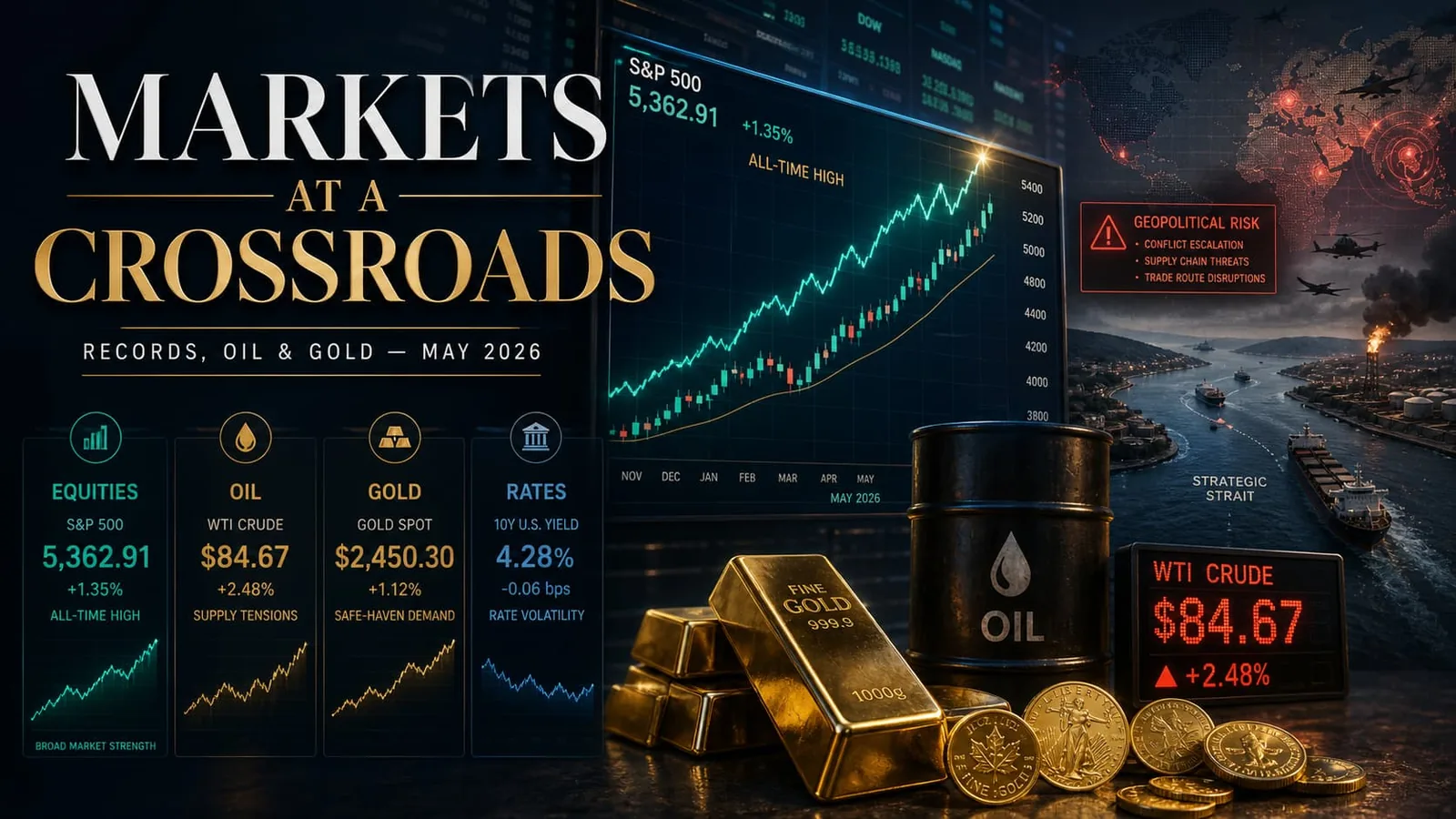
May 2026 opens with one of the strangest setups in recent market memory. The S&P 500 closed Friday at 7,230.12, the Nasdaq Composite ended at an all-time high of 25,114.44, and the Dow slipped 152.87 points to settle at 49,499.27. Both leading benchmarks printed fresh closing records on the same day that the U.S. national average for retail gasoline hit $4.39 per gallon — roughly 50% above pre-conflict levels — and WTI crude was trading near $102 per barrel.
A war is on. The Strait of Hormuz has been contested for almost three months. Gold has spent the year oscillating in a range above $4,600. The 10-year Treasury yield is at 4.39%. And U.S. equities just delivered their strongest April since 2020.
If you find that combination disorienting, you are not alone. Markets are pricing in a very specific version of the future — one in which corporate earnings keep climbing, the Federal Reserve eventually cuts rates again, and the geopolitical conflict resolves without a recession. Each of those assumptions is reasonable on its own. Together, they leave very little room for error — and as we’ll see, the Fed itself is openly divided on the path forward in a way it has not been since 1992.
This briefing walks through what is actually happening — the records, the war, the earnings surprise, the historic Fed dissent, the commodity moves, the Spirit Airlines collapse, and the cracks beneath the surface — and translates each of them into specific positioning decisions you can make in your own portfolio.
It pairs naturally with our recent pieces on AI Trading Agents (the technology layer running underneath this rally), the GENIUS Act and Stablecoin Regulation (where the dollar is going), and Crisis-Proof Investments (which sectors actually hold up when narratives shift).
Where Markets Stand Right Now
Let’s start with the snapshot. As of the May 1, 2026 close:
- S&P 500: 7,230.12 — new all-time closing high
- Nasdaq Composite: 25,114.44 — new all-time closing high
- Dow Jones Industrial Average: 49,499.27 — down roughly 153 points on the day
- 10-year Treasury yield: ~4.37%–4.39%
- WTI crude oil: ~$102–$103 per barrel
- Gold: ~$4,600 per ounce
- Federal funds target rate: 3.50%–3.75% (held at the April 29 meeting, the third consecutive pause)
- U.S. retail gasoline: ~$4.39 per gallon, roughly 50% above late-February levels
April 2026 was the best month for the S&P 500 since 2020. That is the headline most investors will see. The deeper context — and the reason it is happening despite a shooting war — is what matters.
The Earnings Story Driving the Rally
Strip out the geopolitics and one fact dominates the tape: corporate earnings did not just beat — they crushed. And the magnitude of the beat changed materially in the final week of April.
A month ago, analysts expected Q1 2026 S&P 500 earnings to grow roughly 14%. A week before May 1, the consensus had moved up to about 16%. Then Big Tech reported. Alphabet, Meta, Amazon, and Microsoft printed on Wednesday, Apple on Thursday — and by Friday’s close, LSEG IBES data showed Q1 S&P 500 earnings growth tracking at 27.8%, the strongest pace since the fourth quarter of 2021. FactSet’s blended figure put the same number at 27.1%, with seven of eleven sectors posting double-digit growth.
That is not a normal upgrade. Mid-cycle earnings revisions of that magnitude — more than a full doubling of the expected growth rate inside two weeks — are extraordinarily rare, and they are the single most important reason the index is at all-time highs in the middle of an oil shock.
Three drivers stand out underneath the headline number:
The AI capex cycle is real and broadening. Caterpillar beat earnings expectations and pointed to a record backlog and surging demand for power generation equipment from AI data centers. A construction-and-mining bellwether telling you the AI buildout is what’s driving its book is the kind of cross-sector confirmation that earnings models routinely miss. We covered the broader theme in Artificial Intelligence ETFs and the operational side in AI Trading Agents — but the takeaway here is simpler: AI is no longer just a software story, it is a capex story for industrials and utilities too.
Apple delivered the cleanest print in years. Apple jumped roughly 3% Friday after reporting its strongest quarterly sales growth in over four years, driven by demand for the iPhone 17 lineup. A clean print from the largest stock in the index resets sentiment for the entire mega-cap complex.
The energy sector is doing the heavy lifting on revisions. Edward Jones noted that the upward revision to 2026 earnings has been driven largely by a nearly 40% increase in expected earnings per share for the energy sector, reflecting the higher oil-price backdrop. Materials and technology have also seen 2026 earnings estimates rise by more than 11%. In other words, the Iran war is not just a risk — it has materially reshaped which sectors are leading the year.
That is the rotation worth watching. Equity markets in 2025 were heavily driven by the artificial intelligence trade, and 2026 is starting to show a rotation toward segments that had been overlooked.
The Iran War: How Markets Are Pricing the Conflict
The conflict began in late February 2026 and has produced the kind of contradictions that always emerge when geopolitical shocks meet a strong earnings backdrop. Equities have shrugged off the disruption faster than anyone expected.
According to Mercer Advisors, the major averages dipped on the start of the U.S. war with Iran but all three indexes are now trading well above where they began 2026, with the firm describing itself as still strategically bullish on equities even if the conflict persists.
The market’s logic, as best we can read it: the energy disruption is real but partially offset by U.S. Strategic Petroleum Reserve releases (172 million barrels coordinated with more than 30 nations), Jones Act waivers, and EPA fuel-blending flexibility; the Strait of Hormuz situation is bad for shipping but has not produced a global supply shock equivalent to 1973 or 1990; and U.S. corporate earnings, particularly in technology, are durable enough to absorb the macro hit.
Where this is most visible is in oil-sensitive earnings. Exxon and Chevron both beat quarterly earnings expectations but reported sharp drops in profits, with Exxon’s net income down roughly 45% and Chevron’s down 36%. That is a reminder that even integrated oil majors do not benefit linearly from higher crude — refining margins, currency effects, and write-downs all complicate the picture. The simple “war pushes oil up, oil stocks up” trade is not how 2026 has actually played out for the giants.
Where it has played out is in equipment, services, and select energy infrastructure. Power generation, pipelines, and refiners with the right product mix have been the cleaner trade. This is exactly the granular sector analysis we cover in Crisis-Proof Investments: Resilient Sectors in Times of Volatility — because crisis-resilience is rarely about the obvious sector and almost always about the sub-segment.
The other piece is gasoline. The U.S. national average for retail gasoline hit $4.39 per gallon on May 1, up roughly 50% — about $1.50 per gallon — from late February, with prices ranging from $3.38 in Oklahoma to over $5.83 in California and exceeding $6 in some California metros. That is a real-economy tax on consumers, and it is starting to show up in the consumer discretionary tape — which is a clean reason the Dow underperformed the Nasdaq on Friday and why staples and discretionary earnings estimates have been revised lower for 2026 even as the index aggregate has been revised higher.
The Fed: A Historic Dissent in Powell’s Final Meeting
Monetary policy is normally a story about what the Fed does. In April 2026 it became a story about how openly the Fed disagrees with itself.
At the April 29 meeting — Jerome Powell’s last as Fed Chair before his term expires May 15 — the FOMC voted 8-4 to hold rates in the 3.50%–3.75% target range. That single number is the most important Fed development of the year so far. The last time four FOMC members dissented at a single meeting was October 1992. This was not a routine pause; this was the most divided U.S. central bank in over three decades, in the final meeting of an outgoing chair, with a successor (former Fed Governor Kevin Warsh) already nominated and clearing key procedural votes in the Senate.
The four dissents split in opposite directions, which is the part that matters for portfolio construction:
- Stephen Miran (Governor) dissented in favor of a 25-basis-point cut. He has now dissented dovish for six consecutive meetings.
- Beth Hammack (Cleveland Fed President), Neel Kashkari (Minneapolis Fed President), and Lorie Logan (Dallas Fed President) dissented because they supported holding rates but opposed the easing-bias language in the post-meeting statement — the phrase about “the extent and timing of additional adjustments” implying the next move would more likely be a cut than a hike.
The trio’s reasoning was unusually direct. Hammack noted that rising oil prices add to broad-based inflationary pressures and create upside risks to inflation alongside downside risks to growth. Logan, dissenting for the first time since becoming Dallas Fed president in 2022, argued that prolonged supply disruptions from the Middle East could plausibly justify either a cut or a hike as the next move. Kashkari pushed back on issuing forward guidance at all under current uncertainty.
Powell himself, asked at the press conference whether he was handing a divided Fed to his successor, framed the moment in terms of the four supply shocks the central bank has absorbed in five years: the pandemic, the Ukraine invasion, the tariff regime, and now Iran. The answer was a polite acknowledgment that there is no consensus on what the next move should be — and that the new chair will inherit that lack of consensus.
For investors, the practical implications are concrete and slightly different from a week ago:
- Duration risk has become more asymmetric. A 4.39% 10-year is attractive on an absolute basis, but if oil-driven inflation re-accelerates and the new chair cannot quickly build consensus for cuts, long-dated bonds will underperform.
- The “one cut by year-end” base case is now under genuine debate. The Fed’s December projections still implied roughly one quarter-point cut in 2026, but with three voting members on the record opposing easing-bias language, the probability of zero cuts has risen meaningfully.
- The Fed Chair transition itself is a market variable. Kevin Warsh’s confirmation and his first communications will be more market-moving than typical Fed Chair transitions.
We have a deeper framework for this in The Impact of Interest Rates on Investment Choices, and the principle is unchanged: rate regimes shift portfolio construction more than narratives do, and a divided central bank is itself a regime change.
Gold: The Quiet Star of the Cycle
Here is a number that should make every investor pause. Gold delivered roughly 60%+ returns in 2025, crossing $4,000 per ounce for the first time in October. It then extended the move into early 2026, reaching as high as the $5,400s in late January before suffering a sharp pullback — falling roughly 14% in three days in early February — and settling into a wide range that has held above $4,600 through April.
Three reinforcing forces are driving this:
Central banks keep buying. J.P. Morgan Global Research projects investor and central bank gold demand to average around 585 tonnes per quarter in 2026, comprising roughly 190 tonnes per quarter from central banks plus 330 tonnes per quarter in bar and coin demand and around 250 tonnes of expected ETF inflows over the year. That is structural demand independent of any short-term price catalyst.
The dollar has weakened. The dollar continues to drift lower against a basket of trade-weighted currencies, with the rally seen in March after the outbreak of the Iran conflict having faded. A softer dollar makes gold cheaper for the rest of the world and reinforces the bid.
Geopolitical risk is no longer being treated as transient. Even with constructive Iran negotiation headlines, the safe-haven premium has not unwound. The market is pricing elevated geopolitical risk as a new normal rather than a temporary spike.
The forecast picture is unusually wide. J.P. Morgan Global Research projects gold to average $5,055 per ounce in the final quarter of 2026 and around $5,400 by the end of 2027. Société Générale has called for $6,000 per ounce by year-end, while Morgan Stanley has flagged a $5,700 bull case.
This is not a “buy gold” call. It is a recognition that gold has moved structurally and that any portfolio that ignores it is taking a more concentrated bet on dollar-denominated risk assets than its owner probably realizes. We laid out the framework in Portfolio Hedging Strategies: What Each One Costs, and the practical question for May 2026 is not whether to own gold but how much. For most diversified portfolios, a 5%–10% allocation now does meaningfully different work than it did when gold was at $2,000.
A volatility caveat worth repeating: gold lost 14% in three days in early February. It is no longer the slow, steady store-of-value asset of the post-2013 era. Position size accordingly.
Where the Cracks Are Showing
Markets at all-time highs always look invincible until they don’t. Three specific cracks are worth tracking through May.
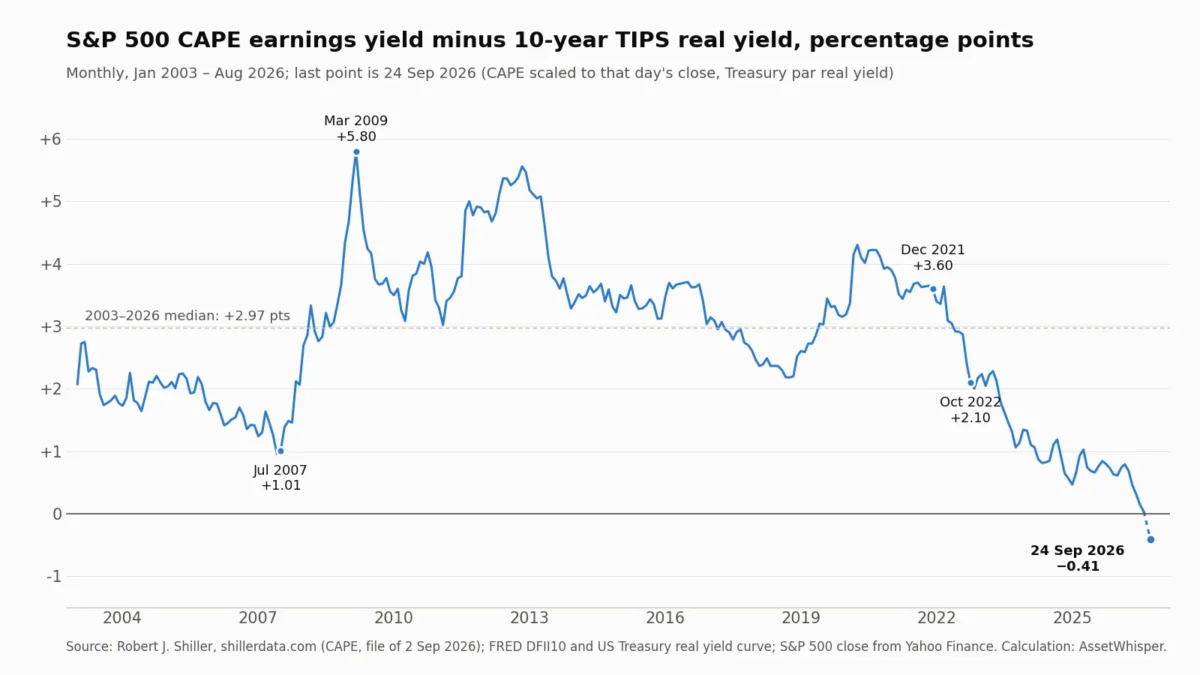
Equity risk premium near zero. As 2026 began, the S&P 500’s forward earnings yield was nearly identical to the 10-year U.S. Treasury yield, leaving an equity risk premium of about 0.02% — among the lowest readings on record. Translation: investors are accepting equity volatility for essentially the same yield they could earn risk-free. That is not by itself a sell signal, but it is the textbook condition where downside surprises hit hardest.
Concentration is still extreme. Over the last three years, mega-cap growth stocks have driven an 86% total return for the S&P 500 versus 43% for the equal-weight index — a gap last seen during the late-1990s tech bubble, fueled mostly by multiple expansion rather than superior earnings growth. The 2026 broadening is happening, but slowly, and the index-level performance still hides a lot of dispersion.
Spirit Airlines just ceased operations. In the early hours of Saturday, May 2, Spirit Airlines announced an immediate orderly wind-down after a $500 million government rescue package fell through, becoming the first major U.S. airline to go out of business for financial reasons in 25 years. Approximately 17,000 jobs are affected, including 14,000 Spirit employees. Spirit Aviation Holdings shares, which fell more than 62% on Friday to 52 cents, are now in liquidation mode. Roblox, separately, tumbled 24% on Friday after slashing its 2026 bookings guidance from a prior range of $8.28–$8.55 billion down to $7.33–$7.6 billion, citing short-term friction from age-based accounts and content monitoring changes.
Both are reminders that index-level records do not protect individual positions from idiosyncratic risk. Spirit was bleeding cash long before Iran, but the war’s impact on jet fuel prices was the final blow. Even a multi-year warning sign can resolve abruptly.
These are exactly the kinds of dynamics we frame in Common Mistakes in Stock Market Investing. The most expensive mistake at all-time highs is not sitting out the rally — it is treating “the market is up” as a substitute for thinking about specific holdings.
How to Position Your Portfolio in May 2026
The goal of a market update is not just to describe what happened — it is to translate it into action. Here is a practical framework for the next 30 to 60 days, adapted to where you sit.
If You Are a Long-Term, Diversified Investor
You probably should not change much. The base case — earnings growth that beat dramatically in Q1, a Fed that ultimately delivers at most one cut this year, and equity records that broaden into more sectors — supports staying invested. The calibration matters more than the direction.
Three small adjustments that pay off in this regime:
- Trim, don’t sell. If your equity allocation has drifted above target because of the rally, rebalance back. This is mechanical, unemotional, and exactly the discipline we describe in How to Develop a Successful Investor Mindset.
- Add a real diversifier. A small (5%–10%) allocation to gold, broad commodities, or a multi-strategy hedge fund product changes the shape of your portfolio’s distribution more than another tech ETF does.
- Stress-test for $120 oil and $80 oil. Both are within the realistic range of outcomes from current Iran negotiations. A portfolio that survives only one scenario is under-diversified.
If You Are Tactical or Swing Trading
This is a tape that rewards earnings-driven momentum and punishes positioning against it. Keep stops tight on overextended winners (a record close is not a reason to add; it is a reason to manage). Watch the energy and materials sectors for the cleaner expression of the geopolitical premium — direct oil-major exposure has been a less efficient trade than equipment, refiners, and select midstream names this cycle. The Spirit collapse is a fresh case study in how single-name risk compounds.
For risk-adjusted comparisons, the discipline in The Sharpe Ratio: History, Applications, and Calculations is more useful right now than headline returns.
If You Are Building Toward a First Major Allocation
This is the hardest spot in the cycle. All-time highs feel like the worst possible entry point. They are not, statistically — but they do mean that how you enter matters more than whether you enter.
Dollar-cost averaging over six to twelve months remains the boring, correct answer. Pair it with a clear written plan: target allocation, rebalancing thresholds, and rules for what you will and will not do during the next 10% drawdown. The plan written in calm beats every plan extemporized in panic. We unpack the full mindset in How to Invest in the Financial Market the Right Way.
If You Are Concerned About a Recession
The recession narrative has not gone away. Soft labor data, sticky service inflation (March headline CPI rose 3.3% year over year, the highest since May 2024), and the political risk around the Fed Chair transition all remain on the watch list. Oppenheimer specifically called out a soft labor market and the upcoming Fed Chair selection as factors that could introduce policy uncertainty later in 2026.
If that is your dominant concern, the answer is not to sell broad equities. It is to upgrade quality. Lean into companies with strong balance sheets, durable cash flow, and pricing power; reduce exposure to high-multiple stories that need everything to go right; keep some dry powder in short-duration Treasuries earning above 4%. This is the same principle we teach in How to Manage Risk in Your Financial Investments — risk management is composition, not timing.
Three Things to Watch in May
The narrative changes that would actually move markets in the next 30 days are concentrated:
The Iran negotiation track. Reports indicate that Iran sent its response through Pakistani mediators to the latest U.S. amendments to a draft agreement aimed at ending the conflict. A genuine breakthrough would crush oil, lift consumer discretionary, and potentially trigger a sharp move in gold. A breakdown does the opposite. Position for both, because the headline risk is binary.
The Powell-to-Warsh transition. Powell’s term as chair ends May 15 and Kevin Warsh has been advancing through Senate confirmation. With three regional Fed presidents now publicly opposed to dovish forward guidance, Warsh’s first communications — and any ability to build consensus quickly — are now a market variable in their own right. Watch for any signal on whether the new chair leans toward Miran’s dovish view or toward the Hammack/Kashkari/Logan caution.
Tier-two earnings and consumer data. The mega-caps reported strongly. The next two weeks bring the consumer companies, the industrials’ supply chain commentary, and the regional banks’ loan books. That is where you find out whether the rally is a small-handful-of-winners story or a genuine broadening — and whether $4.39 gasoline is starting to bite consumer balance sheets.
Where to Go From Here
AssetWhisper does not manage portfolios, run accounts or publish trade signals. What it publishes is the reasoning behind decisions like this one: what a core allocation is supposed to do in a month like this, which sectors hold up when volatility arrives, and how much of it you can sit through.
Frequently Asked Questions
Why are stocks at all-time highs during a war?
Because earnings are growing faster than the war is shrinking them, and because the market has decided the conflict will not produce a global recession. After Big Tech reported, Q1 2026 S&P 500 earnings growth jumped to 27.8% — the strongest pace since Q4 2021 — far above the mid-teens consensus from a month earlier. Records and wars have coexisted before — most recently during the Ukraine conflict — and the deciding factor each time has been the trajectory of corporate profits, not the headlines.
Should I buy stocks at record highs?
It depends on your time horizon and what’s already in your portfolio. For long-term, diversified investors, dollar-cost averaging into broad indexes has historically worked even when initiated at record highs. For tactical traders, records are a reason to tighten risk management, not to add aggressively. The framework in How to Invest in the Financial Market the Right Way applies cleanly here.
Will the Fed cut rates in 2026?
The base case is still one quarter-point cut by year-end, but the probability of zero cuts has risen meaningfully after April’s 8-4 dissent vote — the most divided FOMC since October 1992. With three regional presidents publicly opposed to easing-bias language and a chairmanship transition underway, the bar for a cut is now higher than it appeared in March.
Is gold still a good investment at $4,600?
Gold has worked extraordinarily well for nearly two years and has structural demand from central banks that does not depend on the next 5% move. That said, it is more volatile than it used to be — a 14% drawdown in three days is on the recent record. For most diversified portfolios, gold deserves a 5%–10% allocation as a real diversifier, not a single-position bet.
What sectors are leading in 2026?
Energy (driven by oil prices and a ~40% upward revision to 2026 sector earnings), technology (AI capex and earnings — Communication Services, Information Technology, Consumer Discretionary, and Materials are all posting double-digit Q1 growth), and industrials with AI-data-center exposure (Caterpillar’s print is the cleanest signal). Consumer discretionary and staples have been pressured by higher gasoline prices.
Should I worry about the equity risk premium being near zero?
You should not panic-sell, but you should size positions accordingly. A near-zero equity risk premium means you are not being paid to take equity risk over Treasuries. That historically increases the cost of being wrong. Diversification, quality tilts, and explicit rebalancing rules become more valuable in this regime, not less.
How does the Iran war affect my portfolio if I don’t own oil stocks?
Indirectly but significantly. Higher oil flows through to gasoline (the U.S. national average is now $4.39, up roughly 50% from late February), transport costs, consumer discretionary spending, and inflation expectations — which in turn shape Fed policy and bond yields. Even an “AI tech” portfolio is sensitive to the conflict through Fed-sensitivity and consumer demand for the products those companies sell.
What does the Spirit Airlines collapse mean for the market?
For the index, very little — Spirit was a small-cap with declining market share. For investors, it is a reminder that idiosyncratic risk does not respect macro narratives. A company can be in trouble for years and then collapse over a weekend when one specific catalyst (a failed bailout in Spirit’s case) lines up with one specific shock (jet fuel prices). The takeaway is not “avoid airlines”; it is to keep position sizes consistent with the risk that any single thesis can fail abruptly.
Conclusion
May 2026 is a market that will reward investors who hold two contradictory ideas at once. Yes, U.S. equities are at all-time highs, Q1 earnings just printed at 27.8% growth, and the AI capex cycle is broadening into industrials and energy. And yes, oil is at $102, gold is at $4,600, gasoline is up 50%, the Fed just delivered its most divided vote in 34 years, and a major U.S. airline ceased operations between Friday’s close and Saturday’s open. Both pictures are accurate. The right portfolio reflects both.
The investors who will compound through the rest of 2026 are not the ones who pick the right narrative. They are the ones who build positioning that survives if the narrative shifts — discipline at all-time highs, diversification across geopolitical scenarios, real hedges, and a written plan they can actually follow. That is the playbook we have been refining at AssetWhisper, and it is the one that will matter most in the next 30 to 60 days, particularly as the Powell-to-Warsh Fed transition unfolds.
Records, war, a historically divided Fed, and a weekend airline collapse make for an unusually loud tape. The signal in it is the same as in every cycle: own quality, manage risk, and let earnings — not headlines — do the work.