Nikkei 225 at Record Highs: Why Japan Is 2026’s Best-Performing Market and What It Means for Your Portfolio
Key takeaway
Japan's Nikkei 225 crossed 62,000 for the first time in May 2026, making it the best-performing major market of the year on four structural drivers rather than one rally. For a foreign investor the yen is the decisive variable: currency moves can erase the entire index gain unless the exposure is hedged.
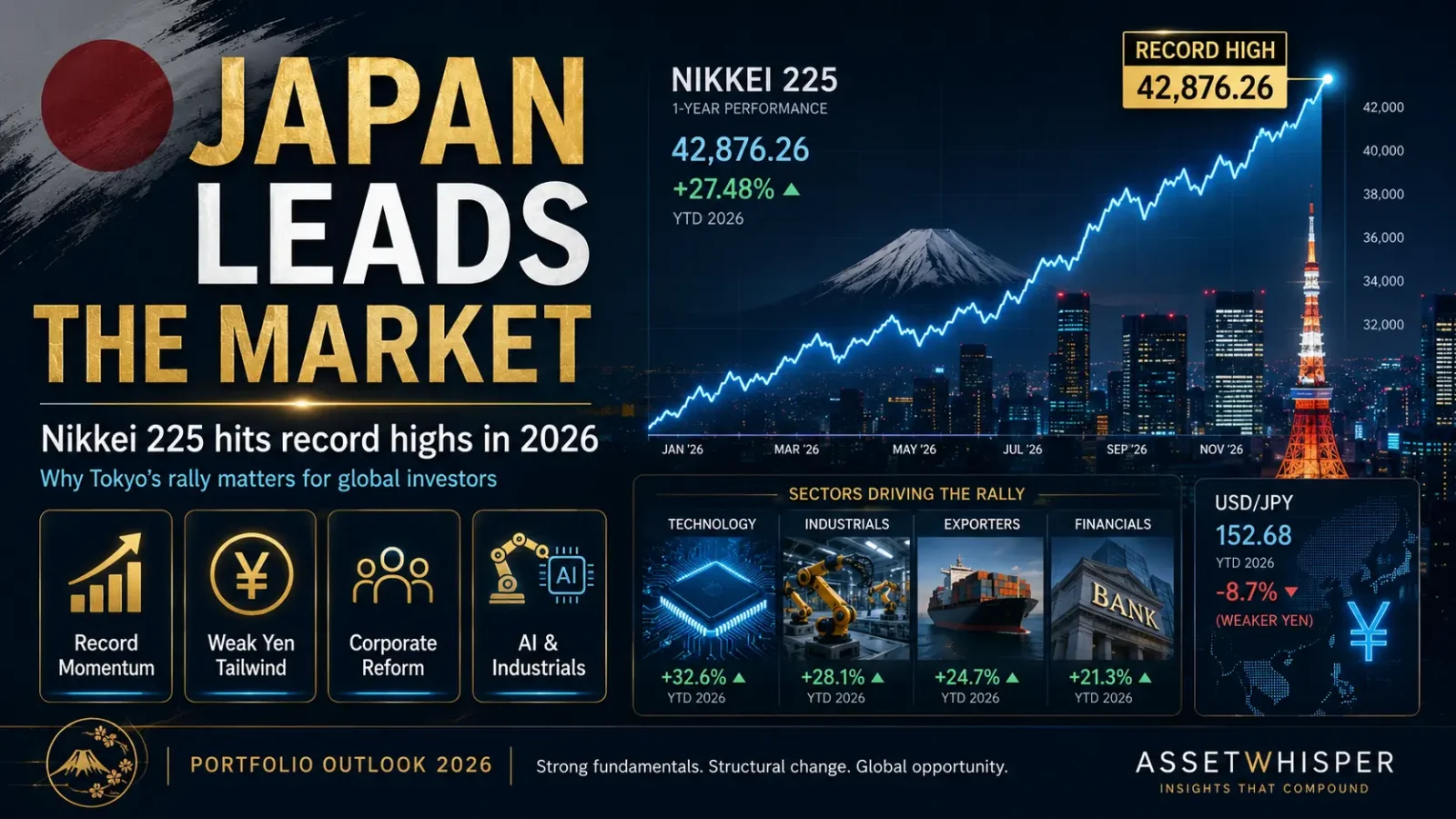
While most investors have spent 2026 fixated on Wall Street, the artificial intelligence rally, and the gyrations of gold and oil, the single best-performing major stock market in the world has been on the other side of the Pacific. Japan’s Nikkei 225 crossed 62,000 on a closing basis for the first time in history on May 6, 2026, and the following session it delivered the largest single-day point gain ever recorded — a surge of 3,320.72 points, or roughly 5.6%, closing at 62,833.84 after briefly topping 63,000 intraday. Through mid-May, the index is up approximately 24% year to date, leaving the S&P 500’s gain of around 8.3% far behind and making the Nikkei the standout performer among the world’s large benchmarks.
For investors who hold mostly domestic assets — and that describes the overwhelming majority of retail investors everywhere — this is more than a piece of foreign market trivia. It is a live, expensive lesson in the cost of home bias. A diversified global investor captured a chunk of that 24% return. A purely domestic investor captured none of it. The Nikkei’s record run is a reminder that opportunity is global, that leadership rotates between regions, and that the portfolio which only owns its home market is making a concentrated bet whether the investor realizes it or not.
This article unpacks what is actually driving Japan’s record-breaking year, why the rally is tightly bound to the same AI forces lifting US markets, the single most important risk that Japanese equity investors must understand — the yen — and the practical, structured ways an investor can add international diversification without simply chasing a hot market at the top.
What Actually Happened: Anatomy of a Record-Breaking Rally
To understand whether Japan’s rally is an opportunity, a warning, or both, an investor first needs to understand the mechanics of how it unfolded — because the timing and the drivers reveal a great deal about its durability.
The explosive move came on May 7, 2026, when the Tokyo market reopened after an extended Golden Week holiday closure. During the days Japanese markets were shut, global equities — and US technology stocks in particular — had staged a powerful rally. Wall Street’s tech-heavy Nasdaq Composite had climbed hundreds of points and set consecutive record highs, propelled by strong artificial intelligence chip earnings and renewed optimism that the US and Iran were moving toward a deal to end their conflict, which sent oil prices sharply lower.
When Tokyo reopened, it effectively had to price several sessions of global gains into a single day. The result was the largest one-day point gain in the index’s history, surpassing the previous record set in August 2024. Roughly 30 of the 33 industry sectors on the Tokyo Stock Exchange advanced, with advancing stocks outnumbering decliners by more than three to one. The broader Topix index, which is more representative of the overall market than the price-weighted Nikkei, also surged and traded near its own record high.
The standout single name was SoftBank Group, the technology-focused investment conglomerate, whose shares soared more than 18% in their best single session since 2020. SoftBank’s move was driven by the market value of its technology holdings, including its stake in chip designer Arm Holdings and its exposure to the broader AI investment landscape. Japanese semiconductor and chip-equipment names rallied hard alongside it — companies that manufacture the testing equipment, lithography tools, and chips that sit deep inside the global AI supply chain.
In the days that followed, the index consolidated near its records rather than collapsing, a sign that the move was not purely a one-day spike. By the May 14 session, the Nikkei had eased modestly to around 62,900 as investors locked in profits — SoftBank itself pulled back several percent despite reporting a sharp rise in quarterly profit — while market participants turned their attention to the Trump-Xi summit in Beijing and its implications for trade.
The key takeaway from the anatomy of the rally is that Japan did not decouple from the global narrative. It amplified it. The same AI-driven forces lifting US markets are lifting Japanese markets, which has important implications for diversification that we will return to below.
Why Japan Is Leading: Four Structural Drivers
A single explosive session can be explained by holiday timing. A 24% year-to-date gain that leads every other major market cannot. Beneath the May fireworks sit four structural forces that have made Japan one of the most compelling equity stories of 2026.
Driver One: Japan’s Deep Position in the AI Supply Chain
The artificial intelligence boom is often framed as an American story, but the physical supply chain that makes AI possible runs straight through Japan. Japanese companies are global leaders in semiconductor manufacturing equipment, chip-testing systems, advanced materials, precision components, and the specialized machinery without which no advanced chip can be produced anywhere in the world.
This means Japanese equities offer exposure to the AI build-out that is different in character from owning US chip designers or hyperscalers. It is exposure to the “picks and shovels” layer — the equipment and materials suppliers whose order books fill up regardless of which specific AI model or platform ultimately wins. For investors who believe in the long-term AI capital expenditure cycle but worry about the valuations of the most obvious US names, the Japanese supply-chain layer is a genuinely different way to express the same thesis. It complements rather than duplicates the exposure found in many AI-focused ETFs, and it connects to the broader universe of emerging technologies reshaping financial markets and the real economy.
Driver Two: Corporate Governance Reform
One of the most underappreciated forces behind Japan’s multi-year re-rating is a sustained push to reform corporate governance. For decades, Japanese companies were known for hoarding cash, holding sprawling cross-shareholdings in one another, and prioritizing almost everything ahead of the shareholder. That has been changing. Pressure from the Tokyo Stock Exchange, regulators, and activist investors has pushed companies to unwind cross-shareholdings, improve returns on equity, raise dividends, and buy back shares.
This is a slow-moving but powerful tailwind because it changes the fundamental value proposition of Japanese equities. A market where companies are increasingly focused on shareholder returns deserves a higher valuation multiple than one where they are not. The re-rating is not finished, which is part of why several global investors continue to view Japan as a place to identify assets that remain undervalued relative to their improving fundamentals.
Driver Three: The End of Deflation
Japan spent the better part of three decades fighting deflation — a corrosive environment in which falling prices encourage consumers and companies to delay spending, which suppresses growth further. The recent shift toward sustained, moderate inflation, accompanied by the first meaningful wage growth in a generation, has changed the domestic economic backdrop. Inflation is uncomfortable for consumers in the short term, but for an economy emerging from chronic deflation, it can be a sign of returning vitality: companies gain pricing power, nominal revenues grow, and the incentive structure shifts toward investment and consumption.
This regime change interacts directly with monetary policy. As Japan normalizes away from its long era of ultra-loose policy, the path of interest rates becomes a central variable for both equities and the currency — which is exactly why understanding the impact of interest rates on investment choices is essential before allocating to Japan.
Driver Four: A Tailwind From the Yen — For Now
For much of the recent period, a relatively weak yen has flattered the earnings of Japan’s large export-oriented companies. When the yen is weak, the overseas revenues of exporters — automakers, electronics firms, machinery producers — translate back into more yen, inflating reported profits and supporting share prices. This currency tailwind has been a meaningful contributor to the earnings strength behind the rally.
But this driver comes with a sharp double edge, and it is so important for foreign investors that it deserves its own full section.
The Yen: The Single Most Important Risk for Foreign Investors
Here is the concept that separates investors who genuinely understand Japanese equities from those who simply see a rising chart: when you buy Japanese stocks as a foreign investor, you are making two bets at once. You are betting on the stocks, and you are betting on the yen. Your total return is the combination of the two, and the currency leg can either amplify your equity gains or quietly erase them.
Consider the mechanics. If the Nikkei rises 10% in yen terms but the yen weakens 10% against your home currency over the same period, your return as a foreign investor is close to zero — the equity gain is cancelled by the currency loss when you convert back. Conversely, if the Nikkei rises 10% and the yen also strengthens 10%, your return is amplified to roughly 20%. The currency is not a footnote. It is half the trade.
This dynamic is made more complex by the fact that the yen and Japanese exporters often move in opposite directions. Yen weakness boosts exporter earnings, which can lift the Nikkei in local terms — but that same yen weakness erodes the foreign investor’s converted return. Yen strength does the reverse: it can pressure exporter earnings and the local index, while improving the foreign investor’s currency translation. The two legs of the trade partially offset each other, which is genuinely useful to understand but is not the same as being fully hedged.
The yen’s path in 2026 is being shaped by several forces at once: the interest rate differential between Japan and other major economies, shifts in global risk appetite, and the prospect of official intervention, which has been observed in recent sessions. The rate side of that differential has moved fast: in September 2026 Japan’s 10-year government bond yield closed above 3% for the first time since 1996, a shift we break down in our analysis of Japanese government bonds at 3%. For a foreign investor, the practical implication is a single critical decision: currency-hedged exposure or unhedged exposure.
A currency-hedged Japan position strips out the yen movement, leaving the investor with something close to the pure equity return that a local Japanese investor would experience. A hedged vehicle is appropriate for an investor who has a view on Japanese stocks but does not want to take a currency view, or who expects the yen to weaken.
An unhedged Japan position leaves the investor exposed to the full yen movement. This is appropriate for an investor who wants the currency diversification — the yen has historically had safe-haven characteristics and can appreciate during global risk-off episodes — or who expects the yen to strengthen.
Neither choice is universally correct. What is universally correct is making the choice deliberately rather than by accident. An investor who buys a Japan fund without knowing whether it is hedged has taken a currency position without deciding to. Building this kind of awareness into the allocation process is a core part of serious investment hedging strategy and of managing risk across a portfolio.
The Bigger Lesson: The Real Cost of Home Bias
Step back from Japan specifically, and the 2026 Nikkei story illustrates one of the most expensive and least examined mistakes in retail investing: home bias, the tendency to hold a portfolio overwhelmingly concentrated in one’s own domestic market.
Home bias feels safe. Domestic companies are familiar, their news is in the investor’s language, and their fortunes seem easier to follow. But familiarity is not the same as diversification, and comfort is not the same as safety. An investor whose entire equity allocation sits in a single national market is exposed to that country’s specific political risks, currency, demographic trajectory, sector composition, and economic cycle. When that single market underperforms — and every market underperforms eventually — there is nothing in the portfolio to offset it.
The numbers from 2026 make the cost concrete. The gap between the Nikkei’s roughly 24% year-to-date gain and the S&P 500’s roughly 8.3% is not a rounding error. It is the difference between two completely different portfolio outcomes, and it accrued to investors who happened to have international exposure and was missed entirely by those who did not. Next year the leadership could easily rotate back, or to Europe, or to emerging markets. The investor cannot know in advance which market will lead. That uncertainty is precisely the argument for owning several of them.
This does not mean abandoning the home market or chasing whichever country topped the table last year — that would simply be one of the most common mistakes in stock market investing dressed up in a passport. It means building a deliberate, permanent allocation to international equities as a structural feature of the portfolio, sized according to the investor’s goals and risk tolerance, and rebalanced with discipline. The principle is the same one that underpins investing in the financial markets the right way: genuine diversification across uncorrelated or partially correlated return streams.
How to Add Japanese and International Exposure: Practical Vehicles
Once an investor has decided that international diversification belongs in the portfolio, the question becomes structural: which vehicle delivers the exposure with the right balance of cost, simplicity, and control? Several options exist, each with a distinct profile.
Broad Japan ETFs — Hedged and Unhedged
The most straightforward route for most investors is a broad Japan equity ETF that tracks the Nikkei 225, the Topix, or a similar benchmark. These vehicles offer instant diversification across hundreds of Japanese companies, low expense ratios, intraday liquidity, and the operational simplicity of a normal brokerage account. The single most important selection criterion, as discussed above, is whether the fund is currency-hedged or unhedged — and many ETF families offer both versions of essentially the same portfolio, letting the investor choose the currency stance explicitly.
Broad International and Global ETFs
For investors who do not want to make a single-country call at all, a broad international developed-markets fund or an all-world ex-domestic fund provides exposure to Japan as part of a wider basket that also includes Europe, the rest of developed Asia, and often emerging markets. This is the lowest-maintenance way to cure home bias: a single holding that ensures the portfolio is never entirely dependent on one country’s fortunes. The trade-off is less control — the investor gets Japan’s weight as determined by the index, not as chosen deliberately.
Thematic and Sector Funds
An investor whose interest in Japan is specifically about the AI supply chain might consider a thematic fund focused on global semiconductors or technology hardware, which would typically carry significant Japanese weight alongside US, Taiwanese, and South Korean names. This is a more concentrated, higher-conviction approach and should be sized accordingly. It overlaps conceptually with the kind of exposure many investors already hold through AI ETFs, so investors should check they are not unintentionally doubling up on the same underlying companies.
American Depositary Receipts and Individual Stocks
A number of the largest Japanese companies trade as American Depositary Receipts on US exchanges, allowing direct ownership of individual names without a foreign brokerage account. This route gives the most control and the most concentration — and therefore demands the most homework. Picking individual Japanese stocks requires genuine company-level analysis, comfort with different disclosure conventions, and a clear-eyed understanding of single-name risk. For most investors, this should be a small satellite position around a diversified core, not the core itself. Anyone going this route should ground the decision in solid fundamental and technical analysis.
Managed and Automated Approaches
Investors who would rather not make these allocation and currency decisions themselves can access international diversification through managed solutions, including robo-advisors that build globally diversified portfolios automatically, or through AI-driven portfolio management and trading agents that dynamically adjust geographic exposure based on market conditions. These approaches trade a degree of control for convenience and systematic discipline, which for many investors is a worthwhile exchange.
Is the Nikkei Too Expensive Now? A Balanced View
No honest analysis of a market at all-time highs can skip the obvious question: after a 24% year-to-date run and a record-breaking surge, is it simply too late?
The bull case argues that the rally rests on real foundations rather than pure speculation. Corporate earnings have been genuinely strong, the governance reforms are structural and ongoing, the AI supply-chain demand is backed by actual capital expenditure, and even after the rally, many Japanese companies trade at valuation multiples that remain reasonable by global standards — a legacy of the decades during which the market was chronically cheap. From this view, Japan is a market that was undervalued for a long time and is still in the process of closing the gap.
The bear case argues for caution. Any market making record highs after a sharp run is more vulnerable to profit-taking, as the modest May 14 pullback already hinted. The rally is heavily tied to the global AI trade, which means a correction in US technology stocks — exactly the kind of scenario that prominent investors have warned about — would almost certainly drag Japan down with it, undermining part of the diversification rationale. And the yen remains a wildcard that could move sharply in either direction.
The honest synthesis is that both cases contain truth, and that the question “is it too expensive?” is the wrong question for a long-term diversifier. The right question is “what is the appropriate permanent allocation to international equities for my goals, and am I building toward it in a disciplined way?” An investor who answers that question properly does not need to time the Nikkei. They accumulate international exposure steadily, perhaps with extra discipline after sharp run-ups, and let the permanent allocation do its work across cycles. Whether any specific entry week is “too late” matters enormously to a trader and very little to a diversified long-term investor. Tools like the Sharpe ratio help an investor judge whether the return a market is offering actually compensates for its risk, which is a more useful lens than the binary “cheap or expensive.”
Behavioral Traps to Avoid With a Hot International Market
A market that just posted the best returns in the world is a behavioral minefield. The same psychological patterns that damage investors in their home market are intensified when a foreign market is involved, because distance and unfamiliarity make it harder to think clearly.
Performance chasing is the most obvious danger. The instinct to pour money into Japan precisely because it just returned 24% is the instinct to buy high. The discipline is to size an international allocation based on its permanent role in the portfolio, not based on last quarter’s leaderboard.
Recency bias convinces investors that whatever just happened will continue. Japan led in 2026; the brain extrapolates that Japan will lead in 2027. Market leadership rotates, and the duration of an outperformance streak is not evidence that it will continue.
Neglecting the currency is the trap specific to international investing. An investor who focuses entirely on the equity chart and ignores the yen has only analyzed half the trade. The currency decision must be conscious.
Home-market overconfidence in reverse — assuming a foreign market is riskier simply because it is foreign — leads investors to underweight international exposure permanently, which is itself the concentrated bet they were trying to avoid.
The antidote to all four is the same: a written plan with a deliberate target allocation, executed with discipline regardless of which market is hot. A deeper understanding of how emotions affect investment decisions and a properly developed long-term investor mindset are worth more here than any view on the Nikkei’s next move. And because the right international allocation depends heavily on individual circumstances, it is worth honestly assessing what type of investor you actually are before settling on a number.
Frequently Asked Questions
Why is the Nikkei 225 at record highs in 2026?
The Nikkei’s record run reflects a combination of forces: Japan’s deep position in the global AI semiconductor supply chain, multi-year corporate governance reforms that have improved shareholder returns, the economy’s emergence from decades of deflation, and a period of yen weakness that has flattered exporter earnings. The explosive single-day gain on May 7, 2026, was amplified by timing — Japanese markets reopened after a holiday closure and priced in several sessions of global tech gains at once.
Is the Nikkei 225 the best-performing stock market in 2026?
Among major global benchmarks, yes, through mid-May 2026. The Nikkei’s year-to-date gain of roughly 24% placed it well ahead of the US S&P 500 at around 8.3% and Canada’s TSX at around 7.7%, making it the standout performer among the world’s large equity indices for the year so far.
Should I invest in Japanese stocks now that they are at all-time highs?
For a long-term investor building international diversification, the better framing is not whether to “time” the Nikkei but what permanent allocation to international equities suits your goals, and whether you are building toward it with discipline. All-time highs increase short-term vulnerability to profit-taking, so investors may choose to accumulate gradually rather than in a single lump sum. The decision should be driven by portfolio construction, not by recent performance.
What is the biggest risk of investing in Japanese stocks as a foreign investor?
The Japanese yen. As a foreign investor you are making two bets simultaneously — on the stocks and on the currency — and the currency leg can amplify or erase your equity returns. If the Nikkei rises but the yen weakens against your home currency by a similar amount, your converted return can be close to zero. This is why choosing between currency-hedged and unhedged exposure is the single most important decision when allocating to Japan.
What is the difference between a currency-hedged and unhedged Japan ETF?
A currency-hedged Japan ETF strips out yen movements, giving you something close to the pure equity return a local Japanese investor experiences — appropriate if you want Japanese stock exposure without a currency view, or expect the yen to weaken. An unhedged Japan ETF leaves you fully exposed to yen movements — appropriate if you want the currency diversification the yen can provide, or expect it to strengthen. Neither is universally better; what matters is choosing deliberately rather than by accident.
How is Japan’s rally connected to the US AI boom?
Very closely. Japanese companies are major suppliers of the semiconductor manufacturing equipment, chip-testing systems, and advanced materials that the global AI build-out depends on. When US AI and chip stocks rally on strong earnings, Japanese supply-chain names typically rally alongside them. This tight connection means Japan offers a different angle on the AI theme, but it also means a correction in US technology stocks would likely pull Japanese equities down too — an important caveat for the diversification argument.
How much of my portfolio should be in international stocks?
There is no single correct number; it depends on your goals, time horizon, risk tolerance, and home market. The key principle is that a deliberate, permanent international allocation reduces the concentration risk of betting everything on one country. Many globally diversified frameworks hold a substantial minority of equity exposure outside the home market. The right figure for you should be set as part of an overall asset allocation plan and then maintained with disciplined rebalancing.
What are the warning signs I should watch with the Nikkei?
Key things to monitor include a sharp correction in global AI and technology stocks, which would likely drag Japan lower given the tight linkage; a rapid strengthening of the yen, which can pressure exporter earnings and the local index; signs of profit-taking after the record run, as briefly seen in mid-May; and shifts in Japanese monetary policy and interest rate expectations, which affect both equities and the currency. None of these is a reason to avoid Japan, but all are reasons to size the position sensibly and stay diversified.
Final Thoughts: Opportunity Is Global
The Nikkei 225’s record-breaking 2026 is, on its surface, a story about Japan. But the more useful way for an investor to read it is as a story about the limits of any single market. The best-performing major equity index in the world this year has been one that most retail investors, anchored to their home market, do not own. That gap — between a roughly 24% return and a single-digit one — is the price of home bias, paid in full and in real money.
Japan’s rally rests on genuine foundations: a structural position in the AI supply chain, real and ongoing corporate governance reform, and an economy that has finally broken free of its long deflationary trap. Those are durable forces. But the rally also carries real risks: a tight dependence on the global AI trade that undercuts part of its diversification value, a market at all-time highs that is more exposed to profit-taking, and the ever-present wildcard of the yen, which can quietly hand a foreign investor a very different return from the one the headline index suggests.
The right response to all of this is not to chase the Nikkei because it is hot, and it is not to ignore international markets because they are unfamiliar. It is to treat international diversification as a permanent, deliberate feature of a well-built portfolio — sized to your goals, conscious about currency, and executed with the behavioral discipline to stick to the plan whether Japan is leading the world or lagging it. Markets rotate. Leadership moves. The investor who owns several of the world’s markets, in sensible proportion, never has to predict which one will be next.
AssetWhisper does not manage portfolios, run accounts or publish trade signals. What it publishes is the reasoning behind decisions like this one: what a global core allocation is for, how rate cycles move through a portfolio, and how much international volatility your profile supports.
Related Reading on AssetWhisper:
- May 2026 Market Update: Records, War, Oil, and Gold
- How to Invest in the Financial Market the Right Way
- Portfolio Hedging Strategies: What Each One Costs
- How to Manage Risk in Your Financial Investments
- The Impact of Interest Rates on Investment Choices
- Artificial Intelligence ETFs
- Behavioral Finance: Six Biases, and What Each One Actually Costs
- Common Mistakes in Stock Market Investing
- How to Develop a Successful Investor Mindset