AI Trading Agents in 2026: The Complete Guide to Autonomous Investing
Key takeaway
An AI trading agent is not a rule that buys when RSI drops below 30. It perceives market conditions, reasons about them, plans a course of action and executes it with limited human input. That autonomy is both the advantage and the risk: an agent can act on a flawed inference faster than anyone can intervene.
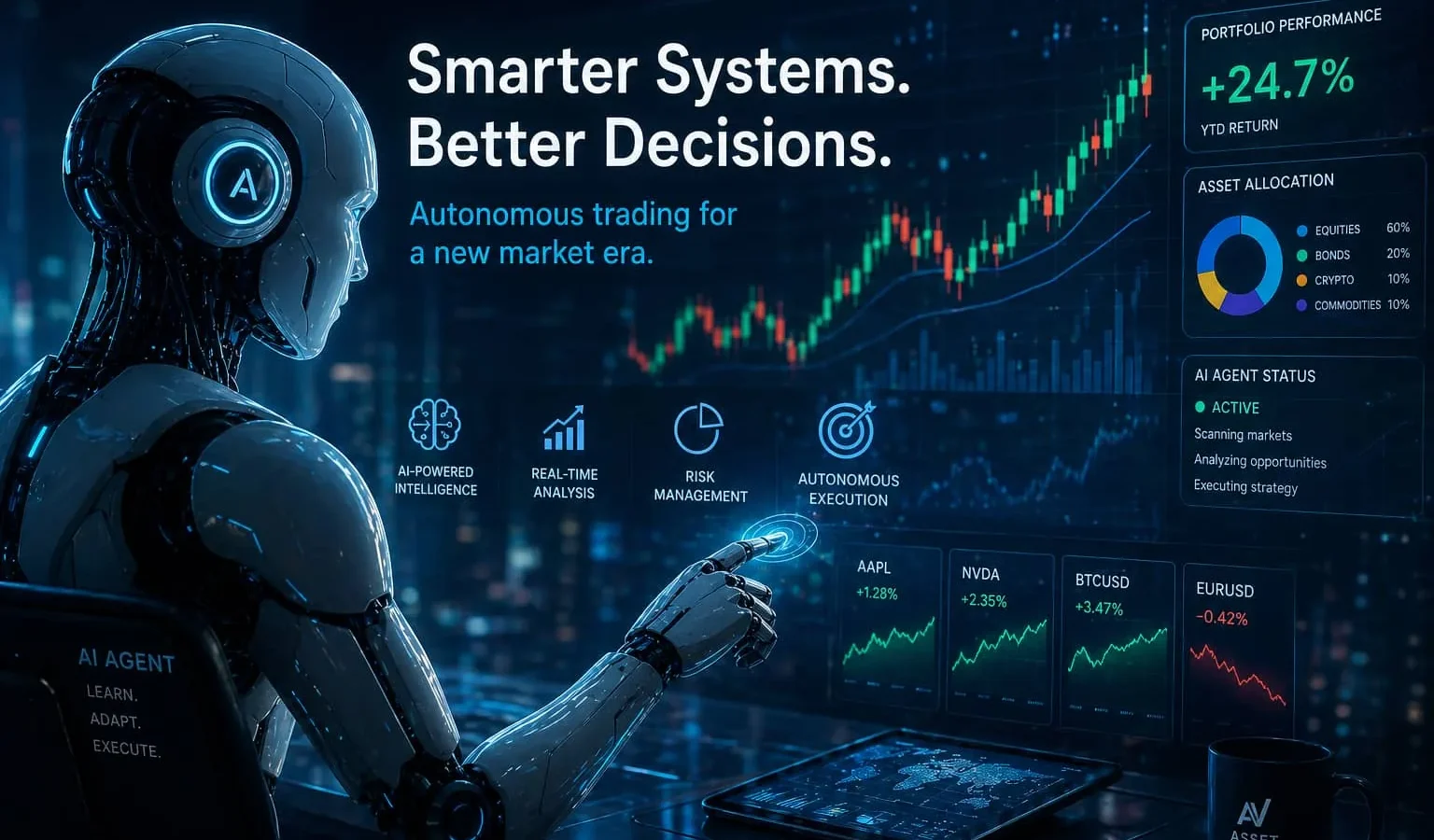
If 2024 was the year retail investors discovered AI-powered ETFs, and 2025 was the year quant funds quietly rebuilt their stacks around large language models, then 2026 is the year AI trading agents stop being a research curiosity and start moving real capital at scale.
A trading agent is not a script that buys when RSI drops below 30. It is software that perceives the market, reasons about it, plans actions, executes trades, and learns from outcomes — closing the full loop that human portfolio managers used to monopolize. The line between “tool” and “trader” is blurring fast, and understanding where it lands will define who wins and who lags this cycle.
This guide is the natural continuation of our deep dive on Artificial Intelligence ETFs and our reference piece on Algorithmic Trading Strategies for 2026. If AI ETFs are how you invest in artificial intelligence, AI trading agents are how artificial intelligence invests for you. Two very different propositions — and you need to understand both.
By the end of this article you will know what AI trading agents really are, how they differ from the trading bots you have probably already met, the architectures powering them in 2026, the realistic risks behind the hype, and a practical roadmap for using them in your own portfolio.
What Are AI Trading Agents?
An AI trading agent is an autonomous software system that makes investment decisions by combining machine learning models, real-time market data, and goal-oriented reasoning. Unlike a traditional trading bot, an agent does not just execute predefined rules — it interprets context, weighs alternatives, and adapts its behavior to changing market regimes.
A useful working definition: an AI trading agent is a system with perception, memory, reasoning, and action, deployed against a financial objective.
- Perception — ingests prices, order books, news, filings, alternative data, and on-chain signals.
- Memory — stores historical context, prior decisions, and lessons from past trades.
- Reasoning — uses statistical models, reinforcement learning policies, or large language models to form views.
- Action — submits orders, rebalances positions, hedges, or simply waits.
The shift from “bot” to “agent” matters because it changes what humans need to specify. With a bot, you write the rules and the bot follows them. With an agent, you specify the goal and the constraints — for example, “maximize risk-adjusted returns on US tech equities, max 15% drawdown, no leverage above 1.5x” — and the agent figures out how.
How AI Trading Agents Differ from AI ETFs
This is one of the most common confusions among retail investors, so let’s settle it cleanly.
| Dimension | AI ETF | AI Trading Agent |
|---|---|---|
| What you own | A basket of AI-related companies | Nothing — the agent operates an account on your behalf |
| Who decides | The fund manager (often passively tracks an index) | The AI itself, within constraints you set |
| Time horizon | Months to years | Seconds to weeks |
| Customization | None — one product fits all | Fully customized per portfolio |
| Cost structure | Expense ratio (0.30%–0.75%) | Subscription, performance fee, or self-hosted |
| Transparency | Holdings disclosed daily | Decisions can be opaque without explainability tooling |
Put simply: AI ETFs give you exposure to the AI theme. AI trading agents give you exposure to AI as a portfolio manager. They serve different goals and can — and often should — coexist in a single portfolio.
How They Differ From Classical Trading Bots
Classical algorithmic bots are deterministic. Given the same input, they produce the same output. They excel at rule execution but fail when the rule itself becomes obsolete — which happens whenever market structure, volatility regime, or correlation behavior changes.
AI trading agents are probabilistic and adaptive. They generate distributions over actions, not a single deterministic output, and they update their internal model as new data arrives. The trade-off is that they are harder to debug, harder to audit, and harder to trust on day one. A serious operator therefore treats agents as junior analysts who need supervision, not as oracles.
How AI Trading Agents Work: The Architecture in 2026
Most production-grade agents in 2026 share a five-layer architecture. Understanding this stack is the difference between evaluating a serious product and falling for marketing copy.
1. Data Ingestion Layer
The agent is only as good as the data flowing into it. Modern stacks combine:
- Market data — tick-by-tick prices, order book depth, options chains, futures curves.
- Fundamental data — filings, earnings transcripts, guidance changes.
- Alternative data — credit card transactions, satellite imagery, web traffic, app downloads.
- News and sentiment — wire services, financial press, regulatory announcements.
- On-chain data — for crypto-aware agents: wallet flows, exchange reserves, stablecoin issuance.
Streaming pipelines (Kafka, Redpanda, or cloud-native equivalents) deliver this data with sub-second latency, while vector databases store embeddings of textual data so the agent can retrieve relevant historical context on demand.
2. Feature and Signal Engineering Layer
Raw data is transformed into features the model can reason over: volatility cones, factor exposures, sentiment scores, macro regime indicators, liquidity metrics. In 2026, much of this is automated by feature stores that version features, monitor for drift, and serve them with point-in-time correctness — which matters enormously for any backtest you trust.
3. Decision Engine
This is where the architectural choices diverge most. Three patterns dominate:
Reinforcement learning (RL) policies — The agent learns a mapping from market state to action by trial-and-error in a simulated environment. PPO, SAC, and more recently distributional RL methods are the workhorses here. RL agents can discover non-obvious strategies but are fragile under regime change.
LLM-based reasoning agents — A large language model is given access to tools (data queries, calculators, broker APIs) and asked to plan trades that satisfy stated objectives. The LLM produces explicit chain-of-thought traces, which makes auditing dramatically easier. The risk is hallucination and over-confidence on data the model never actually retrieved.
Hybrid quant–AI systems — Classical statistical models generate signals; the AI layer arbitrates between them, sizes positions, and handles the edge cases. This is where most institutional money sits in 2026 because it preserves the rigor of quantitative finance while gaining the flexibility of AI.
4. Risk and Execution Layer
A signal is not a trade. Between “the model thinks AAPL goes up” and an actual fill, the agent must:
- Apply position sizing rules (Kelly fraction, volatility targeting, risk parity).
- Check portfolio-level constraints (sector caps, drawdown limits, VaR).
- Choose execution algorithms (TWAP, VWAP, implementation shortfall).
- Route orders to minimize market impact and slippage.
Mature agents treat the risk layer as a non-negotiable veto on the model’s enthusiasm. This is the same discipline we explore in How to Manage Risk in Your Financial Investments — applied here as code, not a checklist.
5. Feedback and Learning Layer
After each trade, the agent records outcomes, attributes performance to specific decisions, and updates its understanding. The best systems separate learning from execution — production agents do not retrain on live data because that creates feedback loops that destroy performance during stress events. Instead, they log everything, retrain offline on validated data, and promote new model versions through a staged rollout.
Types of AI Trading Agents You’ll Encounter in 2026
Not all agents are built the same. Here are the main categories and what they are good for.
Reinforcement Learning Agents
These agents learn policies through millions of simulated episodes. They shine in high-frequency contexts — market making, optimal execution, statistical arbitrage — where the action space is small and the reward signal is dense. They struggle with regime change and are notoriously hard to interpret. If a vendor sells you “RL-powered trading” without explaining their simulator, walk away.
LLM-Based Reasoning Agents
These agents wrap an LLM around tools and prompts. They are particularly strong at research-driven trading — synthesizing earnings calls, comparing companies, drafting macro views, detecting narrative shifts. They are weak at low-latency execution and at any task that requires precise numerical reasoning without tool support. Their killer feature is explainability: every decision comes with a written justification.
Multi-Agent Systems
Instead of one monolithic agent, multiple specialized agents collaborate. A researcher agent forms hypotheses, a quant agent backtests them, a risk agent stress-tests the portfolio, and a portfolio manager agent integrates the outputs. This mirrors how real hedge funds are organized and is becoming the dominant pattern for serious AI-driven funds in 2026.
Sentiment and Narrative Agents
These are specialized agents that monitor news, social media, and filings to detect narrative shifts — the moment when “AI is overhyped” becomes the consensus view, or when a regulatory rumor begins to harden into policy. They rarely trade alone; instead, they feed signals into broader systems.
Personal AI Portfolio Managers
The retail-facing category that is exploding in 2026. These agents take a user’s goals, constraints, and risk tolerance, and run a full personalized portfolio — choosing assets, rebalancing, harvesting tax losses, and hedging tail risk. The frontier here is making them work well for accounts under $100,000, where execution costs would otherwise eat the alpha.
Key Technologies Powering AI Trading Agents
The capability jump in 2026 did not come from a single breakthrough. It came from five technologies maturing simultaneously.
Large language models with reliable tool use. Modern LLMs can be trusted to call APIs, parse responses, and chain reasoning steps without going off the rails — assuming the tools are well-designed. This is what made LLM agents go from demo to production.
Reinforcement learning at scale. Distributed simulators now let researchers train agents on the equivalent of decades of market data in days. Curriculum learning — where the agent first masters easy regimes before being exposed to crises — has dramatically improved robustness.
Vector databases and retrieval-augmented generation (RAG). Instead of stuffing all knowledge into the model’s weights, agents retrieve relevant context (past trades, similar market regimes, prior research) and reason over it. This makes them far more sample-efficient and far easier to update.
Real-time data infrastructure. Sub-millisecond ingestion pipelines, time-series databases optimized for financial data, and feature stores with point-in-time correctness have removed the data-engineering bottleneck that held back smaller players for years.
On-chain analytics for crypto markets. Agents that trade digital assets now have access to wallet-level data, DEX flows, and protocol metrics that would have been unimaginable to the equity quants of a decade ago. This is part of what we discussed in Emerging Technologies in Financial Trading.
Real-World Use Cases for AI Trading Agents
Theory is cheap. Here is where AI agents are actually creating value in 2026.
Equity Trading and Portfolio Management
Long-short equity strategies are a natural fit. An agent can ingest hundreds of earnings transcripts per quarter, extract guidance changes, cross-reference them against historical reactions, and build a ranked book of longs and shorts. The work that used to require a team of sector analysts is now done by a multi-agent system in hours, not weeks.
Crypto and Digital Assets
Crypto markets are open 24/7, fragmented across dozens of venues, and rich in alternative data — exactly the environment agents thrive in. AI agents now handle the bulk of cross-exchange arbitrage, liquidity provision in DeFi pools, and narrative-driven momentum trades. The risk: crypto regimes change faster than any other asset class, so agent retraining cycles must be unusually aggressive.
Foreign Exchange
FX markets reward agents that can rapidly integrate macro news, central bank communications, and positioning data. LLM-based agents are particularly effective at parsing FOMC statements and ECB press conferences in real time and translating tone changes into directional bets, with classical risk models keeping position sizes sane.
Portfolio Rebalancing and Tax Optimization
For long-term investors, the agent’s job is not to time markets but to keep the portfolio on track — rebalancing back to target weights, harvesting tax losses opportunistically, and rolling positions efficiently. This is the most underrated use case because it works for everyone, not just sophisticated traders. It complements the strategies we cover in The Advantages of Dividend Investing and How to Invest in the Financial Market the Right Way.
Sentiment and Event-Driven Trading
When a CEO resigns, an FDA decision drops, or a geopolitical event hits the wires, agents can react in seconds — often parsing the source document, identifying second-order effects, and adjusting positions before human traders have finished reading the headline.
Advantages of AI Trading Agents
Speed and scale are the obvious advantages, but the more interesting ones are subtle.
Emotion-free execution. One of the largest sources of underperformance for retail investors is behavioral — panic selling, FOMO buying, anchoring on entry prices. Agents simply do not feel any of this. We dedicated a full article to why this matters in Behavioral Finance: Six Biases, and What Each One Actually Costs, and AI agents are the most direct technological answer to those biases.
Pattern recognition at scale. Agents can monitor thousands of instruments simultaneously and detect cross-asset relationships that would never be visible to a human watching three screens.
Continuous operation. Markets that never close — crypto, FX — were always poorly served by human teams. Agents work 168 hours a week without degraded performance.
Adaptive learning. When configured correctly, agents update their understanding of market regimes faster than any committee-driven investment process can.
Discipline by construction. A well-designed agent cannot violate its risk limits — they are enforced as code, not as a memo from the chief risk officer.
Risks and Limitations You Need to Take Seriously
Anyone selling you AI trading agents without spending equal time on the risks is selling you something else.
The black box problem. Some architectures — especially deep RL — produce decisions that are genuinely hard to explain. When the agent loses 8% in a week, “the neural network thought it was a good idea” is not an acceptable post-mortem. Demand explainability tooling.
Overfitting and backtest illusion. Modern agents have so many parameters and so much expressive power that they can fit any historical dataset perfectly while generalizing terribly. A pristine backtest with a Sharpe ratio of 4.0 is more often a sign of leakage than of genius. We unpack this in The Sharpe Ratio: Its History, Applications, and Calculations.
Tail-risk blindness. Agents trained on the last decade have not seen a 2008-style credit freeze, a 2020-style pandemic crash, or a 1998-style hedge-fund unwind in their training data with the right intensity. Stress testing against synthetic scenarios is non-negotiable.
Concentration risk in the technology stack. If thousands of agents are trained on similar data, use similar architectures, and react to similar signals, they will sell at the same time. The “quant quake” of August 2007 is the canonical warning. AI agents arguably make this risk worse, not better.
Regulatory uncertainty. In 2026, regulators are still catching up with autonomous trading systems. Expect rules around explainability, accountability for AI-driven losses, and possibly capital surcharges to evolve significantly over the next few years.
Operational and infrastructure risk. A flawed deployment, a stale data feed, a misconfigured rate limit — any of these can cause an agent to generate catastrophic losses in minutes. Production discipline matters more here than in almost any other software domain.
This is the same lens we apply in Common Mistakes in Stock Market Investing: smart tools amplify both good and bad decisions, and an undisciplined operator with an AI agent is more dangerous, not less.
How to Get Started With AI Trading Agents
Your starting point depends on your experience, capital, and time commitment. Here is an honest roadmap.
If You Are a Beginner
Do not start by buying an “AI trading agent” subscription. Start by understanding what they do and how they fit your goals. A reasonable sequence:
- Read How to Develop a Successful Investor Mindset and decide what kind of investor you want to be.
- Take our What Type of Investor Are You? assessment.
- Use a robo-advisor with AI-driven rebalancing for your core portfolio. We covered the category in The Rise of Robo-Advisors: Why They Are Highly Recommended.
- Allocate a small “satellite” sleeve — no more than 10% of investable assets — to a vetted AI trading agent product, with clear stop-loss rules at the account level.
The biggest beginner mistake is treating an AI agent as a magic money button. It is not. It is a tool whose behavior you must understand before sizing up.
If You Are an Intermediate Investor
You probably already run some combination of ETFs, dividend stocks, and tactical positions. AI agents fit naturally as a way to systematize parts of your process — the parts that are repetitive, emotion-prone, or too data-heavy to do well manually.
Start by automating one specific job: tax-loss harvesting, sector rotation based on macro indicators, or rebalancing across asset classes. Validate that the agent does that one job better than you did, then expand.
Building vs. Buying
You have three paths:
- Buy a managed product. Lowest effort, lowest customization. Suitable for the majority of investors.
- Subscribe to signals and execute manually or semi-automatically. Middle ground. You retain control over execution and risk.
- Build your own. Highest effort, highest potential payoff. Requires real engineering, data, and capital. Realistic for fewer people than think they can do it.
Most readers should default to “buy” and consider “build” only after they have run a managed product for at least one full market cycle and understand exactly what they want to do differently.
The Future: Where AI Trading Agents Go From Here
The next 24 months are going to compress more change than the previous decade. Three trajectories are worth watching closely.
Agentic finance. Beyond trading, agents are starting to handle the full investment workflow — tax planning, estate considerations, cash management, debt optimization. The endpoint is a personal CFO that lives in your phone and coordinates a network of specialized agents.
DeFi-native agents. As decentralized finance matures, agents that can read smart contracts, evaluate protocol risk, and operate in fully on-chain environments will unlock yields and strategies that are simply unreachable through traditional brokerage rails.
Multi-modal agents. Today’s agents are mostly text and numbers. Tomorrow’s will read charts, watch earnings call video, listen to podcasts, and integrate that with structured data. This is closer than most people realize.
Personalization at scale. The shift from “one strategy for all clients” to “one strategy per client, tuned weekly to their specific goals and tax situation” is the big retail unlock. It only becomes economic with AI agents — which is exactly what we are building toward at AssetWhisper.
Where AssetWhisper Stands on AI Trading Agents
AssetWhisper is a publication, not a platform. It does not run trading agents for readers, does not publish signals and does not manage money — what the site does and deliberately does not do is written down. What it publishes is the reasoning you need to judge an agent someone else is selling you, held to the standard applied throughout this guide: every claim traceable to specific data, specific reasoning and specific risk controls, or it does not count.
If you want to test these ideas yourself rather than buy them, start with the tooling: which Python backtesting libraries are still maintained, and what each one is actually for. Then decide how much to risk per trade before any agent, yours or a vendor’s, touches real money.
Frequently Asked Questions
Are AI trading agents profitable?
Some are, many are not. Profitability depends on the underlying strategy, the quality of data, the risk discipline, and the execution costs. Treat any product claiming consistent double-digit monthly returns with extreme skepticism — those numbers are almost always either curve-fit, leverage-juiced, or fabricated.
Do I need to know how to code to use AI trading agents?
No. Managed products and platforms like AssetWhisper expose AI-driven analysis through normal user interfaces. Coding is required only if you want to build your own agents or customize them deeply.
Are AI trading agents legal?
Yes, in most jurisdictions, with the standard caveats: you must be appropriately licensed if you offer agent-driven trading as a service, you must comply with market abuse rules, and you remain responsible for trades executed in your name. Regulatory scrutiny is rising, so expect more disclosure requirements over time.
How are AI trading agents different from copy trading?
Copy trading mirrors the trades of a human trader. AI trading agents make their own decisions based on models and data. They can be combined — for example, an agent that copies a base strategy while applying its own risk overlay — but the underlying mechanism is fundamentally different.
Can AI trading agents replace human portfolio managers?
For narrow, well-defined tasks — execution, rebalancing, tax optimization — they already outperform humans. For broader judgment, scenario planning, and client relationships, humans still dominate. The realistic future is augmentation: agents handle the work that scales poorly with humans, humans handle the work that scales poorly with machines.
What is the minimum capital to use an AI trading agent?
It varies. Robo-advisors with AI components start at $1–$500. Standalone AI trading agent products typically require $5,000–$25,000 for the economics to work. Self-built systems become viable around $50,000+, mostly because of execution and infrastructure costs.
Conclusion
AI trading agents are not a fad. They are the natural endpoint of three decades of automation in finance, accelerated by a generational leap in machine intelligence. By 2030, asking whether you “use AI agents” in your investing will sound like asking whether you use the internet to read research.
The winners in this transition will not be the investors who use the most aggressive agents. They will be the ones who understand exactly what their agents are doing, supervise them with discipline, and integrate them into a coherent strategy aligned with their goals. The technology is powerful. The judgment around it is what compounds.
Start small, demand explainability, respect tail risk, and let the agents handle what they are best at while you focus on the decisions only you can make. That is the real edge in 2026 — and the edge that AssetWhisper is built to give you.
AssetWhisper does not manage portfolios, run accounts or publish trade signals. What it publishes is the reasoning behind decisions like this one: the strategy families these agents actually run and the risk layer that decides whether any of them survive.