
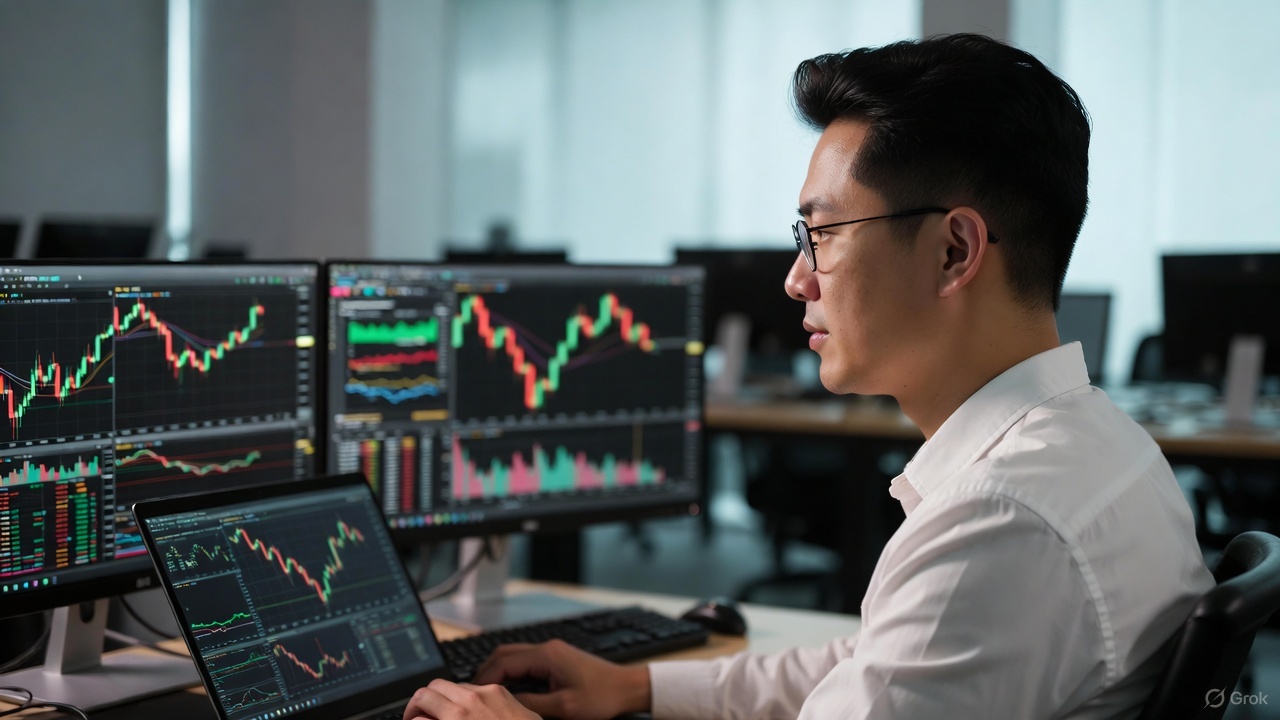
Discover how algorithmic trading can transform your investment approach with proven profitable strategies, practical implementation guides, and real-world examples designed for both beginners taking their first steps and intermediate traders ready to scale.
Algorithmic trading represents the evolution of financial markets, where computer programs execute trades based on predetermined rules and mathematical models. In 2025, this isn't just for Wall Street anymore – it's becoming the standard for serious individual traders who want to compete effectively in modern markets.
The financial markets have fundamentally changed. With over 70% of all trades now executed by algorithms, manual trading is increasingly becoming a disadvantage. But here's the good news: the tools and knowledge that were once exclusive to hedge funds are now accessible to individual traders like you.
Key Benefits of Algorithmic Trading:
Three major developments have converged to make 2025 the year algorithmic trading becomes mainstream:
According to recent QuantInsti research, retail traders using algorithmic strategies have seen average returns improve by 23% compared to discretionary trading.
The landscape of trading automation has matured significantly. What was once a fragmented ecosystem of complex tools has evolved into user-friendly platforms that don't require a PhD in computer science.
Modern algorithmic trading operates on three levels:
Level 1: Strategy Development Using platforms like Python with libraries such as pandas, NumPy, and scikit-learn, traders can develop sophisticated strategies in hours, not months.
Level 2: Execution Infrastructure Cloud-based execution ensures your strategies run 24/7 with 99.99% uptime, connecting directly to broker APIs.
Level 3: Risk Management Layer Real-time monitoring and automatic kill switches protect your capital when markets behave unexpectedly.
Let's dive into five profitable strategies that are generating consistent returns for algorithmic traders in 2025. Each strategy includes expected returns, risk levels, and implementation complexity.
Strategy Overview: This strategy capitalizes on the tendency of prices to revert to their average over time, enhanced with volatility-based entry and exit signals.
Implementation Details:
Performance Metrics:
Code Example (Python):
def mean_reversion_signal(data):
    # Calculate Bollinger Bands
    data['MA20'] = data['Close'].rolling(20).mean()
    data['STD'] = data['Close'].rolling(20).std()
    data['Upper'] = data['MA20'] + (data['STD'] * 2)
    data['Lower'] = data['MA20'] - (data['STD'] * 2)

    # Generate signals
    data['Buy'] = (data['Close'] < data['Lower']) & (data['RSI'] < 30)
    data['Sell'] = data['Close'] > data['MA20']

    return data
Strategy Overview: Identifies strong trends early by detecting breakouts from consolidation patterns, confirmed by unusual volume spikes.
Implementation Details:
Performance Metrics:
Strategy Overview: Exploits temporary divergences between historically correlated assets, betting on convergence.
Implementation Details:
Performance Metrics:
Strategy Overview: Leverages natural language processing to analyze news sentiment and social media trends for predictive signals.
Implementation Details:
Performance Metrics:
Strategy Overview: Combines signals from multiple timeframes to identify and ride major trends while filtering out noise.
Implementation Details:
Performance Metrics:
Starting your algorithmic trading journey doesn't require years of programming experience. Here's a practical roadmap to implement your first profitable strategy in 30 days.
Day 1-3: Environment Setup
Day 4-7: Data Collection
Core Components Every Algorithm Needs:
def generate_signals(data): # Your logic here return buy_signals, sell_signalsdef calculate_position_size(capital, risk_per_trade): return capital * risk_per_tradedef set_stop_loss(entry_price, atr, multiplier=2): return entry_price - (atr * multiplier)Critical Backtesting Metrics to Track:
Common Backtesting Pitfalls:
Pre-Launch Checklist:
The right tools can make the difference between success and failure in algorithmic trading. Here's a comprehensive comparison of platforms for different trader profiles.
1. TradingView with Automation
2. MetaTrader 5 (MT5)
1. QuantConnect
2. Alpaca + Python
1. Interactive Brokers API
2. Custom Cloud Infrastructure
Must-Have Python Libraries:
# Data manipulation
import pandas as pd
import numpy as np

# Technical indicators
import ta
import talib

# Backtesting
import backtrader
import zipline

# Machine learning
from sklearn.ensemble import RandomForestClassifier
import tensorflow as tf

# Visualization
import matplotlib.pyplot as plt
import plotly.graph_objects as go
Without proper risk management, even the most profitable algorithmic trading strategy will eventually fail. Here's how to protect your capital while maximizing returns.
Kelly Criterion Implementation:
def kelly_position_size(win_probability, avg_win, avg_loss):
    """
    Calculate optimal position size using Kelly Criterion
    """
    edge = (win_probability * avg_win) - ((1 - win_probability) * avg_loss)
    odds = avg_win / avg_loss
    kelly_percentage = edge / odds

    # Use 25% of Kelly for safety
    return min(kelly_percentage * 0.25, 0.02)  # Max 2% per trade
Adaptive ATR-Based Stops:
System Circuit Breakers:
Key Metrics to Track:
Risk Dashboard Example:
class RiskMonitor:
    def __init__(self, portfolio):
        self.portfolio = portfolio
        self.max_daily_loss = 0.02
        self.max_positions = 10

    def check_risk_limits(self):
        alerts = []

        # Check daily P&L
        if self.portfolio.daily_pnl < -self.max_daily_loss:
            alerts.append("CRITICAL: Daily loss limit exceeded")

        # Check position count
        if len(self.portfolio.positions) > self.max_positions:
            alerts.append("WARNING: Too many open positions")

        return alerts
Learn from the mistakes of others to preserve your capital and accelerate your success in algorithmic trading.
The Problem: Creating a strategy that performs perfectly on historical data but fails miserably in live trading.
The Solution:
The Problem: A strategy showing 30% annual returns becomes unprofitable after accounting for spreads, commissions, and slippage.
The Solution:
def calculate_real_returns(gross_returns, trades_per_year):
    commission_per_trade = 0.001  # 0.1%
    spread_cost = 0.0005  # 0.05%
    slippage = 0.0005  # 0.05%

    total_cost_per_trade = commission_per_trade + spread_cost + slippage
    annual_trading_cost = total_cost_per_trade * trades_per_year * 2  # Buy and sell

    net_returns = gross_returns - annual_trading_cost
    return net_returns
The Problem: Your signals are correct, but execution delays cause you to miss optimal entry/exit points.
The Solution:
The Problem: Running multiple strategies without proper capital allocation leads to margin calls or missed opportunities.
The Solution:
The Problem: Markets change, and strategies that worked yesterday may fail tomorrow.
The Solution:
Once you have a profitable strategy, scaling requires careful planning and infrastructure investment.
Focus Areas:
Infrastructure Needs:
Expansion Strategy:
Infrastructure Upgrade:
Institutional Features:
Team Considerations:
Monthly Tracking Sheet:
| Metric | Target | Current | Action Needed |
|---|---|---|---|
| Total Return | >2% | ___ | ___ |
| Sharpe Ratio | >1.2 | ___ | ___ |
| Max Drawdown | <10% | ___ | ___ |
| Win Rate | >50% | ___ | ___ |
| System Uptime | >99% | ___ | ___ |
The next frontier in algorithmic trading is here, and it's powered by artificial intelligence and machine learning.
The same technology behind ChatGPT is revolutionizing market prediction:
Applications:
Implementation Example:
from transformers import pipeline

# Initialize sentiment analyzer
sentiment_analyzer = pipeline("sentiment-analysis",
                            model="ProsusAI/finbert")

def analyze_news_sentiment(headlines):
    sentiments = sentiment_analyzer(headlines)

    # Convert to trading signals
    bullish_score = sum(1 for s in sentiments if s['label'] == 'positive')
    bearish_score = sum(1 for s in sentiments if s['label'] == 'negative')

    return bullish_score / len(sentiments)
Expected Breakthroughs:
DeFi Integration:
Compliance Automation:
You now have a comprehensive understanding of profitable algorithmic trading strategies. Here's your action plan for the next 30 days:
A: You can begin paper trading with $0 and start live trading with as little as $1,000. However, we recommend $5,000-$10,000 for meaningful returns after covering costs. Our strategies are designed to scale from $5K to $5M+.
A: Not necessarily. While Python knowledge helps, many successful traders start with no-code platforms and learn programming gradually. Our course includes "Python for Non-Programmers" specifically for traders.
A: With proper strategy implementation and risk management, most students see positive results within 60-90 days. However, we recommend 6 months of consistent trading to evaluate true strategy performance.
A: Yes, but it requires adequate capital, multiple proven strategies, and strict risk management. Most successful traders start part-time and transition gradually as their systems prove profitable.
A: Algorithmic trading encompasses all automated strategies, from long-term investing to day trading. High-frequency trading (HFT) is a subset requiring specialized infrastructure and typically executing thousands of trades per second.
The shift to algorithmic trading isn't just a trend—it's the future of financial markets. With the strategies, tools, and knowledge provided in this guide, you're equipped to join the ranks of successful algorithmic traders.
Remember: Every expert was once a beginner. The difference between those who succeed and those who don't is taking action.
Start small, think big, and let algorithms work for you 24/7.
Disclaimer: Trading involves risk. Past performance does not guarantee future results. Always trade responsibly and never invest more than you can afford to lose.